
Douglas MacArthur
Douglas MacArthur was an American general who led the southwest Pacific campaign in World War II, governed occupied Japan, and was fired during the Korean War.
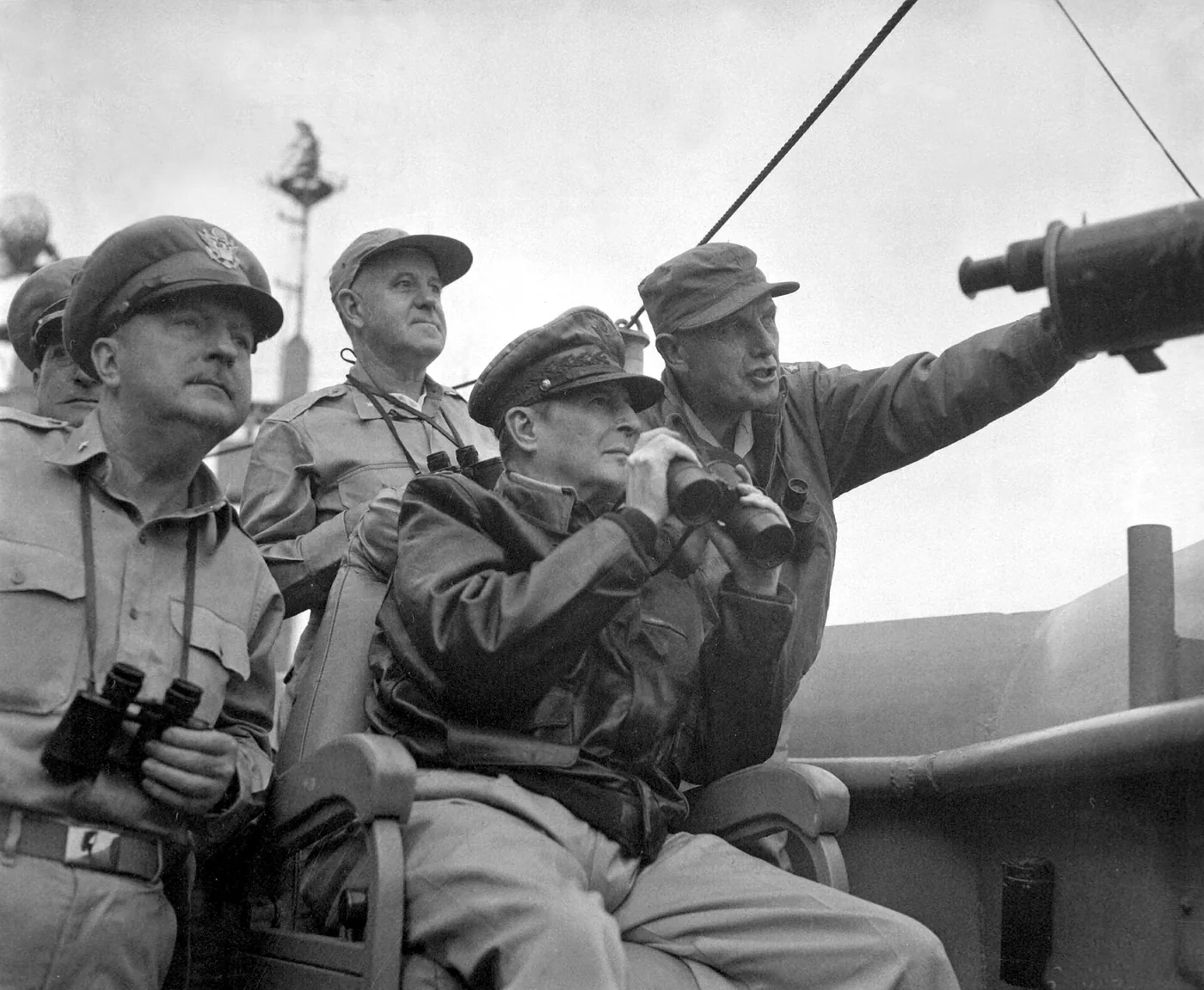
Douglas MacArthur (1880–1964) was an American five-star general who served in three wars across four decades. He commanded the Allied campaign in the southwest Pacific during World War II, governed occupied Japan for six years after the war, and was fired by President Harry Truman for insubordination during the Korean War. His father, Arthur MacArthur Jr., had won the Medal of Honor in the Civil War at age eighteen, and Douglas spent his career trying to surpass him. He graduated first in his class at West Point in 1903, led a brigade in France during World War I when he was thirty-eight, and was named Army chief of staff in 1930. He was talented, vain, and kept a staff around him who did not contradict him.
How MacArthur fought the Pacific War
MacArthur was commanding American forces in the Philippines when Japan attacked Pearl Harbor on December 7, 1941. Much of his air force was destroyed on the ground at Clark Field within hours. By early 1942, his troops were collapsing toward surrender on the Bataan Peninsula. In February, President Roosevelt ordered MacArthur out to Australia. On arriving, he told reporters, "I shall return." Washington wanted him to say "we shall return." He refused.
Over the next two and a half years, MacArthur led the counteroffensive across the southwest Pacific using a strategy called leapfrogging. Instead of assaulting every Japanese-held island, he bypassed the heavily defended ones and seized lightly held positions under air cover. The bypassed garrisons, cut off from supply and reinforcement, were left to wither. This trapped hundreds of thousands of Japanese troops far from the fighting and cost fewer American lives than direct assaults would have.
In October 1944, MacArthur waded ashore at Leyte in the Philippines, fulfilling his promise. On September 2, 1945, he accepted Japan's formal surrender aboard the USS Missouri in Tokyo Bay.
How MacArthur rebuilt Japan
From 1945 to 1951, MacArthur served as Supreme Commander for the Allied Powers in occupied Japan. He ruled the country largely by proclamation.
MacArthur's staff drafted a new constitution in about a week in February 1946. It took effect the following year. Article 9 renounced war as an instrument of national policy, a provision MacArthur insisted on. The occupation also gave women the right to vote, legalized labor unions, broke up the zaibatsu conglomerates that had dominated the economy, and transferred farmland from landlords to the tenants who worked it. The land reform destroyed the rural power structure that had supported Japanese militarism.
MacArthur's most consequential decision was to leave Emperor Hirohito on the throne rather than put him on trial for war crimes. MacArthur argued that governing Japan without the emperor would need many more soldiers and take much longer. The decision worked on its own terms: the occupation was remarkably peaceful. But the question of whether Hirohito bore responsibility for the war has never been settled.
Why Truman fired MacArthur
When North Korea invaded the South across the thirty-eighth parallel in June 1950, MacArthur took command of the United Nations forces. The North Koreans pushed the defenders into a small perimeter around Pusan at the southern tip of the peninsula. MacArthur proposed an amphibious landing at Inchon, a port city far behind enemy lines on the west coast. The plan looked reckless: Inchon had thirty-foot tides, no landing beach, and a fortified city as the objective. Almost every planner in the military opposed it.
The landing went ahead on September 15, 1950. It severed the North Korean army's supply lines, and the front collapsed within weeks. MacArthur had been right when nearly everyone else was wrong.
That success fed his certainty. MacArthur pushed his forces north toward the Yalu River, the border with China. He dismissed Chinese warnings as a bluff, assured Washington that China would not intervene, and divided his army across the central Korean mountains with no link between the two columns. In late November 1950, roughly 300,000 Chinese troops attacked. The United Nations forces fell back more than a hundred miles in the longest withdrawal in American military history.
MacArthur then publicly called for bombing Chinese territory and using Nationalist Chinese troops from Taiwan. He wrote to House Republican leader Joseph Martin that "there is no substitute for victory." He was no longer carrying out the president's policy. He was trying to replace it with his own.
President Truman fired MacArthur on April 11, 1951. The decision was deeply unpopular. MacArthur flew home to a ticker-tape parade and addressed a joint session of Congress. He closed with a line from an old barracks ballad: "Old soldiers never die; they just fade away."
At the Senate inquiry afterward, General Omar Bradley, the chairman of the Joint Chiefs, testified that MacArthur's plan would pit the country against the wrong adversary in a war it did not need to fight.
Truman's firing of MacArthur became the defining American example of civilian authority over the military. It established that a general who is right about a battle does not get to decide whether the country goes to a wider war. That principle has held since 1951, in large part because Truman was willing to pay the political cost of enforcing it.