
Peloponnesian War
The Peloponnesian War was a 27-year conflict between Athens and Sparta, from 431 to 404 BC, that ended Athens's empire.
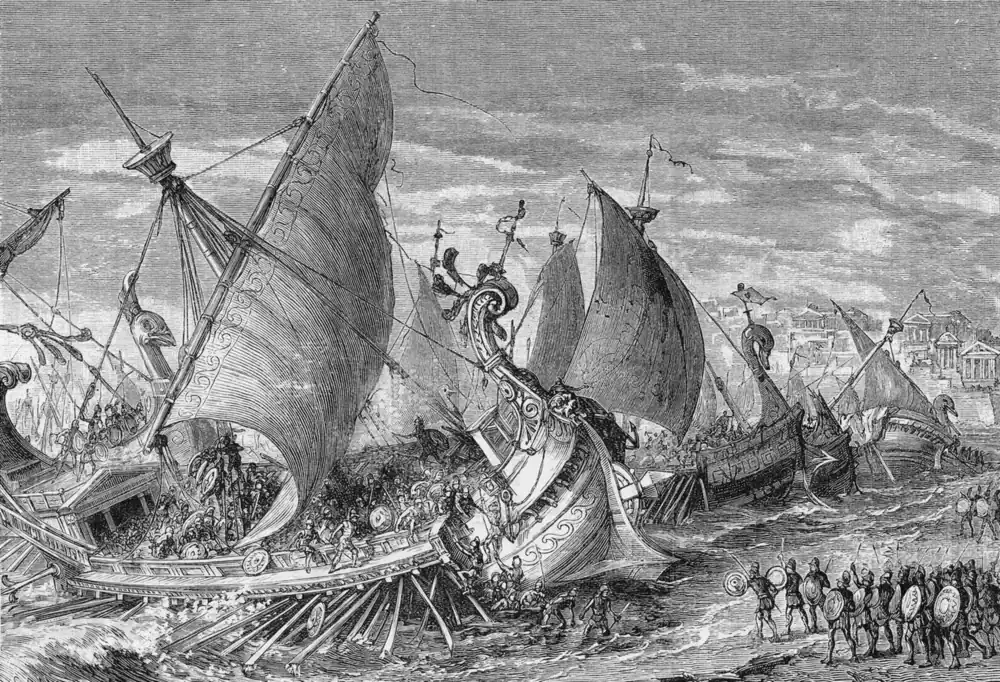
The Peloponnesian War was a 27-year conflict between Athens and Sparta, the two strongest city-states in ancient Greece, fought from 431 to 404 BC. Nearly every other Greek city was drawn into it. Sparta won, but only with Persian money, which made Greek freedom partly dependent on Persia. Plague alone killed roughly a quarter of Athens's people. The war destroyed Athens's navy and its empire and left all of Greece weaker. It is remembered today largely because of Thucydides, the Athenian general who wrote what is considered the first work of realist history.
How Athens and Sparta went to war
Athens and Sparta had almost nothing in common. Athens was a democracy that lived by the sea. It funded itself with tribute from the Delian League, a network of allied city-states. Its safety rested on the strongest navy in Greece and on the Long Walls, fortifications connecting the city to its port at Piraeus. Sparta was a land power and an oligarchy. Its hoplite infantry was the most feared in Greece, and no rival wanted to face it in open battle.
Thucydides said the real cause of the war was simple: Athens was growing more powerful, and Sparta was afraid. The immediate triggers were smaller disputes. Athens sided with the island of Corcyra against Corinth, a Spartan ally, in a naval quarrel. Athens's leading citizen, Pericles, pushed through a trade embargo against Megara, another Spartan ally. Corinth and Megara pressured Sparta to act, and in 431 BC Spartan armies marched into Athenian territory.
Pericles planned for this imbalance. He brought the rural population inside the Long Walls, refused an open fight on land, and used the fleet to raid the Peloponnesian coast. Sparta could burn Athenian farms, but it could not reach the city as long as Athens controlled the sea.
How Athens lost the Peloponnesian War
Pericles's plan had a flaw he could not have expected. In 430 BC, the second year of the war, a plague broke out in the overcrowded city and killed roughly a quarter of its people. Pericles himself died of it in 429 BC. He was about 66 years old and had led Athens for more than thirty years. No one of his ability replaced him.
The first phase of the war, called the Archidamian War, ended with the Peace of Nicias in 421 BC. The peace solved nothing. Both sides broke its terms almost immediately.
In 415 BC, Athens made the decision that cost it the war. It sent a massive expedition to conquer Syracuse, the largest Greek city in Sicily. Syracuse had done Athens little harm. The expedition was pushed by Alcibiades, a brilliant Athenian general known for his extravagance and his good looks. He persuaded the assembly to approve the invasion, then was recalled to face trial for a religious scandal. Rather than return, he defected to Sparta and told the Spartans how to defeat Athens. By 413 BC the entire Sicilian expedition, fleet and army alike, had been destroyed.
Athens fought on for another nine years, but the loss was too large to recover from. Persia, the empire that had tried and failed to conquer Greece decades earlier, now provided the money Sparta needed to build a real navy. In 405 BC, Lysander, Sparta's best admiral, found the Athenian fleet drawn up on shore at Aegospotami and destroyed it. Athens depended on grain imported by sea, and with no fleet, the city starved. Athens surrendered in 404 BC and was forced to tear down the Long Walls.
Who won the Peloponnesian War?
Sparta won. It was the last Greek power standing with an army, a fleet, and allies. After Athens surrendered, Sparta installed a junta of thirty men, known as the Thirty Tyrants, who killed and exiled thousands of Athenians over eight months of rule.
But Sparta's victory did not last. Athenian democrats led by the general Thrasybulus overthrew the Thirty Tyrants in 403 BC and restored democratic government. Athens rebuilt over the following decades, though it never regained the empire it had lost. Sparta governed Greece clumsily, and its dominance lasted barely a generation. In 371 BC the Theban general Epaminondas defeated the Spartan army at the Battle of Leuctra, the first major defeat a full Spartan force had suffered in living memory, and Spartan power collapsed. Less than seventy years after the Peloponnesian War ended, Philip II of Macedon had conquered the Greek city-states that had spent a generation destroying each other.
How Thucydides recorded the Peloponnesian War
Thucydides was an Athenian general who was exiled after losing a city to Sparta early in the war. He spent the rest of the conflict watching from outside and writing. He intended his account to be "a possession for all time." His History of the Peloponnesian War treats the conflict as an analysis of power, ambition, and fear rather than a story of gods and glory. It is considered the founding text of realist history, and scholars still assign it today.
The most famous passage is the Melian Dialogue. In 416 BC, Athens sent envoys to Melos, a small island that had tried to stay neutral, and demanded that it submit. The Melians insisted they had done nothing wrong. The Athenians were not interested in right and wrong. "The strong do what they can," the Athenians said, "and the weak suffer what they must." The islanders would not submit. Athens besieged the island, killed the men, and enslaved the women and children.
Thucydides also gave the war its lasting place in political thought. He argued that the war happened because Athens grew too powerful and Sparta grew too afraid. That pattern, a growing state threatening a dominant one until both fight, is now called the Thucydides trap.