
Persepolis
Persepolis was the ceremonial capital of the Achaemenid Persian Empire, built by Darius the Great around 518 BC in modern Iran.
Persepolis was the ceremonial capital of the Achaemenid Persian Empire, the largest empire the ancient world had seen. Darius the Great began building it around 518 BC on a raised stone platform in the highlands of Fars, in what is now southern Iran. The name is Greek for "city of the Persians." The Persians themselves called it Parsa. It was not mainly a city people lived in. The day-to-day work of governing happened in Susa, Babylon, and Ecbatana. Persepolis existed for ceremony: a place where delegations from across the empire came to present tribute to the king, and where the empire put its power and diversity on display. Alexander of Macedon burned it in 330 BC. Its ruins are now a UNESCO World Heritage site and Iran's most famous ancient monument.
Who built Persepolis?
Darius the Great, who ruled the Achaemenid Empire from 522 to 486 BC, chose the site and began construction. Workers carved a massive platform from the rocky hillside, roughly 450 by 300 meters across and up to 18 meters high, then filled the gaps with cut stone and ran drainage channels through the rock. Darius's successors continued building on the terrace for about a century.
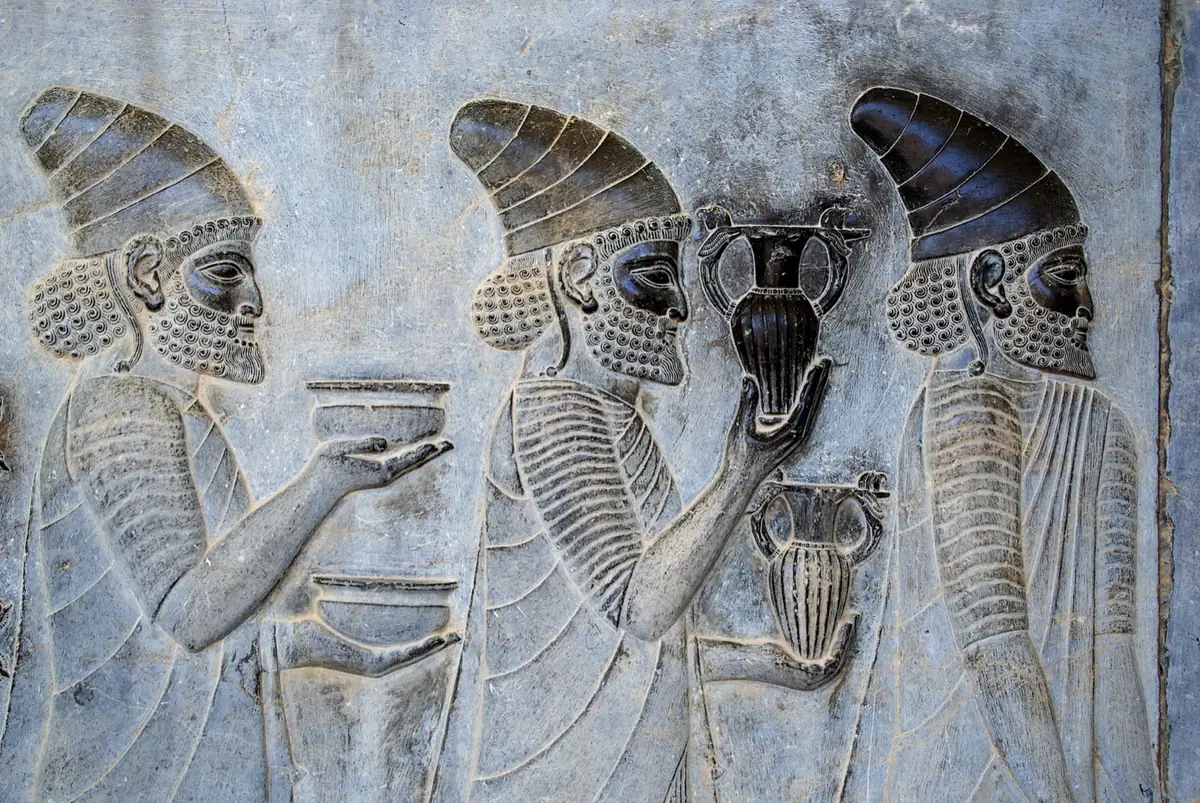
The largest building was the Apadana, an audience hall whose roof rested on 72 columns, each about 20 meters tall. Only 14 of those columns still stand. Twin staircases on the building's east and north sides carry stone reliefs showing 23 delegations from across the empire. Each group brings gifts from its own land: a Lydian carries bowls and bracelets, an Arab leads a camel, and a Nubian brings an okapi and an elephant tusk. No one in the procession appears in chains. The figures walk in orderly rows, escorted by Persian ushers. Some scholars believe the scene depicts Nowruz, the Persian new year celebrated each spring, when delegations from the empire's provinces climbed the terrace to honor the king with gifts.
The reliefs carry a deliberate message: the empire was vast, diverse, and peacefully governed. Whether that matched reality is debated, but it is the image the Achaemenid kings chose to carve in stone.
Visitors entered the site through the Gate of All Nations, built by Darius's son Xerxes. Two pairs of lamassu, winged stone bulls with human heads borrowed from Babylonian and Assyrian tradition, stood guard at its doorways. Other buildings on the terrace included the Tachara, Darius's private palace. Stone reliefs of lions attacking bulls decorated walls throughout the complex.
How Alexander burned Persepolis
Alexander of Macedon captured Persepolis in 330 BC, a year after his army crushed the forces of the last Achaemenid king, Darius III, at the Battle of Gaugamela. He stayed for several months, then set the palaces on fire.
Ancient sources disagree on why. One account, from the historian Diodorus, says it happened at a drunken banquet. An Athenian woman named Thais, the companion of Alexander's general Ptolemy, urged him to burn the palaces as revenge for Xerxes' burning of Athens 150 years earlier. Alexander, according to this version, grabbed a torch first. Many modern historians read the fire instead as a deliberate political act, a signal to the peoples of the empire that Achaemenid rule was finished.
Whatever the reason, the destruction was thorough. Archaeologists still find charred cedar beams and fallen roof stones in the rubble. But the fire had one accidental benefit. Hundreds of unfired clay tablets in the treasury would eventually have crumbled to dust. The heat baked them hard instead. Archaeologists found the tablets during excavations in the 1930s. They turned out to be detailed records from the reigns of Darius, Xerxes, and Artaxerxes I: wages paid to workers in silver, in place of part or all of their food rations.
Persepolis in modern Iran
After Alexander, the ruins sat for centuries while sand and earth covered parts of the terrace. Local people called the site Takht-e Jamshid, "the throne of Jamshid," after a king from Persian mythology. Archaeologists from the University of Chicago began systematic excavation in the 1930s and uncovered much of what visitors see today.
In October 1971, Iran's ruler Mohammad Reza Shah held a lavish celebration at Persepolis to mark what he called 2,500 years of the Persian monarchy. The celebration was meant to connect his Pahlavi dynasty to the ancient empire founded by Cyrus the Great. He invited heads of state from around the world. Guests stayed in air-conditioned tents set beside the ancient ruins and ate meals prepared by caterers flown in from Paris. Outside estimates put the cost at $100 million or more. The celebration was widely criticized inside Iran, and it helped fuel the discontent that led to the 1979 revolution.
Persepolis became a UNESCO World Heritage site in 1979, the same year the revolution overthrew the Shah. The new Islamic government was uneasy about a monument to pre-Islamic royal power, but ordinary Iranians kept visiting. Over time the government came to accept Persepolis as part of Iran's national heritage. Today it is the country's most visited ancient site and, for many Iranians, a source of deep national pride: the most visible reminder that Iran was once the center of the largest empire in the ancient world.