
Cyrus the Great
Cyrus the Great founded the Achaemenid Persian Empire, the largest the world had seen, and governed it through tolerance rather than force.
Cyrus the Great founded the Achaemenid Persian Empire, which at its height covered more territory than any state before it. He was born around 600 BC, though some historians place the date as late as 575 BC. He ruled from about 559 to 530 BC. Cyrus started as the king of Anshan, a small vassal state in the mountains of what is now southwestern Iran. In about twenty years he overthrew his overlord, conquered one of the richest kingdoms in the ancient world, and took Babylon, the largest city on earth. By his death his empire stretched from the Aegean coast of modern Turkey to the borders of India. Cyrus is remembered as much for how he governed as for what he conquered: he let defeated peoples keep their religions, customs, and local rulers, a sharp break from the empires that came before him.
How Cyrus conquered three empires
Around 550 BC, Cyrus turned on his overlord, the Median king Astyages. He defeated the Median army and took the capital at Ecbatana. Rather than destroying the Medes, Cyrus absorbed them into his government and kept Median officials in their positions.
Next came Lydia, in what is now western Turkey. Its king, Croesus, was famous across the ancient world for his wealth. The two armies met at the Battle of Thymbra around 547 BC. Croesus lost, and Cyrus took control of Lydia and the Greek cities along the Aegean coast.
Babylon was the most important target. In 539 BC, Cyrus's forces met the Babylonian army at the Battle of Opis, along the Tigris, and defeated it. Within days the city surrendered, barely resisting. Over about twenty years, Cyrus had taken three of the major powers of the ancient Near East. Ancient writers, especially the Greek historian Herodotus, told legends about Cyrus's early life, including a story that his grandfather Astyages ordered him killed as a baby and a shepherd raised him in secret.
How Cyrus governed his empire
Earlier empires, especially Assyria, had ruled through terror. The Assyrians deported entire populations, flayed rebels alive, and burned cities as warnings. Cyrus took the opposite approach. The peoples Cyrus defeated kept their own gods, temples, leaders, and customs. They owed tribute and loyalty in return.
When Cyrus entered Babylon, he cast himself as a liberator sent by Marduk, the city's main god, rather than an outside conqueror. He returned peoples that earlier Babylonian kings had displaced to their homelands, along with their sacred objects.
The most famous case was the Jews. The Babylonian king Nebuchadnezzar II had destroyed Jerusalem's temple and forced the Jews into exile in Babylon decades earlier. Cyrus let them return home and rebuild the temple. The Book of Isaiah calls Cyrus God's "anointed one," using the Hebrew word mashiach. He is the only non-Jewish figure in the Hebrew Bible to receive that title.
Cyrus's tolerance was practical. Leaving local systems intact cost far less than trying to garrison every province with Persian troops. But the effect was real, and many of the peoples Cyrus conquered remembered him as a liberator.
What is the Cyrus Cylinder?
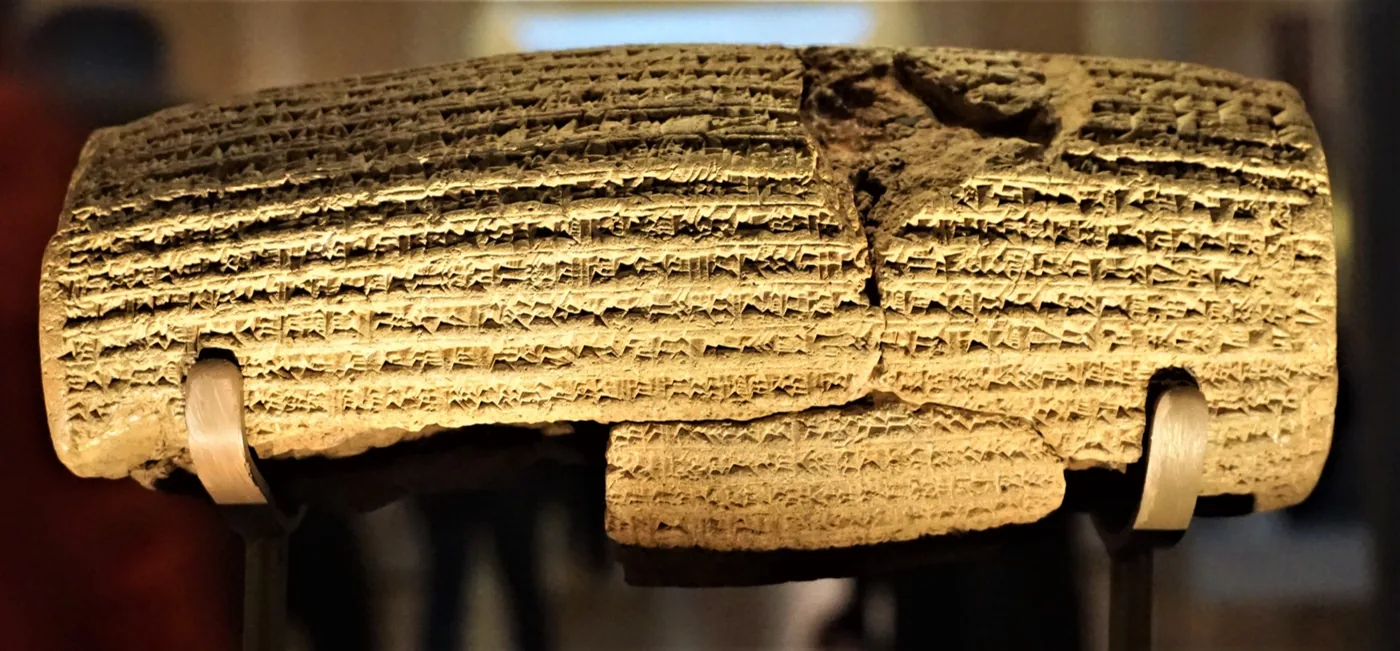
The Cyrus Cylinder is a barrel-shaped clay object inscribed in Akkadian cuneiform. It was made around 539 BC, shortly after Cyrus took Babylon, and it describes Cyrus's takeover of Babylon and his decision to send displaced peoples back to their homelands and restore their temples.
The archaeologist Hormuzd Rassam discovered the cylinder in 1879 during excavations in the ruins of Babylon. It is now in the British Museum in London.
In the twentieth century, Iranian nationalists promoted the cylinder as the earliest declaration of human rights. In 1971, Iran's Shah, Mohammad Reza Pahlavi, had a replica presented to the United Nations, where it is still on display, and built a lavish celebration linking his dynasty to Cyrus. Most historians reject the human rights reading. They consider the cylinder a standard Mesopotamian royal inscription, propaganda meant to legitimize a new king in a familiar genre. Similar texts from earlier rulers follow the same pattern. The tolerance Cyrus practiced was real, but the cylinder itself is a political document, not a declaration of universal rights.
How did Cyrus the Great die?
Cyrus died around 530 BC during a military campaign on his empire's northeastern frontier. The details are uncertain because ancient sources disagree. According to Herodotus, Cyrus attacked the Massagetae, a nomadic people living east of the Caspian Sea. Their queen, Tomyris, defeated his army and killed him. Herodotus writes that Tomyris had Cyrus's head dipped in blood. She was avenging her son, whom Cyrus had captured earlier in the campaign and who had killed himself in captivity. The historian Xenophon wrote instead that Cyrus died peacefully in bed. Historians cannot confirm any single account.
Cyrus was buried in a stone tomb at Pasargadae, the capital he had built in the highlands of southwestern Iran. The tomb still stands. When Alexander the Great conquered the Persian Empire about two hundred years later, he visited the tomb and, according to the ancient writer Aristobulus, ordered it restored after finding it had been looted.
Cyrus the Great's legacy
Cyrus's successors, Cambyses II and Darius I, expanded the empire and refined its system of provinces, called satrapies. The wars with Greece that Darius and his son Xerxes launched relied on the military and the governing structures that Cyrus had created.
The idea that a large empire of many peoples could hold together through respect rather than terror influenced later states, including Rome. Modern Iran still considers Cyrus its founding figure. His tomb at Pasargadae remains a gathering place for Iranians, and his name carries weight in Iranian politics twenty-five centuries after his death.