
Mohammad Reza Shah Pahlavi
Mohammad Reza Shah Pahlavi was the last shah of Iran, ruling from 1941 until the 1979 revolution ended his reign.
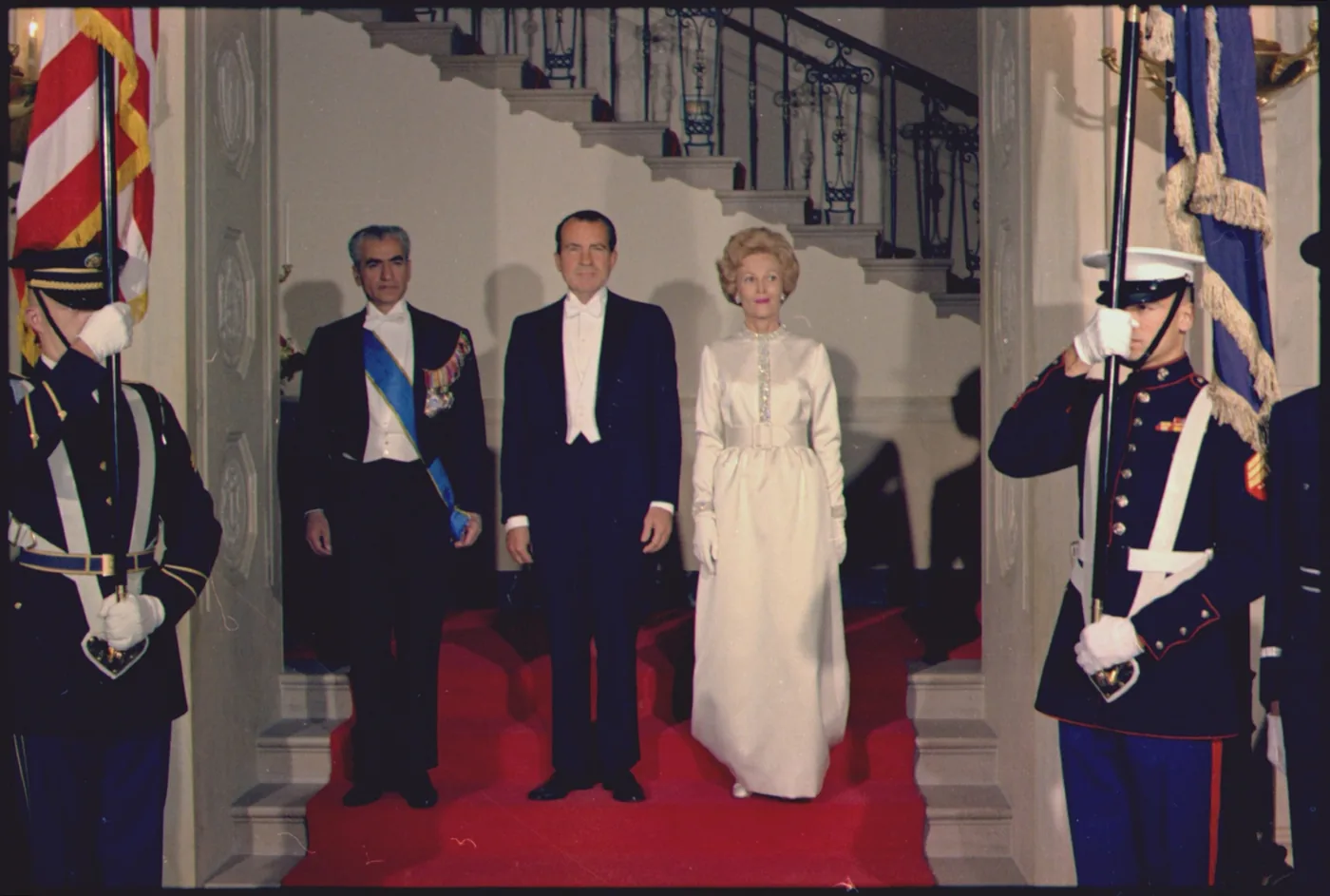
Mohammad Reza Shah Pahlavi was the last shah of Iran. He ruled from 1941 to 1979, longer than any other Iranian monarch in the twentieth century. He inherited the throne at twenty-one when the British and Soviet governments forced his father to abdicate. After a decade in which parliament and an elected prime minister held the real power, a CIA-backed coup in 1953 gave him full control. He launched ambitious reforms that modernized the country, while his secret police crushed political opposition. By the late 1970s, Iranians from across the political spectrum united to force him out. He left Iran in January 1979 and died in exile in Cairo eighteen months later.
How Mohammad Reza Shah came to power
His father, Reza Shah, was an army officer who took the Iranian throne in 1925 and built the foundations of a modern state: railways, factories, and a national army. During World War II, the British and Soviet governments suspected Reza Shah of leaning toward Nazi Germany. They also needed Iran's railways to ship supplies to the Soviet front and wanted to secure its oil. In September 1941, British and Soviet troops occupied Iran and forced Reza Shah to abdicate. They put his twenty-one-year-old son on the throne because they considered him easier to manage.
The young shah had been educated in Switzerland, at the Le Rosey boarding school, and trained at Iran's military academy. For the next twelve years he held the title with little real power. Iran's parliament and, from 1951, its elected prime minister, Mohammad Mosaddegh, drove the country's major decisions. Mosaddegh nationalized Iran's oil industry in 1951, provoking a crisis with Britain. In August 1953, the CIA and Britain's MI6 organized a coup that overthrew Mosaddegh and gave the Shah full control of the government.
After the coup, the Shah ruled as an autocrat. He founded SAVAK, a secret police force, in 1957 with help from the CIA and Israel's Mossad. SAVAK monitored universities, newspapers, and political organizations, and used torture against suspected dissidents. The Shah dissolved independent political parties and ensured parliament answered to him.
The Shah's White Revolution
In 1963, the Shah launched a reform program he called the White Revolution. It included land redistribution, voting rights for women, and a literacy corps that sent young conscripts to teach reading in rural villages. The reforms were imposed from above, and they immediately created enemies. Landlords lost their estates. Shiite clergy lost income from religious endowments that the government took over. A cleric named Ruhollah Khomeini denounced the reforms and was arrested in June 1963, sparking protests across the country. The Shah crushed the protests and sent Khomeini into exile.
Despite the opposition, much of the program worked. It redistributed land to about 2.5 million families and deployed roughly 200,000 literacy corps members to villages that had never had schools. Iran's economy grew, literacy rose, and the country modernized quickly. In October 1971, the Shah hosted a lavish celebration at the ruins of Persepolis to mark 2,500 years of Iranian monarchy. Chefs from Maxim's of Paris served the meals, and about a dozen kings and queens and twenty presidents attended. The Shah spoke at Cyrus the Great's tomb: "Rest in peace, Cyrus, for we are awake." Oil prices quadrupled in 1973. The new revenue funded warplanes, infrastructure, and an army large enough to serve as the West's main force in the Persian Gulf.
But many rural Iranians who moved to cities looking for work ended up in slums. The Shah had shut down every legal channel for political opposition, so the poor, the students, and the bazaar merchants who resented his rule had no voice. The only national institution the Shah could not fully control was the mosque.
How the revolution overthrew the Shah
By the late 1970s, opposition to the Shah had spread across Iranian society. Liberal activists, leftist guerrillas, and followers of Khomeini disagreed about nearly everything, but they agreed the Shah had to go.
In 1978, protests grew larger and more frequent. On September 8, 1978, the government declared martial law and troops fired on demonstrators in Tehran's Jaleh Square. Dozens of people were killed. Iranians called the day Black Friday, and it ended any remaining chance of compromise between the Shah and the opposition. Each funeral brought larger protests, and each protest brought more shootings. Strikes shut down Iran's oil fields. By the end of the year, soldiers were refusing to fire on civilians.
The Shah, who had been secretly battling cancer since about 1974, was physically weakened and indecisive. On January 16, 1979, he and his wife, Empress Farah, left Iran. Two weeks later, Khomeini flew into Tehran from exile in Paris. The military declared itself neutral, and the monarchy was finished.
What happened to the Shah after he left Iran?
After leaving Iran, the Shah moved from country to country. He went first to Egypt, where President Anwar Sadat received him, then to Morocco, the Bahamas, and Mexico. No Western government gave him a permanent home.
In October 1979, President Jimmy Carter allowed the Shah into the United States for treatment of his cancer, which had progressed to non-Hodgkin lymphoma. Two weeks later, on November 4, 1979, Iranian students stormed the US embassy in Tehran and took 66 Americans hostage. The students demanded that the United States return the Shah to Iran for trial. The hostage crisis lasted 444 days. The Shah was not returned.
He left the United States in December 1979, went to Panama, and then returned to Egypt, the only country willing to take him permanently. Mohammad Reza Shah Pahlavi died in a Cairo military hospital on July 27, 1980, at age sixty. He was buried at the Al-Rifa'i Mosque in Cairo, the same mosque where his former brother-in-law, Egypt's King Farouk, is also buried.
The Shah modernized Iran more than any ruler before him, and his overthrow ended Iran's monarchy. The Islamic Republic that replaced it still governs the country.