
Praetorian Guard
The Praetorian Guard was Rome's imperial bodyguard, an elite force that protected emperors for three centuries and sometimes murdered them.
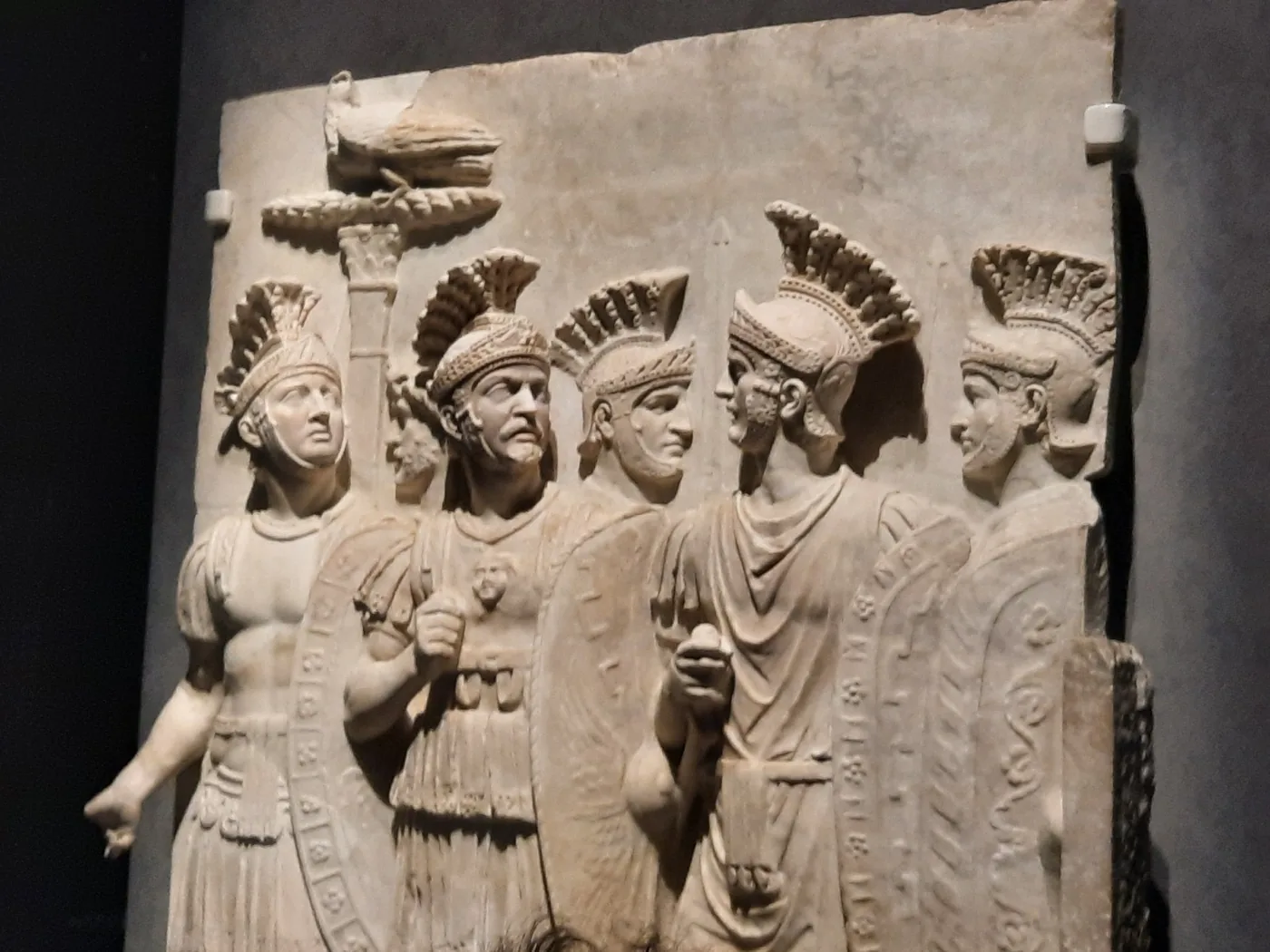
The Praetorian Guard was the personal bodyguard of the Roman emperor, an elite military unit that grew to about 10,000 soldiers, stationed in Rome from 27 BC to 312 AD. It was the largest armed force in a city where armies were otherwise forbidden, and that made it the most politically powerful military unit in the empire. Praetorians earned more than regular legionaries and served shorter terms. Over three centuries the Guard protected some emperors, murdered others, chose their successors, and in 193 AD auctioned the throne to a senator who offered the most money per soldier.
How Augustus created the Praetorian Guard
Roman generals had long kept personal bodyguards called a cohors praetoria. When Augustus became Rome's first emperor in 27 BC, he made the arrangement permanent: nine cohorts of about 500 men each, assigned to protect him. The problem he was solving was political as much as personal. Rome had a deep tradition against keeping armies inside the city, so Augustus moved carefully. He stationed only three cohorts in Rome at a time and billeted the rest in nearby Italian towns. In the city, the soldiers wore togas instead of armor, blending in with civilians.
The Guard's terms were generous. Praetorians served 16 years, compared to 25 for ordinary legionaries, and earned about three times as much pay. That made service in the Guard the most desirable posting in the Roman military.
Under the emperor Tiberius, the Guard's commander, a prefect named Lucius Aelius Sejanus, transformed it from a scattered bodyguard into a concentrated military force. Between 21 and 23 AD, Sejanus moved all the cohorts into one fortified camp called the Castra Praetoria, on the northeastern edge of Rome. The Guard was now armed, organized, and close enough to reach the imperial palace in minutes. Sejanus himself used that position to become the most powerful man in Rome after Tiberius, until the emperor turned on him and had him executed in 31 AD.
How the Guard made and unmade emperors
The first time the Guard openly chose an emperor was in 41 AD. A group of Praetorian officers led by a tribune named Cassius Chaerea murdered the emperor Caligula during the Palatine Games. Caligula had repeatedly mocked Chaerea for his high-pitched voice in front of other soldiers. On January 24, Chaerea and his conspirators stabbed the emperor to death in a corridor of the imperial palace. The Praetorians then found Caligula's uncle, Claudius, crouching behind a curtain in the palace and declared him emperor on the spot. Claudius paid the Guard 15,000 sesterces per man, about five years' salary, for putting him on the throne.
That payment set a pattern. Every new emperor understood that the Guard expected to be paid for its loyalty. In 193 AD the pattern reached its most extreme point. The Praetorians killed the emperor Pertinax after he tried to cut their privileges, then called out from the camp walls that anyone who wanted the throne could bid for it. A senator named Didius Julianus outbid his rival by offering 25,000 sesterces per soldier and was declared emperor on the spot. His reign lasted just over two months. The frontier legions saw an emperor chosen by auction as illegitimate, marched on the capital, and the Senate had him executed.
How Constantine ended the Praetorian Guard
By the early 300s the Guard had backed the losing side in Rome's civil wars one too many times. In 312 AD, the Praetorians fought for the emperor Maxentius against Constantine at the Battle of the Milvian Bridge, just outside Rome. Constantine won. He disbanded the Praetorian Guard entirely, scattered the surviving soldiers across the empire, and demolished the Castra Praetoria. The unit that had shaped Roman politics for more than three centuries was gone.
How large was the Praetorian Guard?
Augustus started with nine cohorts of about 500 men each, roughly 4,500 soldiers in total. Over the following centuries the Guard grew. Later emperors expanded it to ten cohorts of 1,000 men each, bringing the total to about 10,000. Each cohort was commanded by a tribune. Units of about 100 men were led by a centurion. The entire Guard answered to one or two prefects appointed directly by the emperor. The prefect of the Praetorian Guard became one of the most powerful offices in Rome, sometimes rivaling the emperor himself in influence, as Sejanus showed under Tiberius.
What does "praetorian" mean today?
The word "praetorian" is still used to describe an elite guard that gains enough power to control the leader it was meant to protect. The pattern has repeated throughout history. The Ottoman Janissaries, an elite corps of slave-soldiers, deposed sultans for centuries until Sultan Mahmud II abolished them in 1826. Political scientists use the term "praetorian state" for countries where the military holds decisive political power. The Praetorian Guard lasted three centuries, but the problem it demonstrated, that a ruler's protectors can become the greatest threat to the ruler, has never gone away.