
Vasco da Gama
Vasco da Gama was the Portuguese explorer who reached India by sea in 1498, opening a direct route for European trade with Asia.
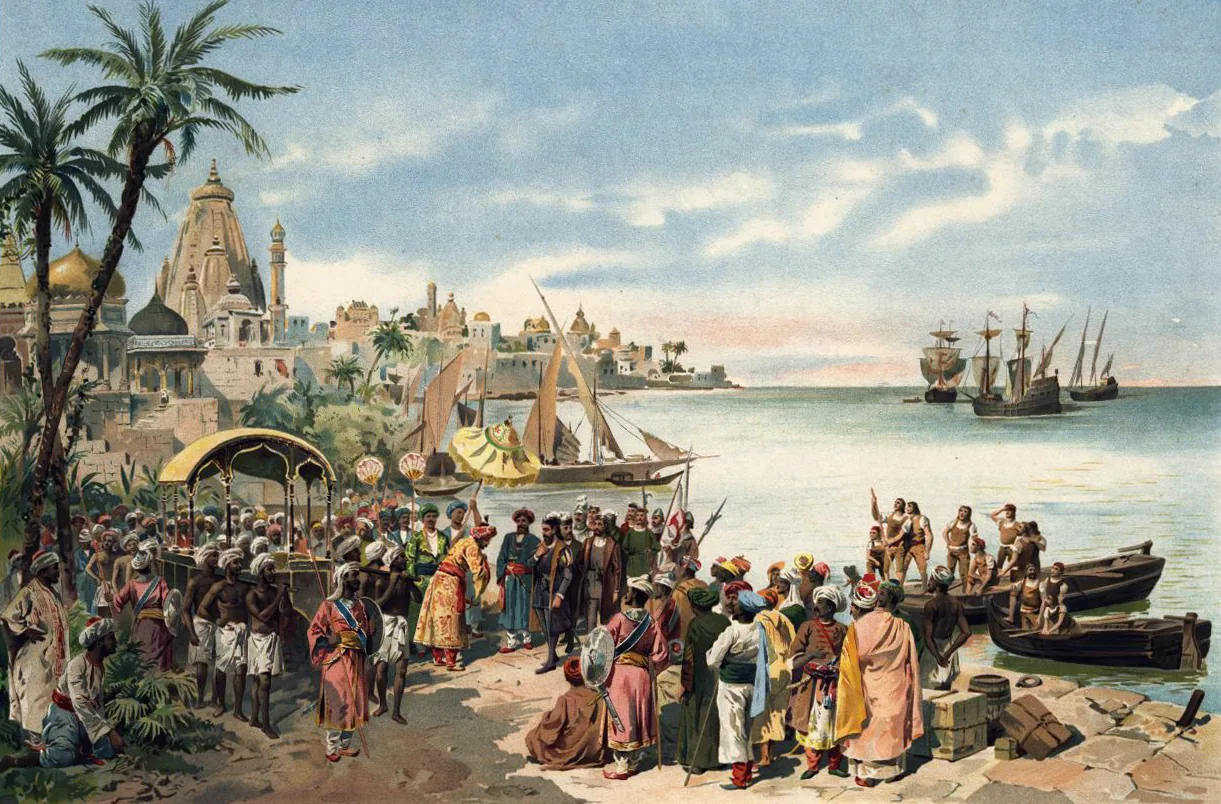
Vasco da Gama was a Portuguese explorer who sailed from Lisbon in 1497 and reached Calicut, on the southwest coast of India, in May 1498. He was the first European to reach India by sea, opening a route that connected Europe directly to the richest trading network in the world. Born around 1460 in Sines, a small coastal town in southern Portugal, da Gama came from minor nobility. His father, Estêvão da Gama, had originally been appointed to lead the expedition, but he died before it could depart, and the command passed to Vasco. The voyage changed global trade. It also introduced a pattern that would define European expansion for centuries: armed force used to control commerce that Europeans could not compete in on equal terms.
How Vasco da Gama reached India
King Manuel I of Portugal gave da Gama four ships: the São Gabriel, his flagship; the São Rafael, commanded by his brother Paulo; a smaller caravel called the Berrio; and a supply vessel. About 170 men sailed from Lisbon on July 8, 1497.
The winds along Africa's coast blew against southbound ships. Da Gama avoided them by sailing deep into the open Atlantic, nearly as far as Brazil, then catching the westerlies of the southern ocean to loop back east toward the Cape of Good Hope. This maneuver, called the volta do mar, kept the fleet out of sight of land for about 93 days, nearly three times as long as Columbus spent crossing the Atlantic. Da Gama rounded the Cape on November 22, 1497.
North of the Cape, he found the Swahili coast, a chain of prosperous Muslim city-states, including Mozambique, Mombasa, and Malindi. These cities did business with the Arabian Peninsula, Persia, the Gujarat coast, and merchants from as far away as China. Zheng He's treasure fleets had visited the same coast two generations earlier. The Portuguese arrived as provincials in a wealthy region, not as explorers among unsophisticated peoples, and were treated accordingly. At Malindi, a pilot who knew the monsoon winds joined the fleet. Twenty-three days later, da Gama reached India.
Calicut ranked among the busiest trading ports in southern Asia. Da Gama offered the Zamorin, Calicut's ruler, what Portugal could spare: bolts of striped fabric, hats, coral beads, sugar, honey, and washbasins. Court officials reportedly laughed at what they saw. Even the humblest trader arriving from Mecca gave richer gifts. Portugal had nothing that Asian markets wanted. Da Gama bought what spices he could get, mainly pepper and cinnamon, and sailed for home.
He left at the wrong time of year, sailing against the monsoon, and the crossing dragged on for months. Scurvy swept through the crew. Da Gama's brother Paulo was among those who died. Two ships had to be left behind along the way. About 55 of the original 170 men reached Portugal in 1499. Even so, the spices sold for a large enough profit to convince Lisbon that the route paid for itself.
How Portugal used force to control the Indian Ocean
Da Gama returned to India in 1502 with twenty warships. This time Portugal did not try to trade on equal terms. Its one advantage was seagoing warships armed with heavy guns. Commerce on the Indian Ocean had moved without serious naval weapons for hundreds of years.
Da Gama shelled Calicut. Off the coast, he seized the Miri, a vessel full of Muslim pilgrims on their way back from Mecca. He took its cargo, locked the passengers below deck, and set the ship on fire. Hundreds of people were on board, women and children among them. According to Portuguese accounts, women held up their babies and begged for mercy. About 300 people died.
Portugal then imposed the cartaz system. Any Asian merchant who wanted to sail waters that Portugal had never previously entered had to purchase a license from Portugal or face seizure of their ship. Within fifteen years this approach produced a chain of fortified bases at the ocean's narrow passages: Goa in 1510, Malacca in 1511, and Hormuz in 1515. Together, these outposts formed Portugal's trading empire.
Da Gama returned to India one final time in 1524 as viceroy. He died at Cochin on December 24, 1524.
Why was Vasco da Gama's voyage important?
Da Gama's voyage mattered less for the route itself than for what Portugal did with it. Sailors from India, the Arab world, Persia, and East Africa had crossed these waters for centuries before any Portuguese ship appeared, and it was one of them who guided da Gama to Calicut. What was new was the use of naval force to control other peoples' trade without having goods to sell.
The Dutch East India Company and the English East India Company later inherited and expanded this model: armed entry into existing commerce, fortified bases at narrow passages, and control of trade flows rather than production of goods. Over time, the Cape route pulled trade and revenue away from the land-based caravan trails and Red Sea shipping lanes that once enriched Venice, Egypt, and the Ottoman Empire.
Da Gama connected a small European kingdom to the richest trade network in the world. The connection held because Portugal could outgun everyone on the water.