
Tanzimat Reforms
The Tanzimat was a series of Ottoman reforms from 1839 to 1876 that tried to modernize the empire by borrowing European legal and administrative models.
The Tanzimat, meaning "reorganization" in Ottoman Turkish, was a series of reforms that the Ottoman Empire carried out between 1839 and 1876. The reforms tried to modernize the state along European lines so it could stop losing wars and territory to European powers. They began with the 1839 Edict of Gülhane, in which Sultan Abdülmecid I promised to protect the life, property, and honor of every Ottoman subject, whether Muslim or Christian. They ended when the empire adopted its first constitution in 1876. During those four decades, Ottoman reformers opened secular schools, built a European-style army, imported Western legal codes, and tried to replace the empire's old religious divisions with a new idea of shared citizenship. The Tanzimat failed to hold the Ottoman Empire together, but it shaped the Turkish republic that replaced it.
How the Tanzimat began
By the late 1830s, the Ottoman Empire, later called the sick man of Europe, had been losing wars and territory for decades. In June 1839, the army of Egypt's governor, Muhammad Ali, defeated the sultan's forces at the Battle of Nezib in southeastern Anatolia. Days later, the Ottoman fleet sailed to Alexandria and surrendered to Muhammad Ali. European powers stepped in to restrain Egypt, but the defeats made the empire's weakness impossible to deny.
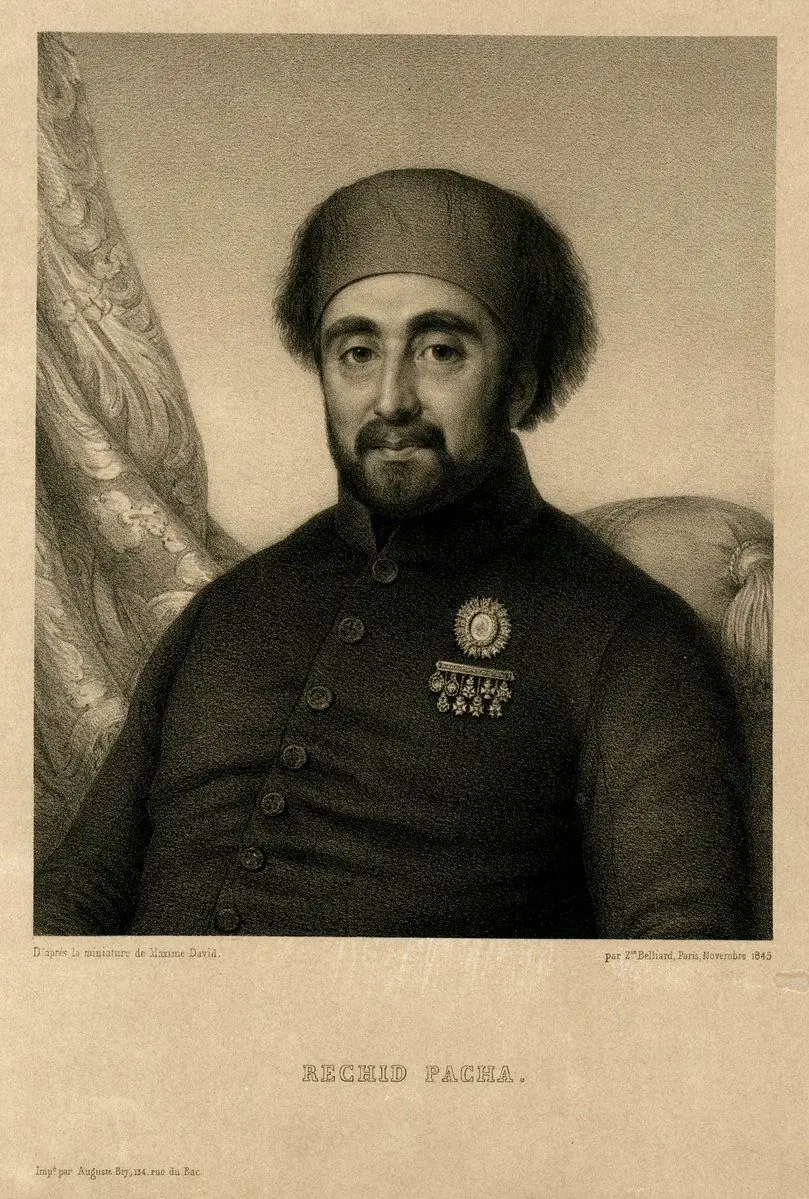
The statesman behind the reforms was Mustafa Reşid Pasha. Born in Constantinople in 1800, Reşid Pasha had entered government service as a young man and risen fast, serving as Ottoman ambassador to Paris in 1834 and to London in 1836. His years in western Europe convinced him that the empire needed new laws and institutions modeled on Western states. On November 3, 1839, Sultan Abdülmecid I had the Edict of Gülhane read out before assembled officials and foreign diplomats. Abdülmecid was sixteen years old and had taken the throne just months earlier after his father's death. He was the first Ottoman sultan to speak French, and he supported the reform program for the rest of his reign. The edict itself, drafted by Reşid Pasha, promised fair taxation, regular conscription, and security of life and property for all subjects, regardless of their religion.
A second reform edict followed on February 18, 1856. Where the first edict had promised protections, the second declared the full legal equality of non-Muslims. Christians and Jews could now serve in the military, attend the same schools, and hold government offices on the same terms as Muslims. The principle behind both edicts became known as Ottomanism: the idea that all the empire's subjects, whatever their religion, were equal citizens of one state. This was a direct break with four centuries of the millet system, which had organized Ottoman society by religious community and given Muslims a higher legal standing.
What the reformers built
The reform program was run from the Sublime Porte, the offices of the grand vizier in Istanbul that served as the working center of Ottoman government. Reşid Pasha himself held the post of grand vizier six times between 1846 and 1858, and two of his protégés, Ali Pasha and Fuad Pasha, continued the program after Reşid Pasha's death in 1858.
The practical changes were broad. The reformers built a conscript army trained on European methods and opened secular schools alongside the traditional religious ones. They adopted a French commercial code in 1850 and later produced the Mecelle, a civil code completed between 1869 and 1876 that organized Islamic jurisprudence into a systematic format modeled on European legal codes. New secular courts called Nizamiye courts handled commercial and criminal cases under these codes, operating alongside the traditional religious courts. Provincial administration was reorganized into a uniform system of governors and councils. Telegraph lines, postal services, and railways began to connect the provinces to Istanbul.
The reformers wanted to build a state that could collect taxes, run schools, raise armies, and administer provinces as effectively as European governments did.
Why did the Tanzimat reforms fail?
The Tanzimat carried a problem it could not solve. The reformers wanted European-style institutions without becoming a European-style society, and the groups they needed to win over rejected the reforms for opposite reasons.
Conservative Muslims and the religious establishment opposed equal citizenship because it stripped Muslims of their traditional legal superiority over Christians and Jews. Many saw the reforms as an attack on Islam itself. At the same time, the empire's Christian populations, especially Greeks, Serbs, and Bulgarians in the Balkans, were not satisfied by equal citizenship within a reformed Ottoman state. They wanted independent nations of their own. The Tanzimat was meant to weaken nationalist movements by making the empire worth staying in, but those movements only grew stronger during the reform era.
The reform era reached its peak in December 1876, when a group of reformers called the Young Ottomans pushed Sultan Abdülhamid II to accept the Kanun-ı Esasi, the first constitution in Ottoman history, and to open an elected parliament. Abdülhamid agreed reluctantly. Within two years, after the costly Russo-Turkish War of 1877-1878, he suspended both the constitution and the parliament and ruled as an absolute monarch for the next thirty years.
The Tanzimat's central idea, that the Ottoman state could survive only by modernizing along secular and centralized lines, outlived the reform era itself. The Young Turks forced the constitution back into effect in 1908. After the Ottoman Empire fell, Mustafa Kemal Atatürk carried the same logic further, abolishing the sultanate and building a secular Turkish republic on the institutional foundations the Tanzimat reformers had laid.