
Treaty of Lausanne
The Treaty of Lausanne (1923) replaced the Treaty of Sevres, set Turkey's borders, and ordered a compulsory population exchange of 1.5 million people.
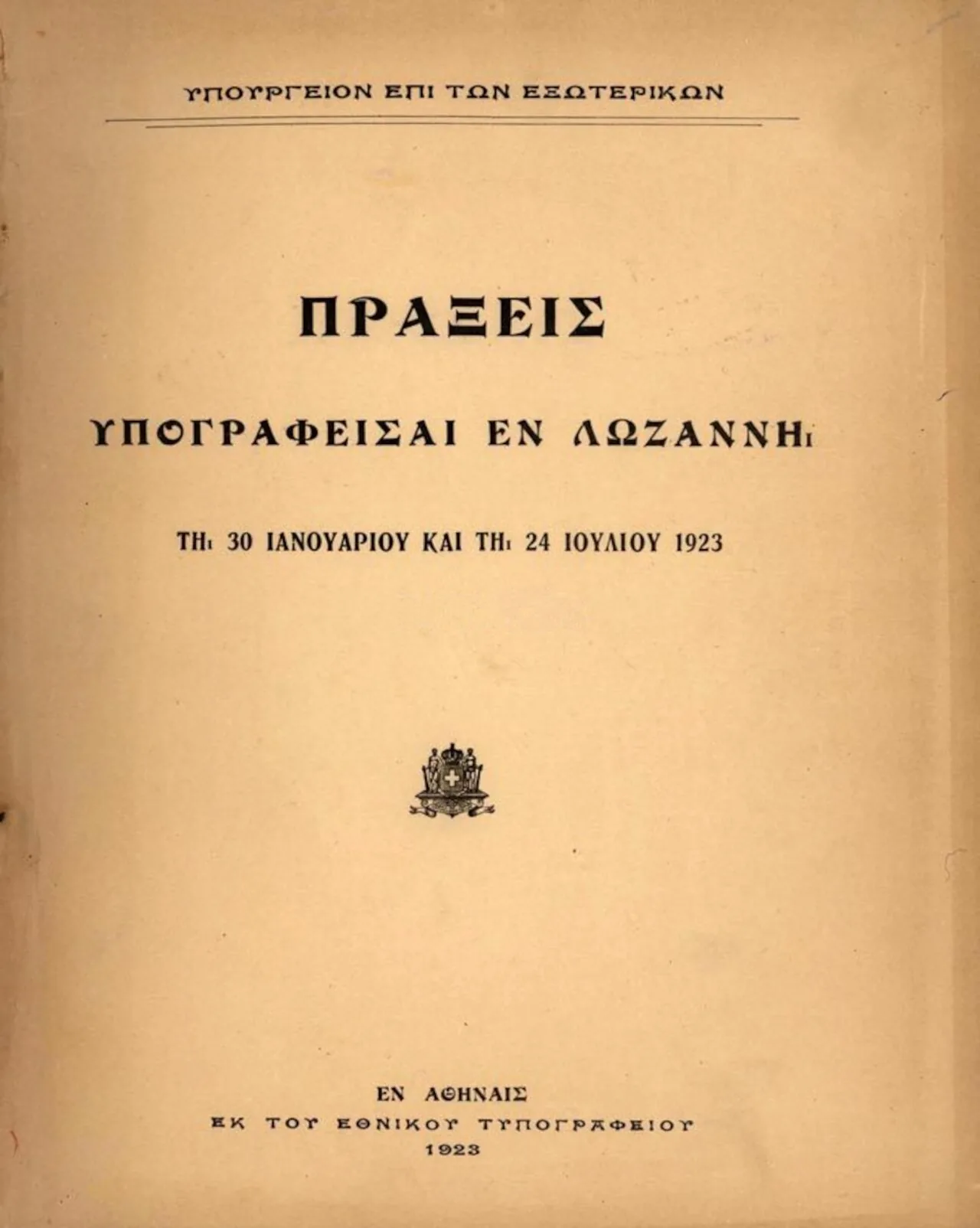
The Treaty of Lausanne was a peace settlement signed on 24 July 1923 in Lausanne, Switzerland, between Turkey and the Allied powers that had won the First World War. The Allies had signed the Treaty of Sevres with the Ottoman sultan in 1920, dividing the empire and giving large parts of Anatolia to Greece, France, Italy, and an independent Armenia. Lausanne replaced that settlement. Lausanne is the only First World War peace treaty that a defeated power rewrote after winning a war. It recognized Turkey's borders as its army had established them, abolished foreign legal privileges, and imposed no significant reparations. A separate convention ordered the first compulsory population exchange in modern history, moving over 1.5 million people between Greece and Turkey.
How Turkey rewrote its own peace treaty
The Treaty of Sevres, signed on 10 August 1920, gave the victors most of what they wanted from the Ottoman Empire. Greece received the city of Izmir and its hinterland. France and Italy took zones of influence in southern Anatolia. The Straits connecting the Black Sea to the Mediterranean were placed under Allied control. The treaty recognized an independent Armenia in the east and outlined an autonomous Kurdish region with a path to independence. It also restored the capitulations, the centuries-old system that exempted foreigners from Ottoman law and Ottoman tariffs.
The sultan's government in Istanbul signed Sevres, but the Turkish national movement under Mustafa Kemal refused it. Kemal controlled the army, and he used it. In the Turkish War of Independence, his forces drove Armenian forces back in the east, pushed the French out of southern Anatolia, and in September 1922 recaptured Izmir from the Greek army. By the end of the war, every territorial concession Sevres had imposed in Anatolia was reversed on the ground.
The peace conference opened in Lausanne in November 1922. Turkey's chief negotiator was Ismet Pasha, later known as Ismet Inonu, a 38-year-old general with almost no diplomatic experience. He was also partially deaf. His counterpart was Lord Curzon, Britain's foreign secretary, a former Viceroy of India and one of the most experienced diplomats in Europe. None of that gave Curzon the advantage. Turkey had just won a war, and Ismet negotiated from that strength. When Curzon finished his speeches, Ismet would simply repeat Turkey's original demands. When Curzon tried to pressure him into signing a draft, Ismet refused. The conference broke off in February 1923 and resumed in April. On 24 July the treaty was signed at the Palais de Rumine in Lausanne.
The terms of the Treaty of Lausanne
Lausanne reversed nearly everything in Sevres. The Allies accepted the borders Turkey's army had fought for in Anatolia and eastern Thrace. Those borders have remained almost unchanged since 1923. Article 28 ended the capitulations entirely. For the first time in centuries, Turkey had full authority over its own courts. No significant reparations were imposed.
The provisions Sevres had made for an independent Armenia and an autonomous Kurdistan were dropped entirely. The Kurds, who number roughly 30 to 40 million today, ended up split across Turkey, Iraq, Syria, and Iran, without any of those states recognizing a Kurdish national claim. Lausanne is the reason the Kurds still have no country of their own.
The treaty demilitarized the Straits and placed them under international oversight. Turkey later renegotiated this arrangement through the Montreux Convention of 1936, which handed Turkey full control of the waterway and the right to restrict warship passage in wartime.
The population exchange between Greece and Turkey
A separate convention, signed on 30 January 1923 during the Lausanne negotiations, ordered a compulsory exchange of populations between Greece and Turkey. The exchange was defined by religion, not by language or self-identification. Most Greek Orthodox Christians in Turkey were sent to Greece. Most Muslims in Greece were sent to Turkey. This meant that Turkish-speaking Orthodox Christians went to Greece, and Greek-speaking Muslims went to Turkey.
About 1.2 million Greek Orthodox Christians left Anatolia and eastern Thrace for Greece. Between 350,000 and 400,000 Muslims went in the other direction, from Greece to Turkey. Communities that had lived in the same places for centuries were uprooted within months. Much of the transfer was retroactive, formalizing flight that had already happened during the war.
The League of Nations endorsed the exchange and an international commission supervised it. For decades afterward, policymakers cited it as a model for resolving ethnic conflict. The idea that peace could be secured by sorting populations to match borders influenced discussions about Palestine in the 1930s, the forced resettlement of Germans from Eastern Europe after 1945, and the division of India in 1947.
Why the Treaty of Lausanne still matters
Turkey treats Lausanne as a founding act of the republic. It is the treaty that forced the great powers to accept the new state as a sovereign equal, not as a protectorate to be divided. Turkish politicians celebrate 24 July as the anniversary of the treaty. The story of Ismet Pasha refusing to yield to Lord Curzon is taught in Turkish schools as part of the republic's founding story.
But Lausanne also created fears that have not gone away. The memory of Sevres, the treaty that tried to partition Anatolia, produced what scholars call Sevres syndrome: the belief that foreign powers are permanently working to weaken or break apart Turkey. Turkish governments have treated Kurdish political demands as threats to the country's territorial integrity, in part because Sevres once promised the Kurds a state, and any concession on the issue can look like a return to those terms.
Turkey's borders have stayed almost exactly where Lausanne set them for over a century. Few First World War peace settlements lasted as long.