
Sun Yat-sen
Sun Yat-sen was a Chinese revolutionary who became the first provisional president of the Republic of China after the 1911 revolution.
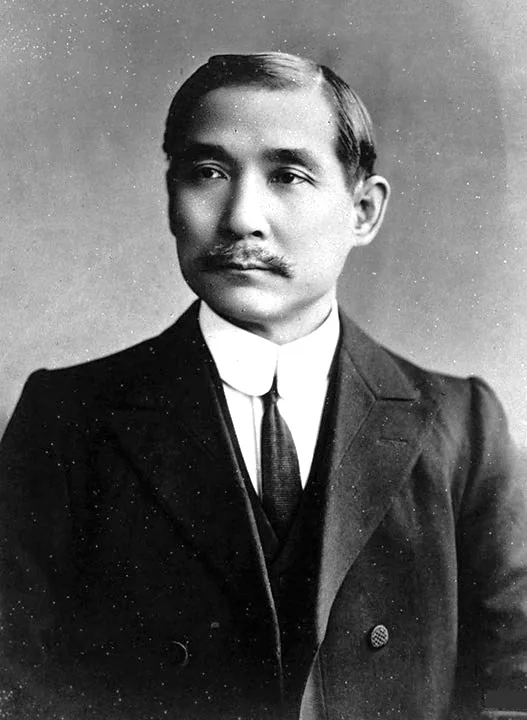
Sun Yat-sen (1866–1925) was a Chinese revolutionary who helped bring down an imperial system that had governed China since 221 BC and became the first provisional president of the Republic of China. He is also known by his Chinese name, Sun Zhongshan. He studied medicine in Hong Kong, gave up his career for politics, and spent nearly two decades organizing uprisings against the Qing dynasty. Most of them failed. When the revolution that finally succeeded broke out in October 1911, Sun was on the other side of the world. He learned the news from a newspaper in Denver, Colorado. Today he is one of the few political figures honored by both China and Taiwan, two governments that agree on almost nothing else.
How Sun Yat-sen became a revolutionary
Sun was born on November 12, 1866, to a farming family in Cuiheng, a village in Guangdong province. At twelve, he moved to Hawaii, where his older brother Sun Mei later became a successful rancher. Sun attended Iolani School in Honolulu, where he learned English and was introduced to Western political ideas. He later studied medicine at the Hong Kong College of Medicine for Chinese and graduated in 1892.
Within two years, Sun gave up medicine to found revolutionary societies. He raised money from overseas Chinese communities for a series of uprisings against the Qing dynasty. The uprisings kept failing.
In 1896, while passing through London, Qing agents lured Sun into the Chinese legation on Portland Place and held him for twelve days. They planned to ship him back to China for execution. His former medical teacher, James Cantlie, alerted the press and the British Foreign Office. The outcry forced Sun's release and made him famous internationally. He published a short book about the experience, "Kidnapped in London," and used his new fame to raise more support for the revolution.
How the 1911 revolution ended imperial China
On October 10, 1911, soldiers in Wuchang, a city on the Yangtze River, mutinied against their Qing officers. The uprising spread faster than anyone expected. Province after province declared independence from the dynasty. Sun was in Denver, Colorado, at the time. He read the news in the Rocky Mountain News at the Brown Palace Hotel. Instead of rushing home, he traveled first to European capitals to make sure the major powers would not intervene on the Qing's behalf.
On January 1, 1912, Sun took office as the first provisional president of a new Chinese republic. But he held the title for only weeks. He struck a deal with Yuan Shikai, the most powerful general in northern China: Yuan would force the last emperor to abdicate, and Sun would step aside. The emperor abdicated on February 12, 1912, and Sun resigned the next day.
The deal fell apart quickly. Yuan tried to make himself emperor. After Yuan's death in 1916, China splintered into territories controlled by rival warlords. Sun spent the following years rebuilding his political party, the Kuomintang (KMT). When Western democracies refused to support him, he turned to the Soviet Union. In 1923 he signed an agreement with a Soviet envoy and accepted Comintern advisers. They reorganized the KMT along Leninist party lines. Sun also brought the newly founded Chinese Communist Party into the alliance.
In 1924, Sun opened the Whampoa Military Academy near Guangzhou to train a revolutionary army. He put Chiang Kai-shek, a young officer, in charge. Sun died of cancer in Beijing on March 12, 1925, at the age of 58. He had been trying to negotiate a reunification deal with northern warlords.
Sun left no clear successor. Chiang drew on his control of the Whampoa graduates to win the power struggle that followed. In 1927, Chiang turned on the Communists and massacred them in Shanghai. The resulting civil war lasted, on and off, until Mao Zedong's victory in 1949. Both Chiang and Mao claimed to be Sun Yat-sen's true heir for the rest of their lives.
Was Sun Yat-sen a communist?
Sun Yat-sen was not a communist. He allied with the Chinese Communist Party in 1923 and accepted Soviet military and political advisers, but his own political philosophy was different. Sun called his political program the Three Principles of the People. It stood for national sovereignty, representative government, and the economic welfare of ordinary citizens. He wanted China to become a republic, not a communist state. His alliance with the Soviet Union was practical. Western democracies had refused to help him, and the Soviet Union was the only major power willing to offer money, weapons, and advisers.
After Sun's death, Chiang Kai-shek broke the alliance. The united front collapsed in 1927, and the Kuomintang and the Communist Party fought each other for the next two decades.
Why both China and Taiwan claim Sun Yat-sen
Sun Yat-sen is one of the few figures honored in both mainland China and Taiwan. In Taipei, the government calls him the Father of the Nation. In Beijing, the government calls him the Forerunner of the Revolution. Sun's Three Principles are written into Taiwan's constitution and quoted by officials in Beijing.
Sun's embalmed body lies in a marble mausoleum on Purple Mountain in Nanjing, reached by 392 granite steps. The mausoleum was built in the late 1920s by the Republic of China, which no longer governs the mainland, and is maintained today by the People's Republic. Sun's legacy has lasted in part because he died before the split between the Nationalists and the Communists became permanent. He worked with both sides, and both sides have used his name and ideas to support their own claims to governing China ever since.