
Comintern
The Comintern was the Soviet-led organization that built and directed communist parties worldwide from 1919 to 1943.
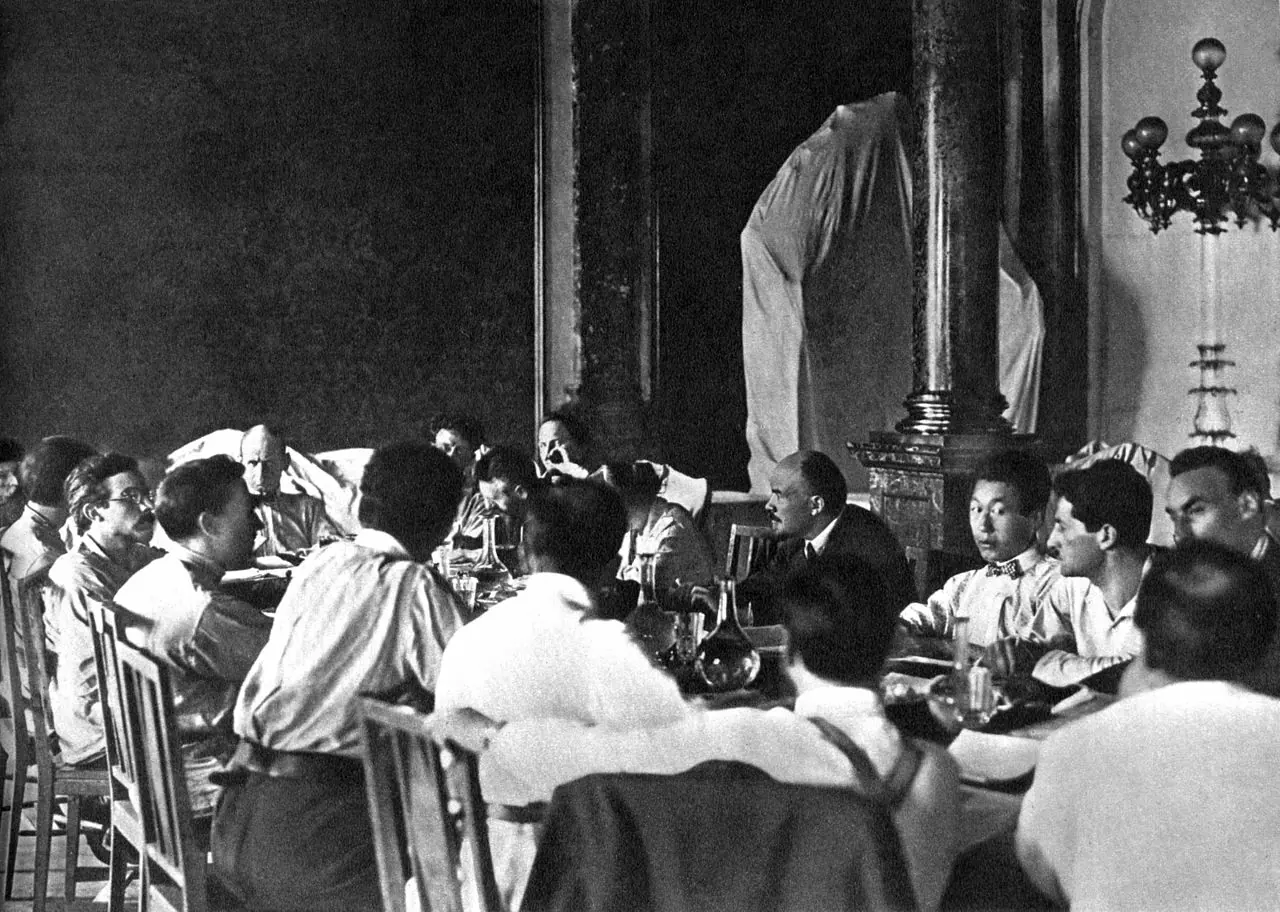
The Communist International, known as the Comintern, was established in Moscow in March 1919 to spread communist revolution across the world. Lenin created it because he believed Russia's revolution would fail unless it spread, and he expected Europe to follow next. Between 1919 and 1943, the Comintern organized and controlled communist parties in dozens of countries, providing training, money, and orders from Moscow. It operated schools for foreign revolutionaries, funneled cash through front organizations, and ran its own intelligence operations. The parties it controlled answered to Moscow. Whenever Moscow's foreign policy shifted, the line every member party had to follow changed with it, usually within weeks. Local communists who refused a new directive were expelled or worse.
How Lenin built the Comintern
The founding congress met in Moscow from March 2 to 6, 1919, with about 50 delegates from more than 20 countries. Lenin was convinced that Europe was about to have its own revolution. When no revolution succeeded, the Comintern's purpose changed from coordinating an uprising already underway to creating tightly organized parties that could make one when the time came.
At the Second Congress in 1920, the Comintern adopted a set of requirements called the Twenty-One Conditions. Every party seeking membership had to agree to all of them. The conditions covered everything from internal structure to foreign policy. Member parties had to remove reformists from their ranks, maintain a secret underground organization parallel to the public one, place their elected officials under party control, and accept every decision by the Comintern's leadership as a binding order. They also had to call themselves Communist, a requirement that forced a visible break with the broader socialist tradition. The result was a fracture across the entire socialist world. In one country after another, parties split into a communist faction and a social democratic faction. The bitterness between those two sides defined left-wing politics in Europe for decades to come.
How the Comintern reshaped the world
The Comintern trained and deployed people who went on to lead countries. Ho Chi Minh was a founding member of the French Communist Party in 1920, studied at a Comintern school in Moscow, and spent years as a Comintern agent building communist organizations across Southeast Asia. Josip Broz Tito trained in Moscow and worked for the Comintern before leading Yugoslavia's partisan movement in World War II.
But the cost of the Comintern's discipline was that every member party had to follow Soviet interests, even when the result was catastrophic for the local party.
In China, the Comintern helped found the Chinese Communist Party in 1921 and then ordered the young party to work alongside the Nationalist Party, which Chiang Kai-shek came to lead. Moscow insisted on that cooperation until April 1927, when Chiang turned on the communists and killed thousands in Shanghai. The surviving Chinese communists concluded that following Moscow could get them killed. That experience helped push Mao Zedong's rural guerrilla strategy over the Comintern-approved urban approach, and it gave the Chinese party enough independence from Moscow to eventually produce the Sino-Soviet split.
The damage in Germany took a different form. In 1928, the Comintern adopted the "Third Period" line, which declared that social democrats were the main enemy, not the far right. German communists labeled social democrats "social fascists" and refused to cooperate with them against Hitler. Germany's two biggest left-wing parties used the years before the Nazi takeover to attack each other instead of building a common front. The failure to unite against fascism is widely considered one of the most consequential political blunders of the twentieth century.
In 1935, the Comintern changed course again. Its Seventh Congress launched the Popular Front approach and told communists to ally with anyone opposing fascism. Popular Front governments took power in France and Spain. The Comintern organized the International Brigades that fought in the Spanish Civil War, drawing about 35,000 volunteers from more than 50 countries.
The Comintern and World War II
In August 1939, Stalin's government signed the Molotov-Ribbentrop Pact with Nazi Germany, and the Comintern told communist parties worldwide that the new war was not a struggle against fascism. Many people left the movement after that reversal. When Germany invaded the Soviet Union in June 1941, the line flipped once more, and communists everywhere were told to back the war against Hitler.
In May 1943, Stalin formally shut down the Comintern. The move was meant to reassure Britain and the United States that Moscow was a reliable wartime partner, not the center of a global revolutionary project. In practice, the Comintern's operations were simply absorbed into the Soviet Communist Party's own apparatus. In 1947, the Soviet Union created the Cominform, a smaller successor that coordinated European communist parties during the early Cold War.
The Comintern was the first systematic effort by a great power to build and steer partisan networks within foreign states as an instrument of policy. The movements it created shaped politics on every continent, and the model it pioneered outlasted the organization by decades.