
Chiang Kai-shek
Chiang Kai-shek was the Chinese Nationalist leader who fought Japan, lost a civil war to Mao Zedong, and ruled Taiwan until his death in 1975.
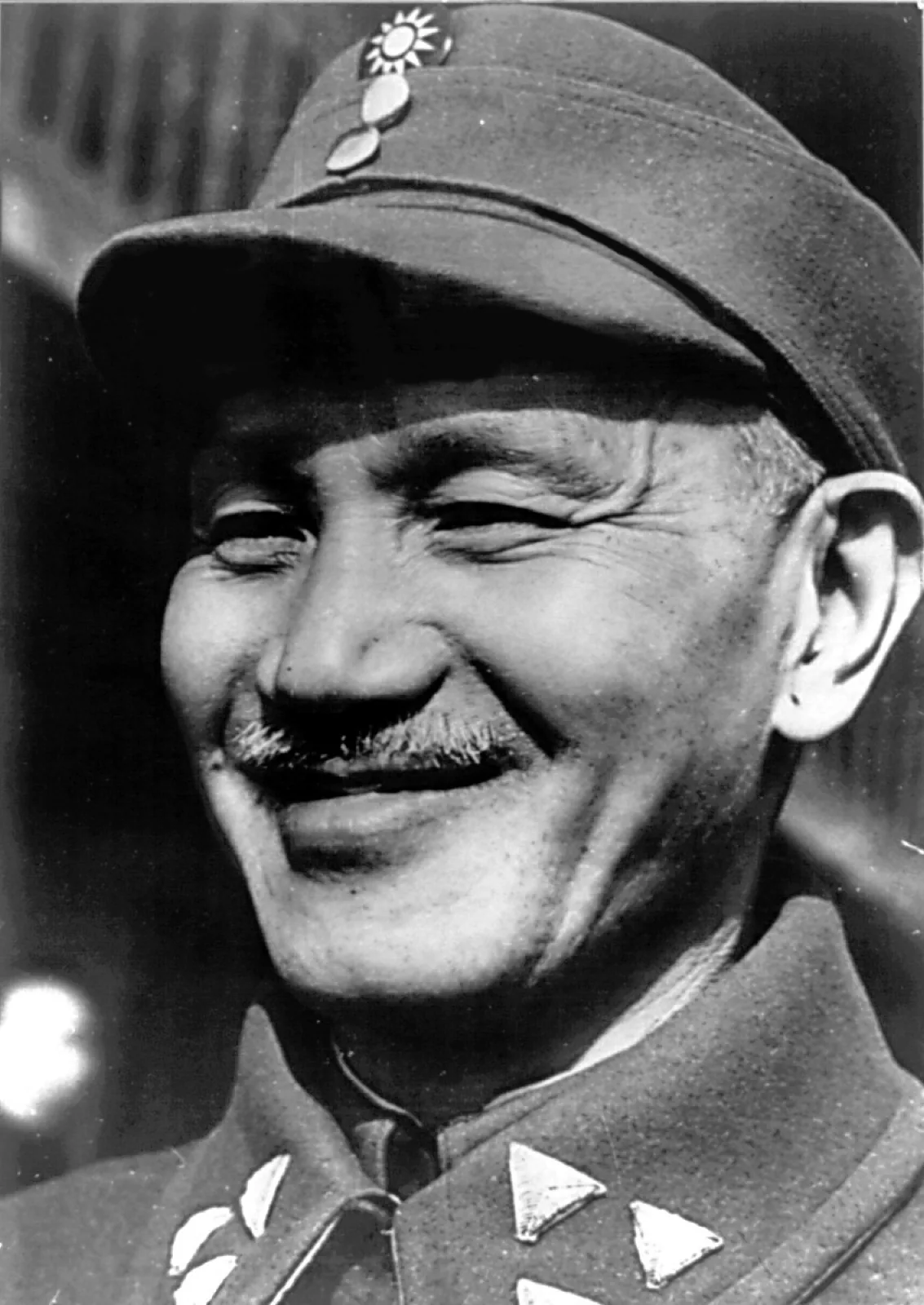
Chiang Kai-shek was the leader of Nationalist China from the late 1920s until his death in 1975. He unified much of China by force, led the country through eight years of war against Japan, and then lost a civil war to Mao Zedong's Communists in 1949. He retreated to Taiwan with about two million soldiers and refugees and ruled the island under martial law for the rest of his life. He never gave up his claim to be the legitimate ruler of all of China. Beijing insisted that the Communist Party was China's rightful government, but agreed with Chiang on the basic point: there was only one China. That shared premise still shapes the standoff between Beijing, Taipei, and Washington today.
How Chiang Kai-shek rose to power
Chiang was born in 1887 in Xikou, a small town in Zhejiang province. His father was a salt merchant who died when Chiang was eight. As a young man Chiang trained at a military academy in Japan, where many future Chinese revolutionaries studied. He returned to China, joined the revolution against the Qing dynasty, and became a follower of Sun Yat-sen, the founder of the Kuomintang (the Nationalist Party, or KMT).
Sun put Chiang in charge of the Whampoa Military Academy near Guangzhou in 1924. Whampoa trained the officers who would serve under Chiang for decades. When Sun died in 1925, Chiang used that army to launch the Northern Expedition in 1926, a military campaign to reunify China after years of warlord rule. By 1928 he controlled most of the country, at least on paper.
Chiang had allied with the Chinese Communist Party to fight the warlords. In April 1927 he broke with them violently. In Shanghai, his forces killed thousands of Communists and suspected sympathizers in a bloody purge. The surviving Communists retreated into the countryside and regrouped. Their Long March to China's remote northwest in 1934 and 1935 nearly destroyed them, but under Mao Zedong they rebuilt and waited.
Chiang Kai-shek and the war against Japan
Through the 1930s, Chiang governed a fragile republic while trying to wipe out the Communists. In December 1936, two of his generals seized him at Xian and held him until he agreed to stop fighting the Communists and join forces against Japan. Japan invaded China in full the following year, beginning eight years of war that killed millions of Chinese civilians and soldiers.
Chiang moved his capital inland to Chongqing and held on. By 1943, China was recognized as one of the major Allied powers, and Chiang sat beside Franklin Roosevelt and Winston Churchill at the Cairo Conference in November. His wife, Soong Mei-ling, had graduated from Wellesley College in Massachusetts and spoke fluent English. She addressed the US Congress in February 1943 and became one of the most famous women in the world. For years Soong Mei-ling lobbied Washington's press and politicians on Chiang's behalf, and the American alliance she helped build outlasted the war itself.
Chiang Kai-shek's defeat and retreat to Taiwan
Japan surrendered in August 1945, and the civil war resumed almost immediately. Chiang had the larger army, more territory, and American backing. But his government was weakened by years of war, widespread corruption, and runaway inflation that destroyed public trust. Several of his generals defected to the Communist side with their troops.
Mao's forces had spent the war years building support in the countryside by cutting rents. By 1948 the Communists were winning battle after battle in Manchuria and northern China. In October 1949, Mao proclaimed the People's Republic of China in Beijing. Chiang evacuated to Taiwan with roughly two million soldiers and civilians, a large share of the national treasury, and thousands of crates of artworks and artifacts from Beijing's imperial collections. Those treasures are now in Taipei's National Palace Museum, one of the largest collections of Chinese art in the world.
On Taiwan, the Nationalists imposed martial law in 1949. It lasted until 1987, one of the longest periods of martial law in modern history. The political repression that followed is known as the White Terror. Tens of thousands of people were jailed, and thousands were executed. When the Korean War began in 1950, the United States sent the Seventh Fleet to patrol the Taiwan Strait and guard the island from invasion. That American presence locked the civil war into a permanent standoff. Chiang kept promising to retake the mainland, but the invasion never came.
Under American protection, Chiang's government carried out land reform and promoted export-driven manufacturing. That growth laid the foundation for Taiwan's later rise as one of Asia's most advanced economies, including its dominance in semiconductor manufacturing. Under Chiang's successors, Taiwan became a democracy.
How did Chiang Kai-shek die?
Chiang died on April 5, 1975, in Taipei, at the age of 87. He had been in declining health for several years. The cause of death was heart and kidney failure. His son, Chiang Ching-kuo, was already running much of the government and became president of Taiwan in 1978.
Until his death, Chiang maintained that his government in Taipei was the rightful government of all of China. Beijing took the opposite view, but both sides agreed there was only one China. That shared premise, and the tension between its two interpretations, remains at the center of the Taiwan question today.