
Yuan Shikai
Yuan Shikai was a Chinese general who ended the Qing dynasty, became president of the republic, and tried to make himself emperor.
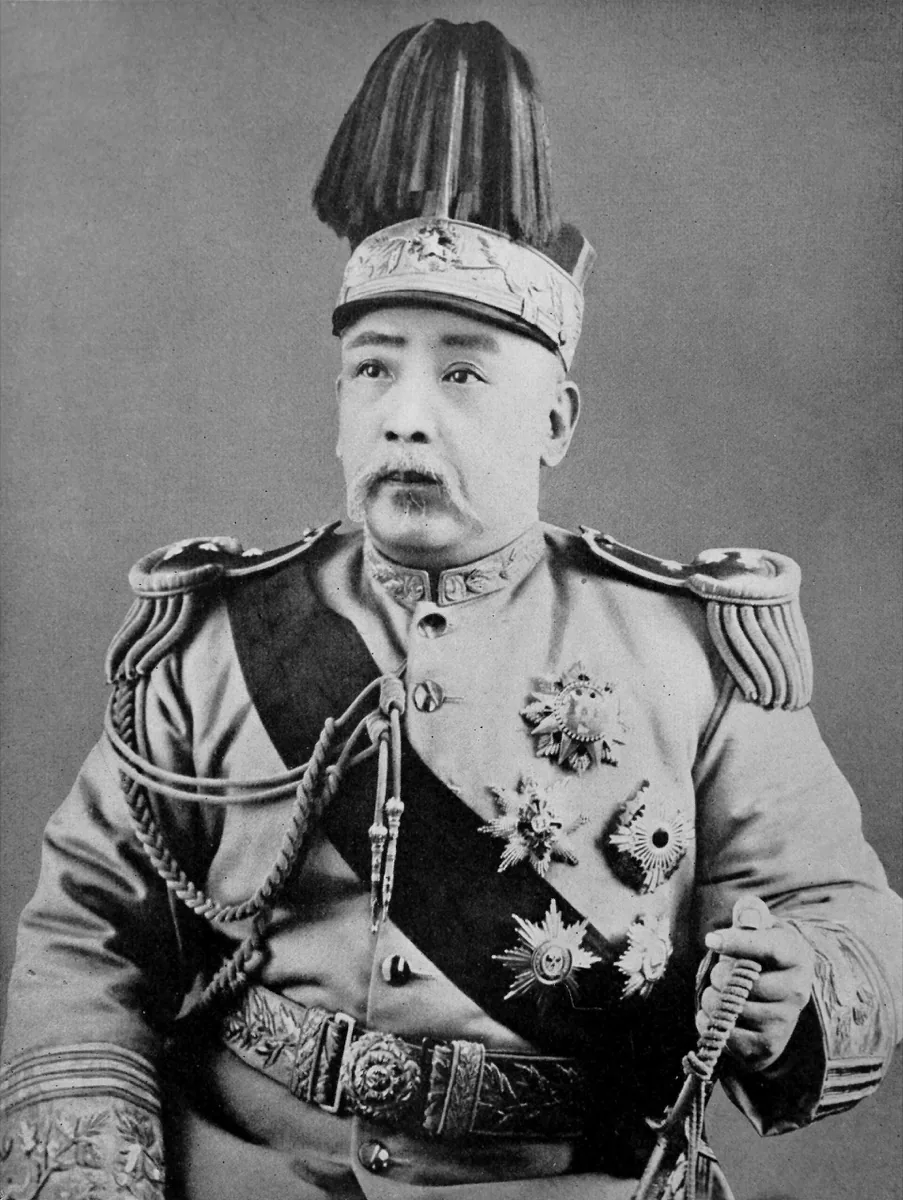
Yuan Shikai (1859–1916) was a Chinese general and politician who brought down an empire that had lasted more than two millennia, then seized the republic that followed. He built the Beiyang Army, the most modern military force in China, and leveraged it to negotiate the abdication of the last emperor in 1912. Yuan became president of the Republic of China, but over the next four years he banned the opposition, dissolved parliament, and tried to make himself emperor. He failed, and his death in 1916 left China without a functioning central government. Historians date the start of the warlord era from that moment.
How Yuan Shikai built the Beiyang Army
Yuan sat for the imperial civil service examinations twice, failed both times, and chose a military career. In the 1880s the Qing court sent him to Korea, where he spent nearly a decade as China's resident in Seoul, governing the kingdom as a protectorate.
After China lost a war to Japan in 1895, the Qing court tasked Yuan with creating a Western-style army. He created the Beiyang Army, training it with German methods, foreign instructors, and modern artillery. By around 1905 it had roughly 60,000 soldiers organized in six divisions, the largest modern force in China. Yuan personally selected and promoted the officer corps, and their loyalty ran to Yuan, not to the throne.
In 1898, the Guangxu Emperor, who was still in his twenties, launched a burst of modernizing reforms known as the Hundred Days. The emperor wanted Yuan's military support. Yuan betrayed him, siding with Empress Dowager Cixi, who ended the reforms and placed the emperor under house arrest. Yuan's career advanced steadily after that, and he came to run one of the best-governed provinces in the Qing empire. In 1909, a new regent forced Yuan out of office.
How Yuan Shikai ended the Chinese empire
In October 1911, a military uprising broke out in Wuchang, a city on the Yangtze River. Southern provinces declared independence one after another. The Qing court had no one else who could command a real army, and brought Yuan back on his own terms.
Yuan played both sides. He assured the court he would save the dynasty, while telling the revolutionaries he could deliver a peaceful end to it. In February 1912, Yuan persuaded the court to accept the abdication of the six-year-old emperor Puyi, ending imperial rule in China. Sun Yat-sen, the revolutionary leader who had been named provisional president, stepped aside. Yuan became president of the Republic of China. The revolutionaries had no strong army of their own, and Yuan controlled the only serious fighting force in the country.
How Yuan Shikai destroyed the republic
China held its first parliamentary elections in late 1912. The Kuomintang, the Nationalist party organized by Sun Yat-sen's allies, won the most seats. Song Jiaoren, the party's thirty-year-old organizer and campaign leader, was expected to become premier. On March 20, 1913, a gunman shot Song on the platform of the Shanghai railway station. Song died two days later. Evidence quickly pointed to Yuan's inner circle.
The Nationalists launched an armed revolt against Yuan that summer, called the Second Revolution. Yuan's Beiyang Army put it down in less than two months. Yuan responded by outlawing the Kuomintang, expelling its members from parliament, shutting down the parliament altogether, and rewriting the constitution so that he held power for life.
In January 1915, Japan presented Yuan with the Twenty-One Demands, a set of concessions that would give Japan control over large parts of China's economy and territory. After months of negotiation, Yuan accepted a reduced set of thirteen demands in May. The agreement gave Japan extensive rights in Manchuria, Shandong, and Chinese industry. Yuan himself declared May 9, the day he accepted Japan's ultimatum, as National Humiliation Day.
In December 1915, Yuan announced that he was restoring the monarchy and would reign as the Hongxian Emperor. Southern provinces revolted, launching the National Protection War. Yuan's own Beiyang generals refused to fight for him. After eighty-three days, Yuan canceled the restoration.
Yuan Shikai's death
Yuan Shikai died of uremia, a form of kidney failure, on June 6, 1916. He was fifty-six. His health had been declining for months after the failed restoration.
After Yuan's death, the Beiyang Army, which had held together only through his personal authority, fractured into rival cliques. Its generals spent the next twelve years fighting each other for control of provinces, railways, and tax revenues. No central government controlled China until the Kuomintang's Northern Expedition reunified most of the country in 1928.
Yuan's career left a lasting mark on Chinese politics. He demonstrated that a republic survives only if the army answers to its government, not to one man. The Chinese Communist Party absorbed that lesson and has kept the military under direct party control ever since.