
Peace of Westphalia
The 1648 treaties that ended the Thirty Years' War and established the principle that each state is sovereign within its own borders.
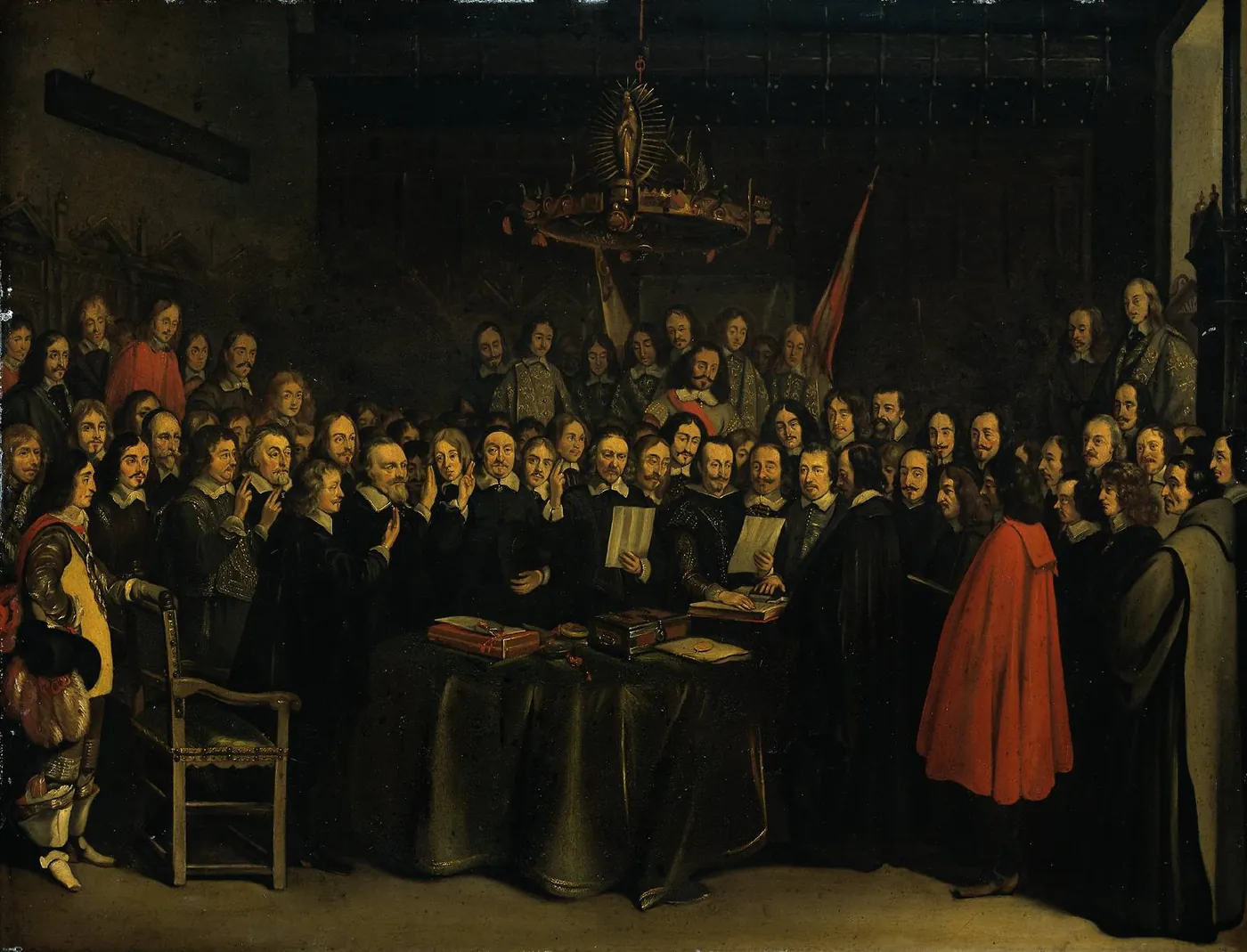
The Peace of Westphalia refers to two treaties signed on October 24, 1648, that brought an end to the Thirty Years' War across the Holy Roman Empire. A separate treaty signed earlier that year ended the eighty-year struggle for Dutch independence from Spain. The two documents were negotiated in separate Westphalian towns roughly thirty miles apart. The Treaty of Osnabruck settled matters between the emperor and Sweden together with the Protestant German estates. The Treaty of Munster settled matters between the emperor and France. Negotiations had begun in 1643, and 109 separate delegations took part, making it the largest diplomatic gathering Europe had seen. The settlement redrew borders, recognized new states, and set a precedent that shaped international politics for centuries: the principle that a ruler governs his own territory without outside interference.
How the negotiations worked
The Thirty Years' War started in 1618 when Protestant nobles in Bohemia revolted against their Catholic Habsburg ruler. What began as a local rebellion pulled in nearly every power in Europe and devastated the German-speaking lands, where up to a third of the population died. By the early 1640s, exhaustion had made every side willing to talk, but the sheer number of interested parties, the emperor, France, Sweden, the Dutch, dozens of German princes, free cities, and bishops, made a single table impractical.
The organizers split the congress along confessional lines. France, a Catholic power, sent its diplomats to the Catholic city of Munster. Sweden, a Protestant one, sent its diplomats to the Protestant city of Osnabruck. Both towns were made neutral ground, with all troops withdrawn for the length of the talks. The 109 delegations sat as legal equals, with no pope or supreme authority directing the process. The congress dragged on for five years, partly because couriers on horseback were the only way to carry instructions across a continent still at war.
What the Peace of Westphalia changed on the map
The terms gave France control of Alsace and three bishoprics, Metz, Toul, and Verdun, extending French territory eastward to the Rhine. Sweden received Western Pomerania along with the port city of Wismar, and picked up two former church territories, Bremen and Verden, that had been converted to secular holdings. Sweden also won seats in the Imperial Diet, giving the Swedish crown a formal role in the empire's internal decisions. Both the Dutch Republic and the Swiss Confederation gained official recognition as independent states, ending Spanish and Habsburg authority over them.
The biggest structural change was inside the empire. About 300 German principalities won what the treaties called Landeshoheit: the legal authority to run their own affairs and sign treaties with foreign governments, so long as those agreements did not target the emperor. The empire did not break apart. It continued to function, with its emperor and its Diet, for another century and a half, until Napoleon forced its dissolution in 1806. But after 1648 the German princes answered to their own interests far more than to any central authority.
How the Peace of Westphalia handled religion
Religion had driven the war. The 1555 Peace of Augsburg had introduced the principle cuius regio, eius religio: each prince picked the faith of his territory. That arrangement recognized only two options, Catholicism and Lutheranism, and said nothing about Calvinism, which had spread widely in the decades since.
The 1648 settlement added Calvinists as a third accepted confession. It also froze each territory's religion to what it had been in the "normal year" of 1624. Whatever faith a territory practiced in that year became permanent, and religious minorities already worshipping there in 1624 kept the right to continue. This did not amount to freedom of religion in any modern sense. But it took away the main trigger for war: a prince could no longer change his territory's confession and force his subjects to follow.
What is Westphalian sovereignty?
Westphalian sovereignty is the idea that every state holds exclusive power over its own territory and people, with no outside state entitled to interfere in its domestic affairs. The term comes from the 1648 settlement, which is widely described as the moment this principle entered international law.
That description is an oversimplification. The actual treaty texts never use the word "sovereignty." They include no statement about non-interference and no mention of a balance of power. The empire itself survived intact for generations after 1648. In a well-known 2001 article, the political scientist Andreas Osiander called "Westphalian sovereignty" a myth that later scholars projected backward because the discipline of international relations needed a founding moment.
What the treaties did do was push a trend already in motion further along. Three hundred German states gained the legal standing to conduct foreign policy on their own. The congress itself set the model for multilateral, secular diplomacy among formally equal participants. And the religious clauses, by locking each territory's faith in place, told neighboring rulers to stay out of one another's domestic religious choices. The core elements of the modern state system, fixed borders, legal equality among states, and a norm against intervention, came together visibly at Westphalia, even if the people who signed the treaties would not have used those words.
Why the Peace of Westphalia still matters
About 190 countries now belong to the international system. Its basic operating assumption is still the one the 1648 settlement helped establish: states are sovereign, and outsiders do not get a vote on what a government does inside its own borders. The Congress of Vienna in 1815 and the creation of the United Nations in 1945 both extended and formalized that framework.
The question the 1648 negotiators tried to answer has never gone away: at what point, if ever, does what happens inside one country become the legitimate business of others? The Peace of Westphalia said, in practice, almost never. Close to four hundred years later, every debate over sanctions, humanitarian intervention, or the responsibility to protect is still a debate about where to draw that line.