
Tiananmen Square
Tiananmen Square is a large public plaza in Beijing, site of the 1989 pro-democracy protests and military crackdown.
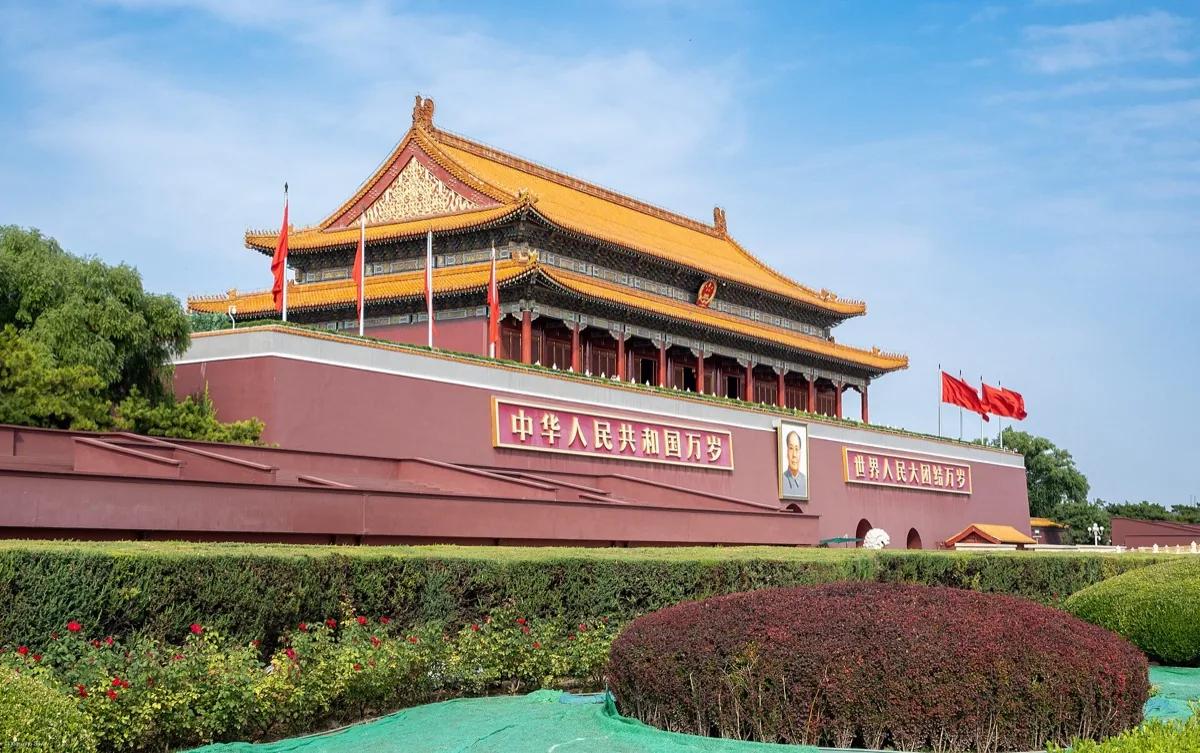
Tiananmen Square is a public plaza in central Beijing, one of the largest of its kind in the world. It covers about 44 hectares, roughly 880 meters from north to south and 500 meters from east to west. The square sits along the same north-south axis as the old imperial palace, and since 1949 it has served as the center of the Chinese state's public ceremonies. It is best known outside China for the 1989 pro-democracy protests, when students and workers held the square for seven weeks before the military cleared it with tanks and live ammunition, killing hundreds or possibly thousands of people.
How Tiananmen Square became China's political center
The gate that gives the square its name, the Tiananmen, which translates to Gate of Heavenly Peace, was first built in 1417. Under the Ming and Qing dynasties, it served as the ceremonial entrance to the Forbidden City. In front of it stood a walled enclosure of government offices, not a place common people could enter. Emperors announced their decrees by lowering them from the gate in a golden container, a ritual described as the emperor's word descending from heaven.
In May 1919, about 3,000 students gathered in front of the gate to denounce the Treaty of Versailles decision to transfer Germany's territorial rights in Shandong province to Japan. That protest launched the May Fourth Movement, which influenced a generation of Chinese thinkers, among them the men who went on to found the Communist Party.
On October 1, 1949, Mao Zedong stood on the gate's balcony and proclaimed the People's Republic of China. Between 1958 and 1959, his government demolished the old walls and offices and expanded the ground into a large open plaza. New buildings rose around the plaza: the Great Hall of the People on its west side, the national museum on its east, and the Monument to the People's Heroes at its center. A mausoleum for Mao was completed in 1977. The square was built to hold 500,000 people for rallies, and it still serves as the setting for military parades on the anniversary of the republic.
In April 1976, mourners gathered in the square to lay wreaths for the recently deceased premier Zhou Enlai. The mourning became a mass protest against the Gang of Four. The government cleared the crowd by force.
The 1989 protests and crackdown
On April 15, 1989, Hu Yaobang died of a heart attack at 73. Hu had served as general secretary of the Communist Party and had pushed for political reform. The party forced him from his post in 1987 after blaming him for student protests. Students began gathering in Tiananmen Square to mourn him. Within days, the mourning turned into a broader movement. By late April, tens of thousands of students, joined by workers and ordinary Beijing residents, were occupying the square. They demanded an end to corruption and greater political freedom.
The occupation lasted seven weeks. On May 30, art students erected a ten-meter-tall statue called the Goddess of Democracy, built from foam and plaster over a metal frame. It faced Mao's portrait across the square. The government had declared martial law on May 20, and China's paramount leader, Deng Xiaoping, had decided to use force against the protesters. But the army did not clear the square for two more weeks.
After dark on June 3, troops advanced from the west with armored vehicles and live ammunition. The worst killing happened not in the square itself but on the approach roads, along Chang'an Avenue and the streets leading toward it, where soldiers fired on crowds trying to block their path. By morning the square had been cleared and the statue destroyed.
The following day, June 5, an unidentified man walked into the road and blocked a line of tanks heading down Chang'an Avenue. Photographers captured the scene from a nearby hotel. The image, known as Tank Man, became one of the most recognized photographs of the twentieth century. The man's identity has never been confirmed.
How many people died at Tiananmen Square?
No one knows for certain. The Chinese government's official figure is about 200 to 300, including soldiers. The Chinese Red Cross initially reported about 2,600 deaths but later denied the figure. Independent estimates generally range from several hundred to about 2,600. A British diplomatic cable declassified in 2017, written by the ambassador Sir Alan Donald, cited a source inside China's State Council and estimated at least 10,000, far higher than other accounts.
The wide range exists because the Chinese government has never allowed an independent investigation. Most of the dead were not students inside the square but residents and bystanders on the surrounding streets.
Why is Tiananmen Square censored in China?
The Chinese government treats the 1989 crackdown as a subject that cannot be discussed publicly. The date June 4 is not taught in schools, does not appear in textbooks, and is blocked from search engines and social media platforms inside China. Automated systems, including AI-powered filters, scan posts for any reference to the anniversary. Each year, citizens invent new codes and wordplay to refer to the date, and each year the censors add those terms to the blocklist.
The square itself is open to visitors, but under heavy surveillance. Every June, security around the square is tightened further. In Hong Kong, which held large public vigils for decades, police began banning commemorations in 2020, the year a national security law took effect. In 2024, a man sitting alone on a park bench near the old vigil site was warned by police that his phone flashlight could constitute sedition.
The government's position, stated rarely and briefly, is that the military action was necessary to restore order and protect economic reform.