
Triffin Dilemma
The Triffin dilemma is the problem Robert Triffin identified in 1960: supplying the world's reserve currency requires deficits that weaken it.
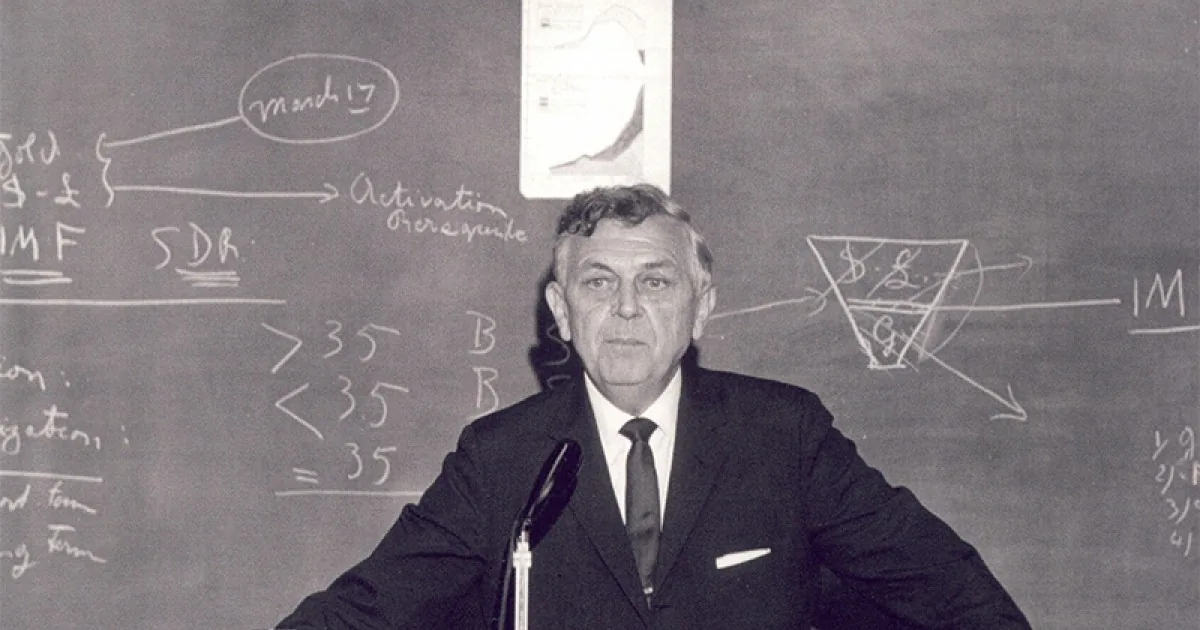
The Triffin dilemma is the contradiction facing any country whose currency serves as the world's reserve currency. To supply the world with enough of that currency for trade and reserves, the country must run persistent deficits, sending out more money than it takes in. But as those deficits grow, foreign holders grow less confident that the currency will hold its value. The country cannot do both at once: supply the world and keep the currency strong.
Robert Triffin, a Belgian-American economist, described this problem in Gold and the Dollar Crisis, published in 1960. He warned that the dollar-based system created at Bretton Woods near the end of World War II would eventually destroy itself. Eleven years later, it did.
How Robert Triffin identified the problem
Triffin was born in 1911 in Flobecq, a small town in southern Belgium. He studied law and economics at the Catholic University of Leuven, then won a scholarship to Harvard, where he worked under the economists Joseph Schumpeter and Wassily Leontief. After serving at the Federal Reserve and the International Monetary Fund, he helped set up the European Payments Union in 1950, the system that let Western European countries settle trade with each other while their economies rebuilt after the war. In 1951 he joined Yale as a professor of economics and spent most of his career there.
That work gave Triffin a close view of how international money actually moved. In Gold and the Dollar Crisis and in testimony to Congress, he laid out the problem. Under the Bretton Woods system, other countries pegged their currencies to the dollar, and the United States promised to convert dollars to gold at $35 an ounce. The world needed dollars for trade and reserves, and dollars reached foreign hands only when the United States ran balance-of-payments deficits. But every dollar held abroad was a claim on American gold. As the pile of foreign-held dollars grew, it would eventually pass the gold the United States had to back it. At that point, holders would lose confidence, and the system would break.
By 1960 the problem was already visible. Dollars held abroad had begun to exceed the American gold stock, and gold was trading above $35 in the London market.
How the dilemma brought down Bretton Woods
In November 1961, the United States and seven other countries, Britain, France, West Germany, Italy, Belgium, the Netherlands, and Switzerland, formed the London Gold Pool. They pooled about $270 million in gold and agreed to sell from it whenever the market price rose above $35 an ounce. The United States put up half.
The pool held for six years, but the underlying problem kept growing. France's president, Charles de Gaulle, made the strain public. In 1965 he announced that France would convert its dollar reserves into gold. By 1967 France had pulled out of the Gold Pool entirely. In March 1968, heavy gold buying overwhelmed the remaining members, and the pool collapsed.
The gap between dollars held abroad and American gold reserves kept widening. In August 1971, President Richard Nixon ended dollar convertibility into gold because the United States no longer had enough gold to meet foreign claims. The Bretton Woods system collapsed roughly on the timeline Triffin had described eleven years earlier.
The Triffin dilemma today
Ending gold convertibility removed the specific trigger Triffin warned about: a run on American gold. But it did not remove the underlying contradiction. The United States still supplies the world's main reserve currency and still runs the deficits needed to get dollars into foreign hands.
In the 1960s, France's finance minister Valéry Giscard d'Estaing called this arrangement an "exorbitant privilege." The United States can settle its debts in money it alone prints. Foreign demand for dollars also lets the American government borrow at lower interest rates than it otherwise could. But there is a cost: the arrangement pushes the United States toward spending beyond what it earns.
The dollar's share of global foreign exchange reserves has been falling. In 2000 it stood at about 71%. By the first quarter of 2026 it had dropped to about 57%, according to IMF data. China, once the largest foreign holder of US government debt, has been steadily reducing its Treasury holdings, from over a trillion dollars a decade ago to roughly $618 billion by mid-2026. How long the dollar can keep this role is an open question, but no other currency has come close to replacing it.
The problem Triffin described in 1960 has outlasted the system he was warning about. As long as one country's currency serves as the world's money, that country faces the same choice: supply the world, or protect the currency, but not both.