
The 8 maritime chokepoints in 2026: one closed, one half empty, one contested
World trade squeezes through eight narrow waters. In 2026, Hormuz is shut, the Red Sea is half empty, and the Panama Canal is a US-China battleground.
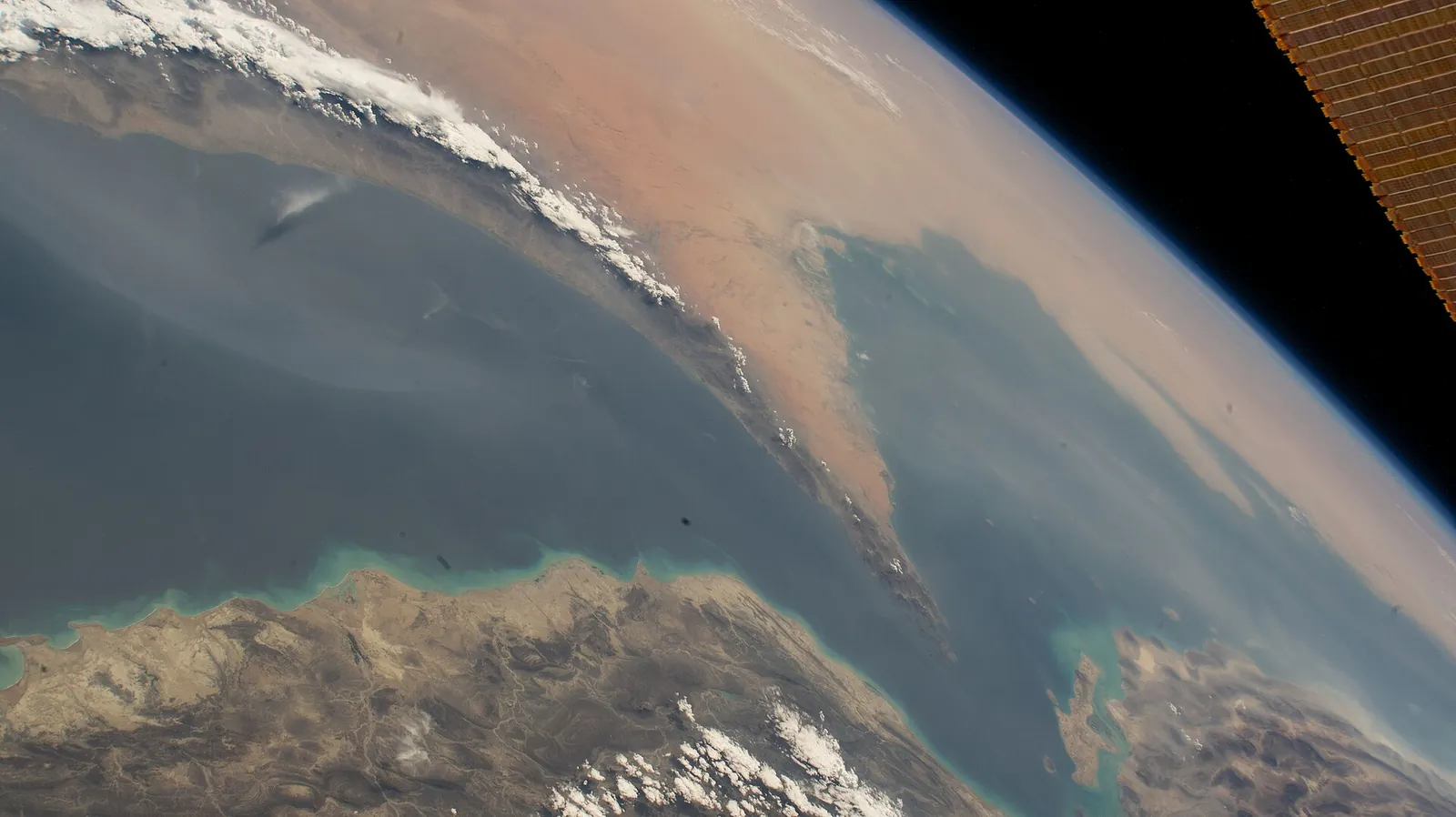
On March 4, 2026, Iran did the thing it had threatened for forty years and never done: it closed the Strait of Hormuz. Brent crude rose about 65 percent in a single month, its biggest monthly jump on record, and the International Energy Agency called it the largest disruption in the history of the global oil market. Five months later, the strait is still mostly shut. On a normal day, roughly 73 ships make the passage. On August 2, two did, under naval escort.
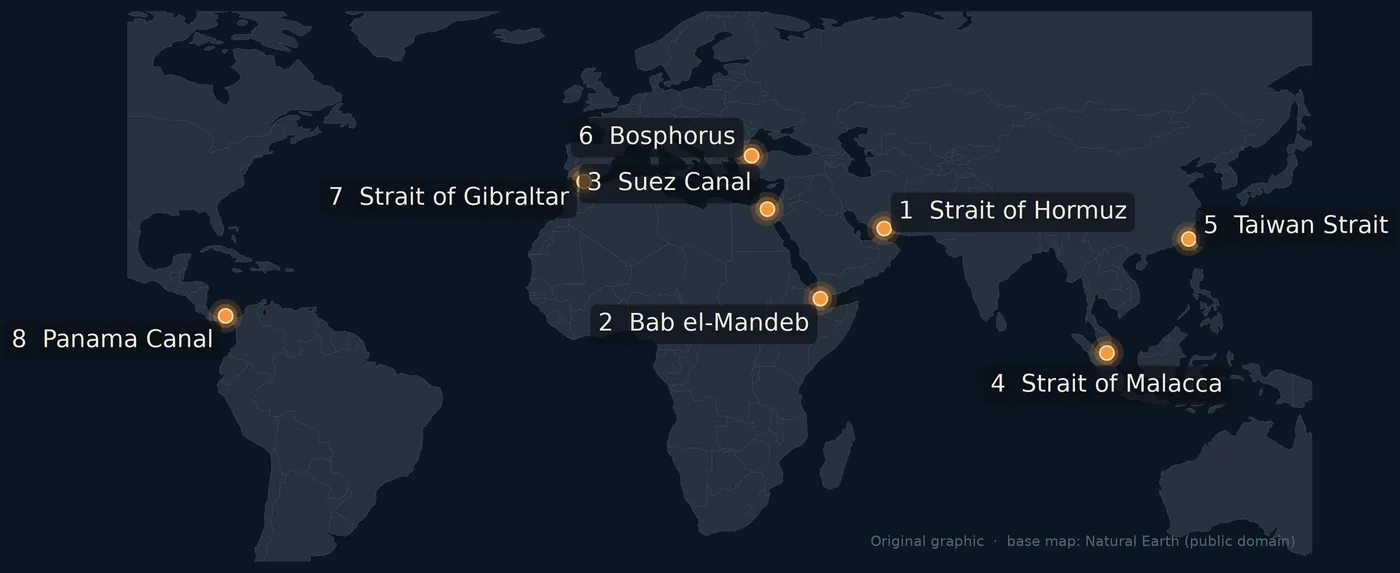
Hormuz is only the most famous of eight narrow waters that carry most of the world's seaborne trade, and 2026 has been the year they stopped being a map exercise and became the news. One of the eight is closed. Another has been running at a fraction of its traffic for over two years. A third is being fought over in courtrooms instead of at sea.
Eight straits carry the world's trade
On a live map of global shipping, the ocean is not a wide open space. It is a set of rivers of traffic, and the rivers all pass through the same few gaps. Two of them are oil's gates: Hormuz, 39 kilometers wide between Iran and Oman, and the Bab el-Mandeb, 26 kilometers wide between Yemen and Djibouti, the southern door of the Red Sea. Two are Asia's: the Strait of Malacca, which narrows to 2.8 kilometers near Singapore, and the Taiwan Strait. Two were dug by hand: the Suez Canal in 1869 and the Panama Canal in 1914. And two guard Europe: the Bosphorus, just 700 meters across at its tightest point in the middle of Istanbul, and the Strait of Gibraltar, 13 kilometers between Spain and Morocco.
Malacca alone carries roughly a quarter of everything traded by sea. Before the current crisis, the Red Sea corridor carried about another fifth. What flows through these gaps is not just oil: it is grain, fertilizer, cars, medicines, and nearly every chip and phone on Earth. The strangest fact in modern geopolitics is how small the hardware is. You could swim across several of these waterways in an afternoon.
Hormuz: the threat that finally happened
For decades, the standard analysis said Iran would never actually close Hormuz, because Iran's own oil sails through it. That analysis missed the point of asymmetric pain. About 20 million barrels a day, a fifth of the world's oil, passed through the strait in 2024, and far more of it belonged to Saudi Arabia, the Emirates, Iraq, and Kuwait than to sanctioned, export-strangled Iran. When the confrontation with the United States and Israel escalated this spring, Tehran concluded it had less to lose than everyone else, and shut the door.
What has followed is a lesson in how hard a chokepoint is to reopen. A US-Iran memorandum signed on June 17 lifted the blockade, and tanker traffic surged within days. By early July, after fresh attacks on commercial ships, the deal had collapsed and the strait was effectively closed again. Since then, shipping has moved in small escorted convoys, insurers have priced Gulf transits like a war zone, and Iran and Oman have spent the summer negotiating the coordinates of a safe corridor that does not yet exist. Oil has come down from its March peak of around $126, but the deeper damage is to an assumption: that the world's most important strait would always, in the end, stay open.
The Red Sea: what a militia with drones can do
The second gate never needed a state to close it. Starting in late 2023, Yemen's Houthis began firing cheap missiles and drones at commercial shipping in the Bab el-Mandeb, and the world's container lines simply left. Going around Africa instead of through Suez adds roughly 10 to 12 days and 8,500 kilometers to a voyage, and yet that detour became the default: the canal's share of Asia-Europe trade fell from about 80 percent to under 20, and it remains there in 2026. This July briefly brought the highest transit numbers since 2023, until the Houthis announced a ban on ships serving Saudi ports and confidence sagged again.
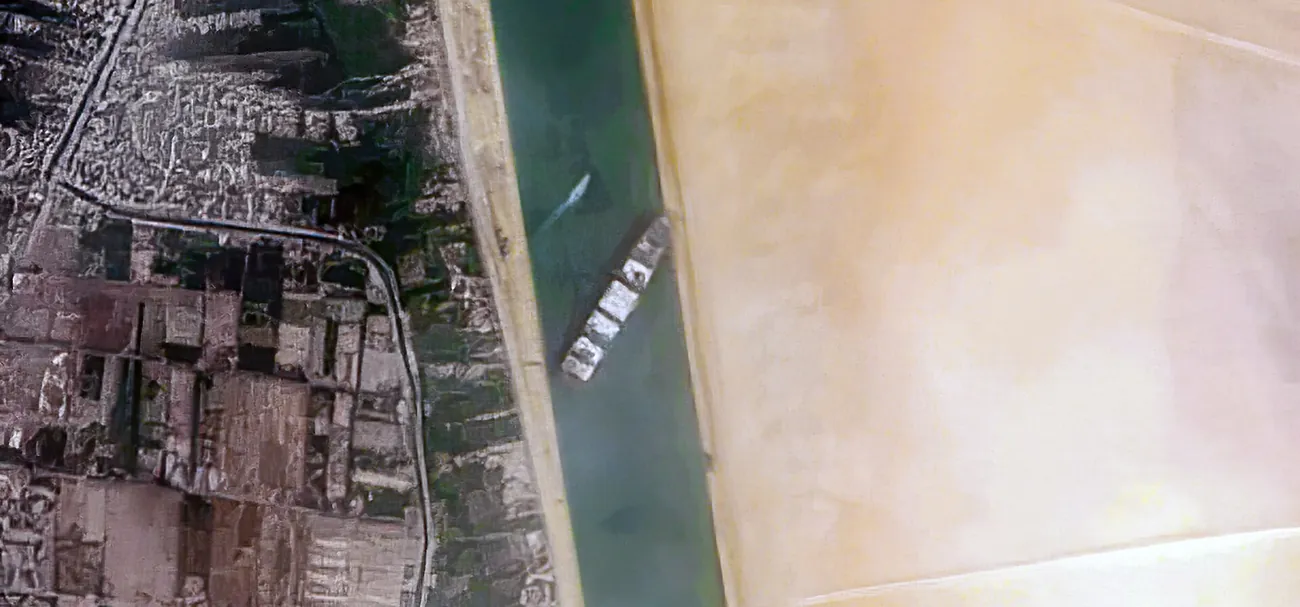
Egypt is the bystander paying the bill. Suez tolls earned it a record $10.25 billion in 2023 and just under $4 billion in 2024, a two-thirds collapse in one of its main sources of foreign currency. And all of this comes on top of the canal's own reminder of fragility: when the Ever Given wedged itself sideways in 2021, six days of blockage held up an estimated $9.6 billion of trade per day and left 369 ships waiting at anchor. A chokepoint does not distinguish between a missile and a mistake.
Panama: contested in court, not at sea
The Panama Canal moves about 5 percent of world trade but roughly 40 percent of US container traffic, which is why the 2023 drought that cut its capacity by more than a third showed up in East Coast grocery prices. In 2026 the threat is not water levels. After Washington accused China of controlling the canal's approaches, the Hong Kong conglomerate CK Hutchison agreed to sell its global ports business, including the terminals at either end of the canal, to a BlackRock-led consortium for $23 billion. Beijing stalled the deal. In January, Panama's Supreme Court declared the concessions unconstitutional; in February, the government annulled them and handed the terminals on an interim basis to Maersk and MSC.
China's response has been a chokepoint tactic of its own, aimed at ships rather than ports: in April alone its authorities detained 136 Panamanian-flagged vessels, more than six times the previous year's average. Theodore Roosevelt backed a revolt against Colombia in 1903 to bring this canal into existence. A century later the fight over it continues with lawyers, flag registries, and port contracts instead of gunboats, and it is no less serious for that.
The five still open are the bigger story
The quiet chokepoints are the ones with the most riding on them. Around 80 percent of China's imported oil comes through Malacca, a dependence Beijing has spent twenty years and a fortune failing to escape; the Malacca dilemma has its own article. The Taiwan Strait sees roughly half of the world's container fleet pass through each year, and Taiwan itself makes about 90 percent of the world's most advanced chips. A closure there would make the Hormuz shock look like a rehearsal: within weeks, car plants, data centers, and phone assembly lines worldwide would be waiting on components that no longer arrive.
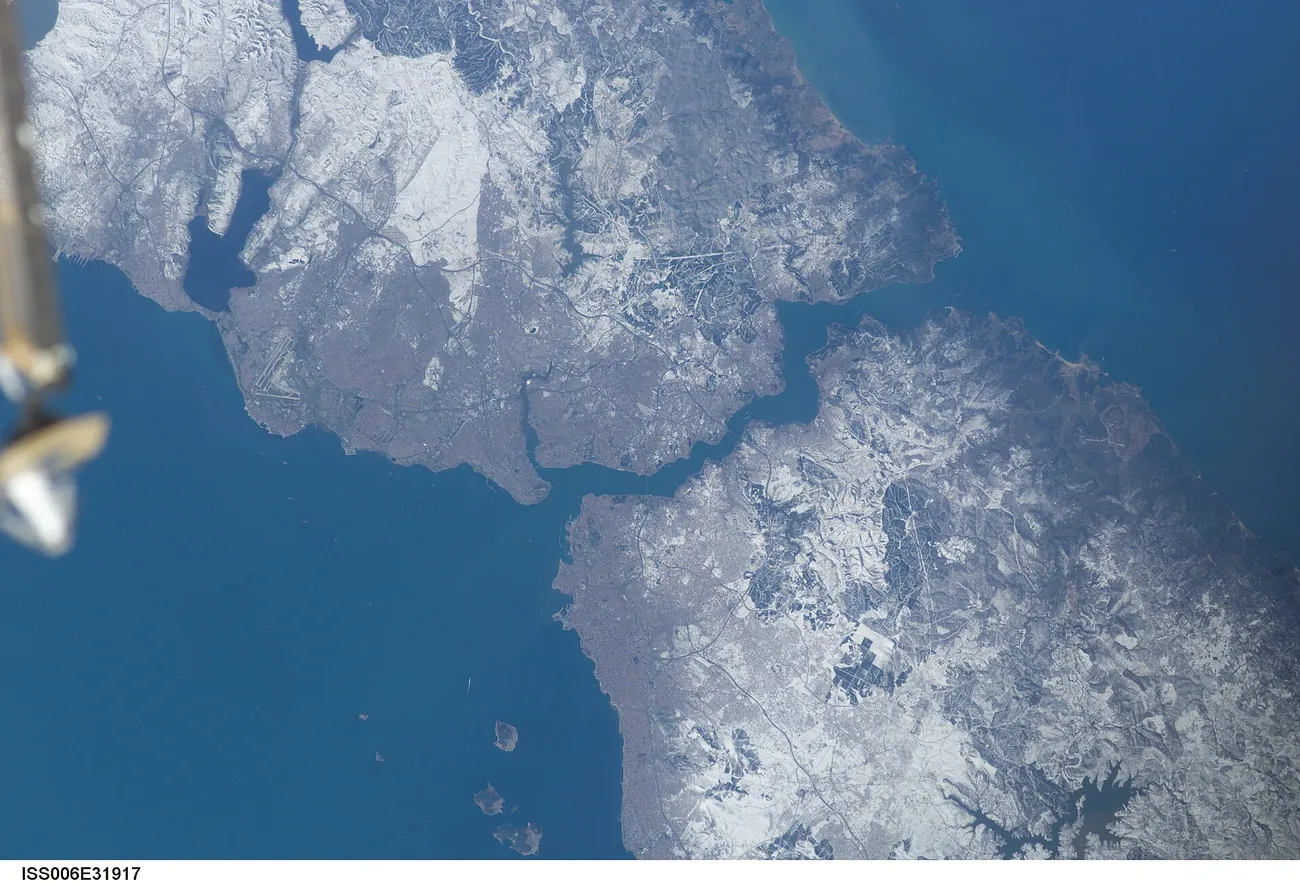
Europe's two gates hold steady, but not by accident. Turkey has controlled the Bosphorus since 1453, and under the 1936 Montreux Convention it may close the strait to warships in wartime, a power it used against Russia within days of the 2022 invasion of Ukraine. Gibraltar has been British since 1713 and remains the only way into the Mediterranean from the Atlantic. Open, in other words, is not the natural state of these waters. It is a policy, renewed daily, by whoever holds the shore.
What 2026 settled
Three old assumptions died this year. The first is that closing a chokepoint requires a great-power navy: the Houthis emptied a trade corridor with weapons costing less than a shipping container's cargo, and Iran shut the oil trade's front door despite a fraction of America's fleet. The second, unexpectedly, is that a closed strait means economic catastrophe: the crash so many predicted in March never came. The world absorbed the shock with buffers it happened to have. OPEC had idle production capacity. Shipping lines had a surplus of newly built vessels. Saudi Arabia and the UAE had pipelines that route around Hormuz. But absorbed is not avoided. The cost arrives as a quiet tax of longer voyages, war-zone insurance, and a lasting risk premium on oil, and a buffer, once spent, does not refill on its own. The third is that free passage through international straits is simply how the world works. Iran, the Houthis, Turkey, China, and the United States have each, in their own way, treated a chokepoint as leverage in the past four years.
The eight gaps on the map have not moved, and none of them has gotten wider. If you want to guess where the next global crisis begins, skip the summits and the election nights. Watch the straits.
Test what you learned
6 questions on this article. About two minutes, no signup.