
Zionism
Zionism is the movement to establish a Jewish national home in Palestine, founded by Theodor Herzl in the 1890s.
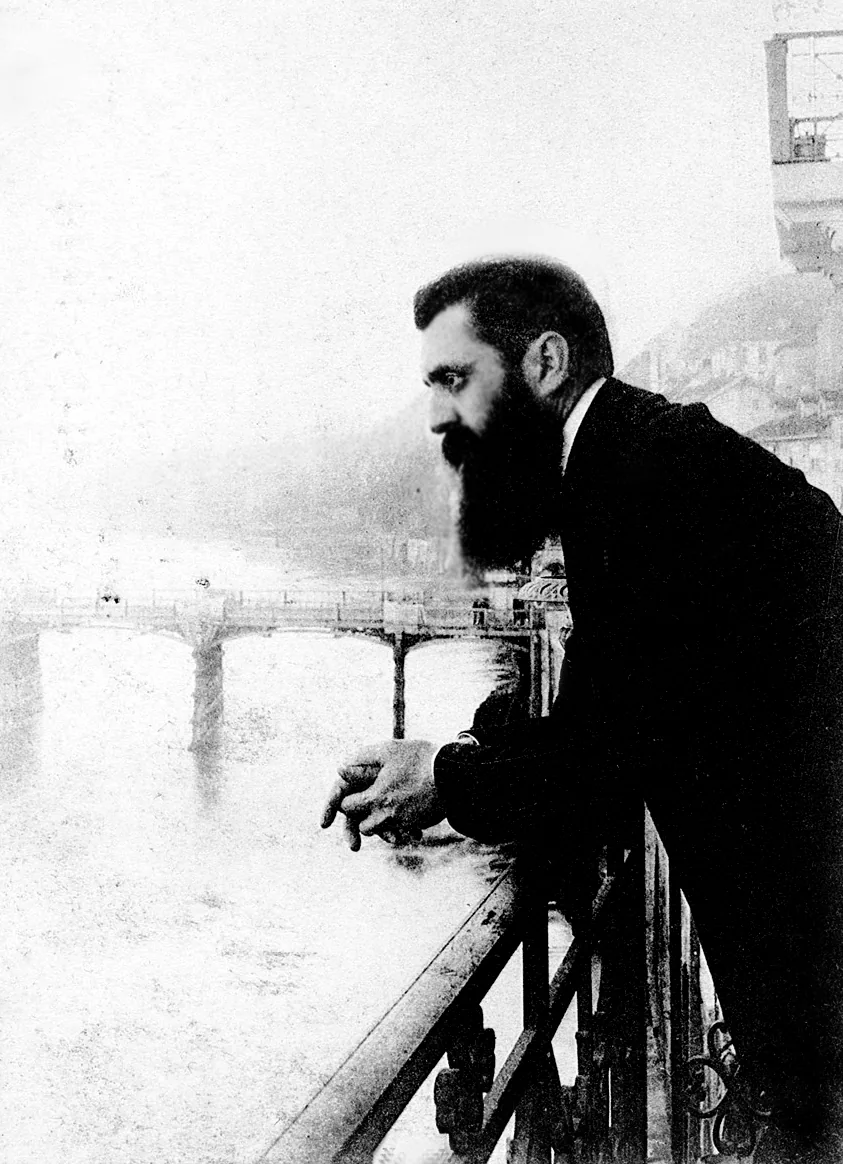
Zionism is the political movement that sought to create a Jewish state in the territory known to Jews as Eretz Israel and to Arabs as Palestine. The movement took shape in the 1890s. Its founders held that Jews were a people, not merely followers of a faith, and that centuries of persecution proved they could be secure only in a country of their own. Theodor Herzl, a journalist born in Budapest, organized the First Zionist Congress, which met in Basel, Switzerland, in 1897. Around 200 delegates attended. They established the World Zionist Organization and approved a program calling for a Jewish home in Palestine "secured under public law." Fifty-one years later, in 1948, Israel declared independence. Herzl had predicted the state would come within fifty years of the congress. He missed by less than a year.
How the Zionist movement began
Starting in 1881, waves of pogroms hit the Russian Empire, sending millions of Jews into exile. Most fled to the United States. A small number settled in Ottoman Palestine. The violence proved that Jews in eastern Europe were not safe, but it took events further west to show that fitting into European society would not protect them either.
In 1894, Alfred Dreyfus, a Jewish captain in the French army, was wrongly convicted of passing military secrets to Germany. The case played out before antisemitic crowds in Paris. Herzl was then a correspondent for a Vienna newspaper. He covered the affair closely and concluded that if hatred of Jews could thrive in France, the first European country to grant them full legal equality, then assimilation offered no real protection. In 1896 he published a pamphlet called Der Judenstaat (The Jewish State), making the case that Jews needed a country of their own. A year later he organized the Basel Congress.
Zionism was never one unified movement. Political Zionists followed Herzl and lobbied the great powers for a charter. Cultural Zionists, whose leading voice was the writer Ahad Ha'am, were less concerned with statehood than with renewing the Hebrew language and Jewish intellectual life. Labor Zionists were socialists who founded the collective farms called kibbutzim. Their leaders, above all David Ben-Gurion, would go on to run independent Israel. Religious Zionists understood the project through scripture. What held these factions together was aliyah, the Hebrew word for immigration to Palestine. The destination was close to non-negotiable. In 1903, when Britain offered land for a Jewish settlement in East Africa (a proposal called the Uganda Scheme), the congress came close to splitting before voting the plan down in 1905. Palestine, not any substitute, was the goal.
How Zionism led to the State of Israel
When the movement began, Palestine was under Ottoman rule, home to a Jewish population of only a few tens of thousands. Several waves of aliyah brought settlers who bought land, built farms, and founded new towns. The movement stayed small until World War One changed its position.
In 1917, the British government issued the Balfour Declaration, declaring support for "a national home for the Jewish people." The declaration named Palestine as the site. After the Ottoman Empire collapsed, Britain governed Palestine under a League of Nations mandate and allowed continued Jewish immigration. By the late 1940s the Jewish population had risen from roughly 60,000 to more than 600,000.
Tensions between settlers and the Arab majority produced repeated violence. The Holocaust, in which six million European Jews were murdered, gave the argument for a Jewish state new force around the world. In 1947 the United Nations voted to partition Palestine into a Jewish state and an Arab state. On May 14, 1948, Ben-Gurion proclaimed the State of Israel. Zionism had reached its central goal. The full story of Israel's founding is told in How did Israel become a country?.
What is the difference between Zionism and Judaism?
Judaism is a religion with a history of about 3,000 years. Zionism is a political movement that began in the 1890s. They overlap but are not the same thing.
Zionism drew on the Jewish religious connection to the land of Israel, but its founders were mostly secular. Herzl came from a secular family in Budapest, and many of the Labor Zionists who built the early state were atheists. At the same time, some of the strongest opponents of early Zionism were religious Jews. Ultra-Orthodox communities believed that a Jewish state should come only through divine action, not political organizing. Reform Jews in western Europe and America argued that Judaism was a religion, not a nationality, and that Jews belonged to the countries where they lived.
Today most Jews worldwide support Israel's right to exist, but many disagree with the policies of the Israeli government. A number of Jewish organizations define themselves as anti-Zionist or non-Zionist.
Why is Zionism controversial?
For its supporters, Zionism is a liberation movement. It gave a people nearly destroyed in the Holocaust a country and a refuge. Palestinians call those same events the Nakba, meaning "catastrophe." In the fighting that accompanied Israel's birth in 1948, roughly 700,000 Palestinian Arabs fled or were expelled from their homes.
Israelis and Palestinians are describing the same places and, often, the same events. For one side the word Zionism means refuge. For the other it means loss. The Palestine Liberation Organization, established in 1964, defined itself against Zionism. Many Israelis saw the PLO's founding charter as a rejection of the Jewish right to self-determination.
The disagreement has grown sharper since 1967, when Israel occupied the West Bank and Gaza Strip in the Six-Day War. The expansion of Israeli settlements in the occupied territories has deepened it. Critics of Israel distinguish between the original goal of a Jewish homeland and the ongoing occupation, while many Israelis see the two as inseparable from the country's security. Zionism is still one of the most divisive political terms in the world.