
Balfour Declaration
The Balfour Declaration was a 1917 British statement supporting a Jewish national home in Palestine, issued during World War I.
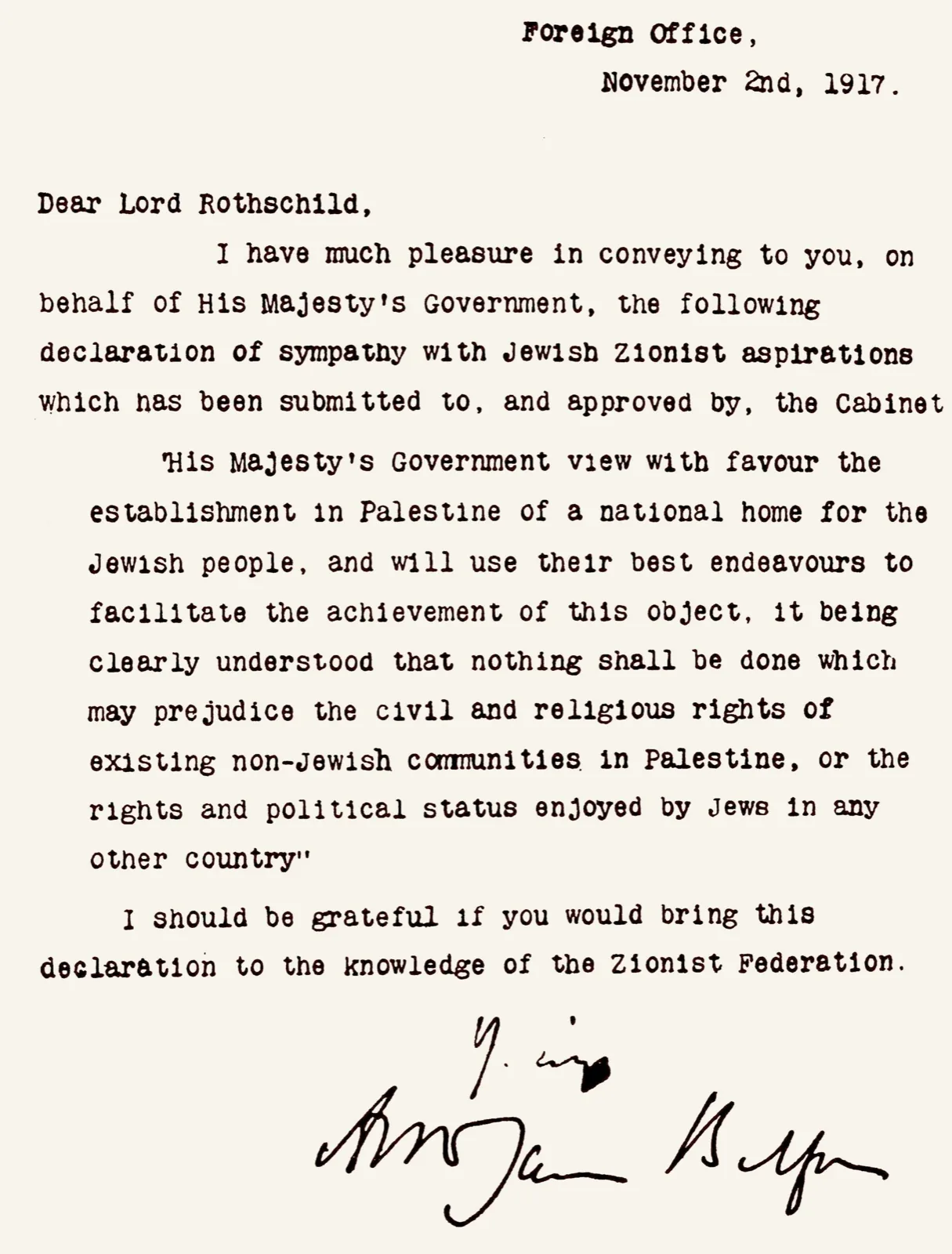
On November 2, 1917, Arthur Balfour, Britain's foreign secretary, sent a letter to Lord Rothschild for the English Zionist Federation. Its key passage was a single sentence, 67 words long. Its central promise was British support for "a national home for the Jewish people" in Palestine. But the same sentence added a condition: the "non-Jewish communities in Palestine" should keep their civil and religious rights. Those communities, Arab Muslims and Christians, made up about 90 percent of Palestine's population. The declaration did not name them. It described them only by what they were not.
How the Balfour Declaration came about
The person who did the most to bring the declaration into existence was Chaim Weizmann, a chemist and a leader of the Zionist movement. Weizmann was born in 1874 in what is now Belarus. He studied chemistry in Germany and Switzerland, settled in England in 1904, and took a position at the University of Manchester.
Weizmann had something unusual to offer the British government. Early in World War I, Britain ran short of acetone, a chemical needed to manufacture cordite, the propellant used in artillery shells. Weizmann had invented a fermentation process that could produce acetone from grain. The government adopted his method and used it in factories across Britain, Canada, and the United States. The work brought Weizmann into direct contact with David Lloyd George, then the minister of munitions, and with Balfour himself. Balfour had served as Britain's prime minister from 1902 to 1905 and had been interested in Zionism since at least 1906, when he first met Weizmann in Manchester.
The war gave Britain other reasons to make the declaration. By late 1917, the war was going badly. The British government hoped that a public commitment to Zionism would rally Jewish support in the United States, which had recently joined the war, and in Russia, which was sliding toward revolution. Britain also calculated that controlling Palestine would secure the Suez Canal corridor and the passage to India. Lloyd George and Balfour were both raised as devout Protestants and felt a personal connection to the idea of restoring a Jewish presence in the biblical lands. Strategic interest and religious conviction pointed in the same direction.
Three British promises for one land
The Balfour Declaration was the third of three British commitments concerning the same part of the collapsing Ottoman Empire. The three could not all be honored.
Between 1915 and 1916, Sir Henry McMahon, the British high commissioner in Egypt, exchanged a series of letters with Sharif Hussein of Mecca. In what became known as the McMahon-Hussein correspondence, McMahon promised British support for Arab independence in exchange for a revolt against the Ottomans. Many Arabs understood the promise to include Palestine.
In 1916, Britain and France secretly signed the Sykes-Picot Agreement, dividing the same region between themselves.
Then, in November 1917, Britain promised the Zionists a national home in Palestine.
When the secret Sykes-Picot Agreement became public in late 1917, many Arabs felt betrayed. Britain had asked them to fight the Ottomans with a promise of independence, then divided the land with France and promised part of it to someone else.
Did the Balfour Declaration promise a Jewish state?
The declaration said "a national home for the Jewish people," not a state. The phrase was deliberately vague. It did not define what a "national home" meant, how large it would be, or what kind of government it would have. The British War Cabinet debated the wording for months and chose language that committed Britain to something less than a full state.
The declaration also did not say what would happen if Jewish and Arab claims to the same land conflicted. It promised the Jewish people a national home and promised the Arab majority civil and religious rights, but not political rights. That gap was left unresolved.
The Balfour Declaration and the creation of Israel
The declaration gained legal force in 1922, when the League of Nations granted Britain the Mandate for Palestine. The mandate incorporated the declaration's text and made Britain responsible for carrying out its terms. In the decades that followed, Jewish immigration to Palestine rose, and Arab opposition to it grew.
The full story of how Israel became a country runs through those thirty years of rising tension. When Israel declared independence in 1948, Israelis saw the Balfour Declaration as the first time a major power had endorsed their right to a homeland. Palestinians called the same events the Nakba, meaning "the catastrophe," and saw the declaration as the moment an outside power gave away their land without consulting them.
More than a century later, both readings remain. The 67 words that Arthur Balfour put into a letter in 1917 are still the starting point of the argument over who has the stronger claim to the land.