Alliance · Union of neighbors
GCC
Gulf Cooperation Council
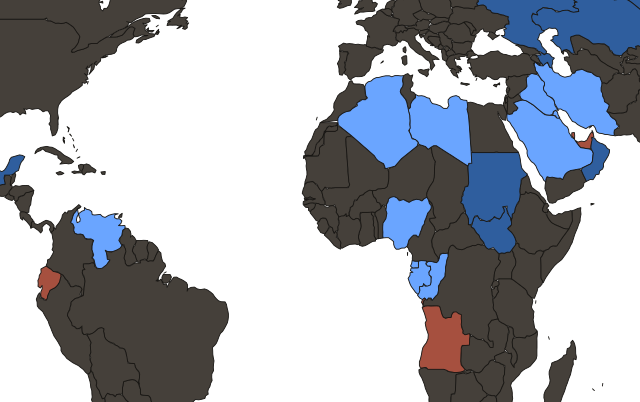
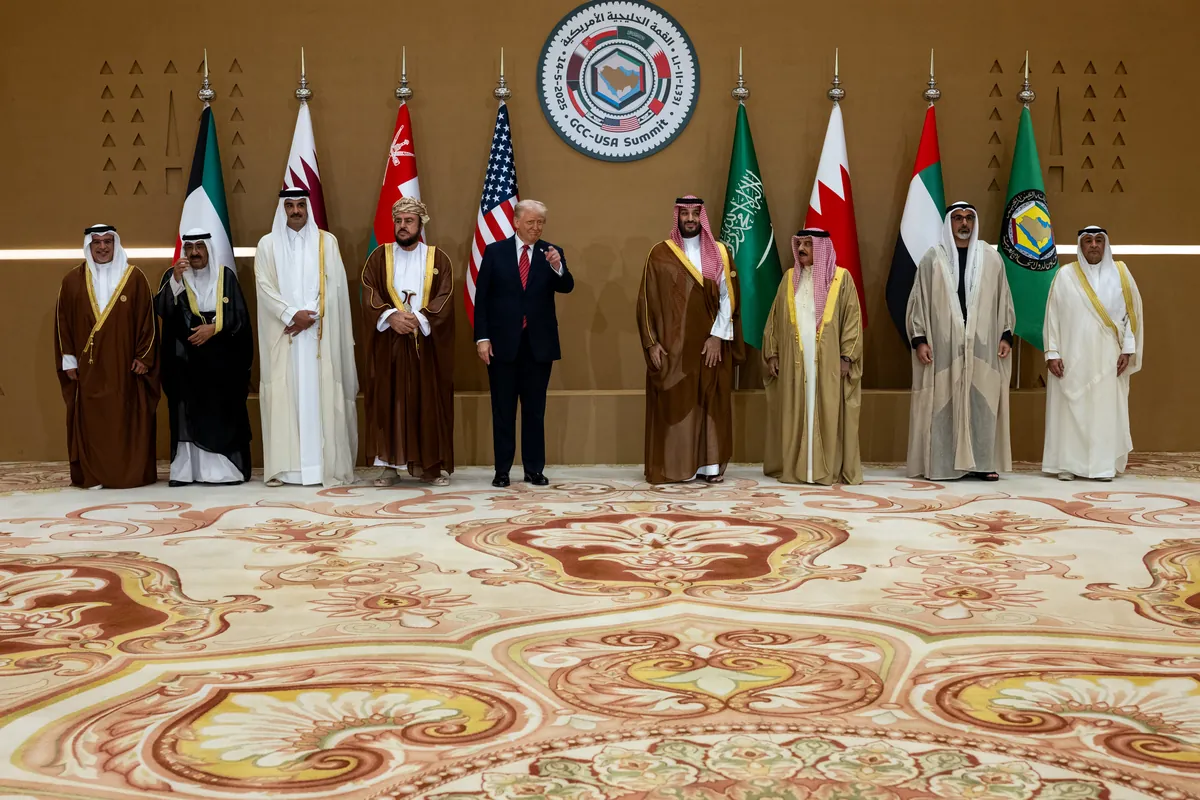
The Gulf Cooperation Council is a union of six Arab monarchies on the Gulf: Saudi Arabia, the United Arab Emirates, Qatar, Kuwait, Bahrain and Oman. It was founded in 1981 and has its headquarters in Riyadh. Their citizens may live, work and own property in any of the six. Together the six have 61 million people, and they produced 22% of the world's crude oil in 2025.
- Members
- 6
- All founders, 1981
- Headquarters
- Riyadh
- Saudi Arabia
- People
- 61 million
- 0.7% of the world, 2025
- Crude oil
- 22%
- Of the world's output, 2025
- Secretary-General
 Jasem AlBudaiwi
- Second term from 2026
Which countries are in the GCC?
Six countries are members: Saudi Arabia, the United Arab Emirates, Qatar, Kuwait, Bahrain and Oman. Their rulers signed the GCC's charter in Abu Dhabi on May 25, 1981. Its official name is the "Cooperation Council for the Arab States of the Gulf". In May 1976 Sheikh Jaber al-Ahmad, then Kuwait's crown prince and prime minister, first proposed Gulf unity. The GCC's first Secretary-General said the rulers were worried by Iran's 1979 revolution and by the war Iraq started against Iran in September 1980.
Yemen has wanted to join since 1996. Since 2001 it has taken part in four GCC bodies, but the members have never admitted it. In 2011 the GCC welcomed a request from Jordan to join and invited Morocco. Neither joined. Instead, four members gave each of them $5 billion over five years.
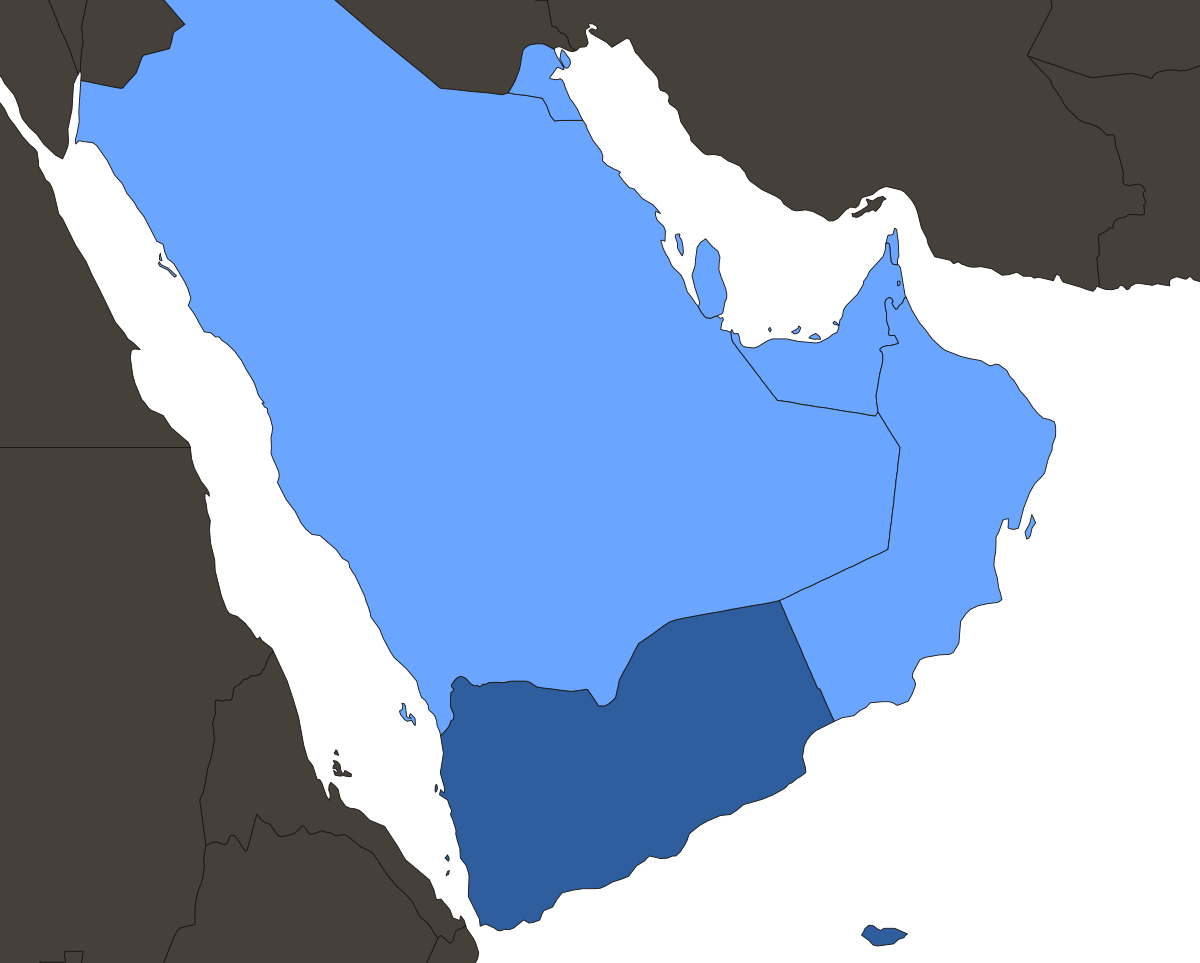
- Member
- In some GCC bodies
- Not a member
All 6 members
 Bahrain
- Kuwait
 Oman
Oman Qatar
Qatar Saudi Arabia
 United Arab Emirates
What does the GCC do?
The six rulers meet once a year as the Supreme Council. It decides important matters unanimously, and its presidency rotates in alphabetical order. The foreign ministers meet every three months. The secretariat is in Riyadh. Its Secretary-General, Jasem AlBudaiwi of Kuwait, began a second three-year term in February 2026.
At the 46th summit, in Bahrain on December 3, 2025, the leaders created a Gulf civil aviation authority based in the UAE. They also approved an agreement to connect the members' railways. Italy's prime minister, Giorgia Meloni, attended as a guest. Saudi Arabia hosts the next summit. Trade between the six was about $146 billion in 2024, less than a tenth of their total trade.
-
Common marketSince 2008
Citizens of any member have the same rights as locals in the others: to live and work there, own property, start companies and use schools and hospitals.
-
Customs union5% tariff
Since 2003, goods from outside pay one 5% duty where they enter. It was complete in 2015. Gulf-made goods have crossed borders duty-free since 1983.
-
Single currencyNever launched
Planned for 2010. Oman pulled out in 2006, and the UAE in 2009 after Riyadh was chosen for the future central bank.
-
Gulf tourist visaNot yet
One visa for all six, approved by interior ministers in November 2023. In September 2026 the Secretary-General said it would launch soon, without a date.
-
Gulf railwayDue 2030
About 2,117 km from Kuwait to Muscat, due by December 2030. In 2025 Saudi Arabia and Qatar agreed a separate high-speed line from Riyadh to Doha.
Why did Saudi Arabia, the UAE and Bahrain cut off Qatar?
Saudi Arabia, the UAE and Bahrain objected to Qatar's ties with Iran and the Muslim Brotherhood, and to its TV channel Al Jazeera. On June 5, 2017, the three and Egypt cut diplomatic ties with Qatar and closed their airspace and sea routes to it. Saudi Arabia also closed Qatar's only land border. Qatar had imported about 40% of its food from or through Saudi Arabia. On June 22 the four sent 13 demands through Kuwait, among them closing Al Jazeera and a Turkish military base.
Turkey sent troops and Iran flew in food. To make its own milk, Qatar began flying in thousands of dairy cows for a new farm. The boycott ended on January 5, 2021, when the six members and Egypt signed the AlUla Declaration in Maraya, a Saudi concert hall that holds the record as the world's largest mirrored building. Qatar never left the GCC.
Qatar and its neighbors
- 1981Qatar is one of the six founders
- 2017Saudi Arabia, the UAE, Bahrain and Egypt cut ties and close the border
- 2017The four demand, among other things, that Qatar close Al Jazeera
- 2017Turkey sends troops, Iran flies in food, cows arrive by air
- 2021The AlUla Declaration ends the boycott
- 2025Iran fires missiles at Al Udeid air base; Israel strikes Doha
- 2026Iranian missiles hit the Ras Laffan gas complex
Does the GCC defend its members?
The six promised in 2000 to defend each other, but they have seldom acted as one. A Joint Defense Agreement signed in Manama in December 2000 treats an attack on one member as an attack on all, but it has no automatic trigger for military action. The joint Peninsula Shield Force, set up in 1984, was not ready to defend Kuwait when Iraq invaded in 1990. In March 2011 it sent more than 1,000 Saudi troops and about 500 UAE police into Bahrain during protests there.
Since February 28, 2026, Iranian missiles and drones have hit all six members. On March 1 the GCC's foreign ministers declared that an attack on any member is an attack on all, but the GCC has run no joint military operation. On April 27 Anwar Gargash, an adviser to the UAE's president, said the GCC's political and military stance had been the weakest in its history.
An attack on any member State means an attack against all of them, and any danger threatening any of them means a threat to all of them.
- June 2025Iran fires 14 missiles at Al Udeid air base in Qatar; one hits, no one is hurt
- Sept 2025Israel strikes Hamas leaders in Doha, killing six people, among them a Qatari officer
- Feb 2026Iranian missiles and drones start hitting all six members
- Mar 2026Missiles hit Ras Laffan, knocking out 17% of Qatar's gas export capacity for years
- Sept 2026Drones hit Saudi Arabia's East-West oil pipeline; the Houthis fire missiles at Saudi cities
How rich are the Gulf states?
Oil and gas made them rich. In 2025 the six produced 18.4 million barrels of crude oil a day, 22% of the world's output. Saudi Arabia alone produced 9.6 million, third after the United States and Russia. Qatar produced 170 billion cubic meters of natural gas in 2024. GDP per person in 2025 was $69,680 in Qatar and $50,232 in the UAE, but $19,996 in Oman (IMF). The governments have put their oil money into some of the world's largest state investment funds.
Much of the work is done by foreigners. Non-citizens make up 69.6% of Kuwait's residents (2025), 53.5% of Bahrain's (2024), 44.4% of Saudi Arabia's (2024) and 43.6% of Oman's (2026). The UAE and Qatar publish no such figure. Researchers estimate that close to 9 in 10 of their residents were foreigners in 2022.
The largest state investment fund of each member
-
Abu Dhabi Investment Authority$1.13 trillion
The largest Gulf fund, 9th among state investors worldwide. Abu Dhabi also owns Mubadala, with $385 billion.
-
Kuwait Investment Authority$1.00 trillion
It began as an office in London in 1953, eight years before Kuwait's independence. It is often called the world's oldest sovereign fund.
-
Public Investment Fund$906 billion
Saudi Arabia's main fund. Its own report for 2025 gives assets of more than $900 billion.
-
Qatar Investment Authority$580 billion
Qatar's fund, 20th among state investors worldwide.
-
Oman Investment Authority$60 billion
Oman has the lowest GDP per person in the GCC.
-
Mumtalakat$18 billion
Bahrain produces the least oil of the six, about 176,000 barrels a day in 2025.
Is it in the GCC?
Short answers for the countries people ask about most.

Is Yemen in the GCC?
NoSince 2001 it has taken part in four GCC bodies, among them the health ministers' council and the Gulf Cup football tournament. It has never been a member.

Is Iraq in the GCC?
NoIt has never been considered. In 2003 the GCC's Secretary-General denied reports that Iraq had asked to join.

Is Iran in the GCC?
NoThe GCC was founded partly in reaction to Iran's 1979 revolution. In 2026 Iranian missiles and drones struck all six members.

Is Jordan in the GCC?
NoIt asked to join in 2011. The GCC welcomed the request, but it turned into a five-year partnership with aid.

Is Morocco in the GCC?
NoThe GCC invited it in 2011, although Morocco had not applied. It got a five-year partnership with aid instead.

Is Egypt in the GCC?
NoIt joined Saudi Arabia, the UAE and Bahrain in the boycott of Qatar from 2017 and signed the 2021 declaration that ended it.
Is Qatar in the GCC?
YesA founder. Three fellow members cut it off from 2017 to 2021, but it never left.
Is Oman in the GCC?
YesA founder. In 2013 it said it would stay out if the others formed a closer union. Its ruling family is Ibadi, neither Sunni nor Shia.
Is the UAE in the GCC?
YesA founder. It left OPEC in May 2026, not the GCC.
Is Kuwait in the GCC?
YesA founder, and the first to propose Gulf unity, in 1976. The GCC's Secretary-General is Kuwaiti.