
GDP vs PPP: is China's economy already bigger than America's?
China is both the world's largest economy and 11 trillion dollars behind the United States. What GDP and PPP measure, and which number to trust.
The International Monetary Fund publishes two answers to the question of which country has the world's largest economy. On one measure, the United States leads China by more than 11 trillion dollars a year, a gap bigger than the entire economy of Japan. On the other, China passed the United States back in 2016 and is now about a third larger. The two numbers describe the same countries in the same year, and both are correct.
The difference between them comes down to one technical choice: how to turn an economy that runs on yuan into dollars. That choice is what separates GDP from PPP, and it decides most arguments about whether America is being overtaken.
What GDP actually measures
GDP, gross domestic product, adds up the value of everything a country produced in a year: every car, every haircut, every hospital visit, every apartment built.
The complication starts when you compare countries. China counts its production in yuan, America counts in dollars, and to put them side by side you have to convert one currency into the other. The obvious way is to use the exchange rate, the same rate you would get at an airport currency desk. Do that and you get nominal GDP: America at about 32 trillion dollars in 2026, China at about 21 trillion. On this scoreboard, America is comfortably first.
The number has a famous flaw, and the man who built it saw the flaw first. Simon Kuznets, the economist who designed America's national accounts for the US Senate in 1934, warned in the very report that introduced them that "the welfare of a nation can scarcely be inferred from a measurement of national income." GDP counts activity. It does not tell you what that activity is worth to the people living inside it, and, as it turns out, converting it at the exchange rate does not even tell you how much stuff a country really produces.
Why a dollar buys more in China
The airport exchange rate has a blind spot: most of what people spend money on can never cross a border. A haircut, a bus ride, a restaurant meal, the rent on an apartment: all of it costs whatever local wages make it cost. In Shenzhen, a street barber will cut your hair for a few yuan, well under a dollar. In Chicago, the same twenty minutes of work costs thirty dollars or more. It is the same haircut. Nobody can ship it.

The Big Mac is the cleanest illustration, which is why The Economist has used it since 1986. It is the same burger, built to the same recipe, everywhere on earth. In America it costs about 6.20 dollars. In China it costs just under 4. The beef and the bun are not cheaper in Beijing. The labor and the rent are.
Exchange rates ignore all of this, because they are set by the things that do cross borders: oil, chips, cars, and flows of money. So when you convert China's output into dollars at the exchange rate, you undercount everything the country produces and consumes at its own low prices, which is most of the economy.
PPP, purchasing power parity, is the correction. It takes the same output and re-prices it as if the same thing cost the same amount in every country. This is not done with a formula but with legwork: roughly every six years, the World Bank sends survey teams into about 175 countries to record what an identical basket of goods and services actually costs, from rice to rent to a visit to the dentist. Priced that way, China's economy in 2026 comes out at about 44 trillion dollars, roughly a third larger than America's 32 trillion.
That single adjustment is the entire disagreement. Measured at exchange rates, China is 11 trillion dollars behind. Measured at what the money actually buys, China has been ahead for a decade.
Which number is right?
Both are, because they answer different questions.
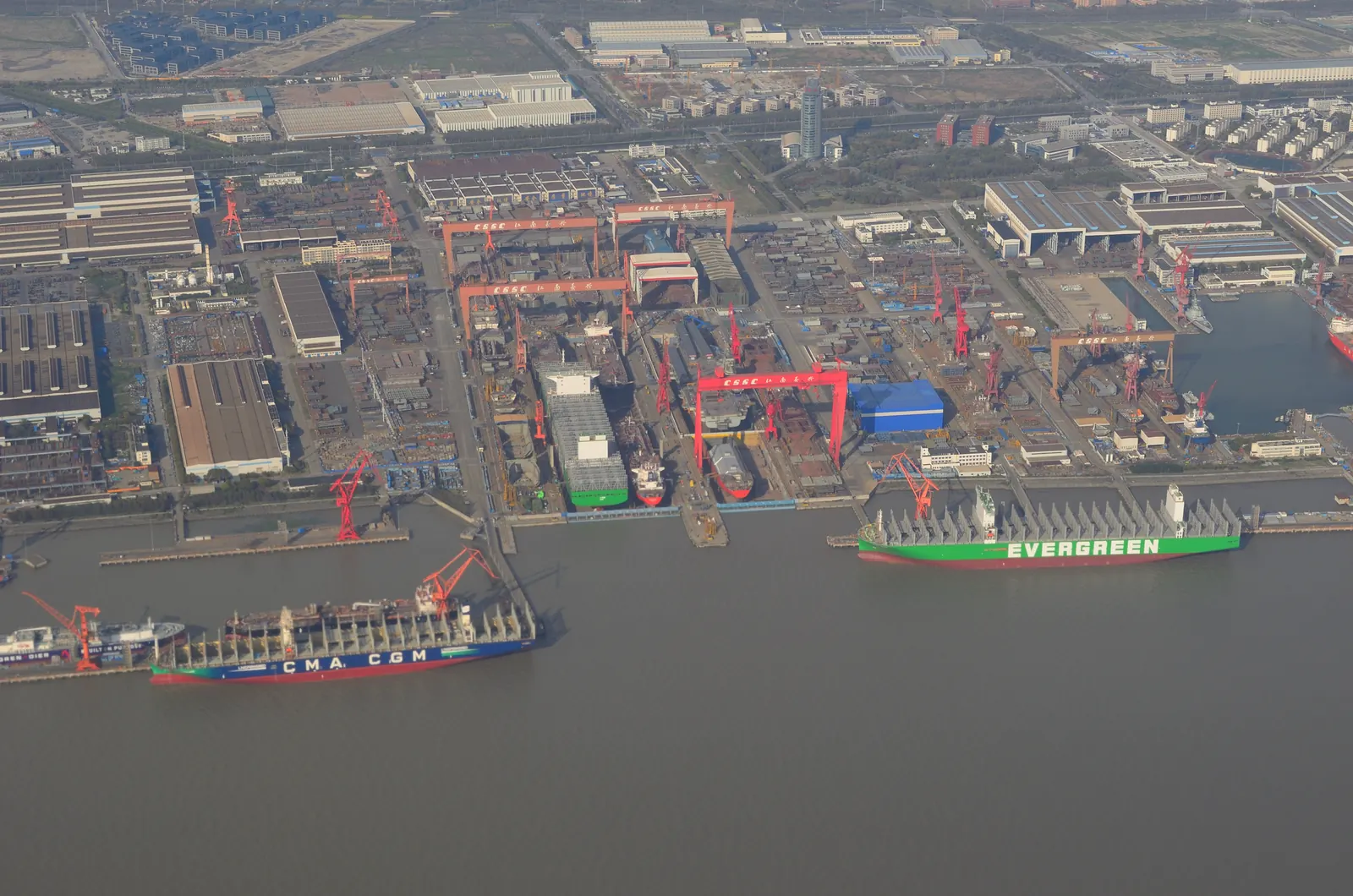
PPP tells you what a country can build with its own money and its own people. A shipyard in Shanghai pays its welders in yuan, buys its steel in yuan, and rents its land in yuan. The dollar exchange rate never touches any of it. This is why PPP is the measure defense analysts care about. China's announced military budget for 2025 was about 245 billion dollars, a quarter of America's 954 billion. But a soldier's pay and a ton of steel cost a fraction of the American price inside China, and researchers who adjust for that put China's real military purchasing power near 474 billion dollars. The real gap is closer to 2:1 than 4:1. You can see the result in the water: China's navy has around 395 battle-force ships to America's 295, and a leaked US Navy briefing put China's total shipbuilding capacity at over 23 million tons a year against under 100,000 tons for the United States.
Nominal GDP tells you what a country can do beyond its own borders. The moment China has to buy something from abroad, its cheap haircuts stop helping. Oil is priced in dollars. So are the advanced chip-making machines China still cannot build, the jets its airlines fly, and the debt its companies owe abroad. Sanctions, frozen reserves, and blocked payments all run through the dollar-based financial system too. On that scoreboard, the 11-trillion-dollar gap is the number that counts, and it is not closing quickly.
Russia, India, and Switzerland: the same trick elsewhere
The same two measures explain some long-running puzzles about other countries.
Start with Russia. At exchange rates, its economy is about 2.5 trillion dollars, roughly the size of Italy's, which is why Senator John McCain could mock it in 2014 as "a gas station masquerading as a country." Yet this Italy-sized economy has fought the largest war in Europe since 1945 for more than four years and out-produced the West in artillery shells. PPP explains how. Adjusted for what money buys inside Russia, its economy is about 7.5 trillion dollars, the fourth largest in the world. Soldiers, shells, and steel are paid for in rubles, and rubles go a long way at home. Everyone who predicted sanctions would collapse the Russian war effort was reading the wrong scoreboard.
India is the same story without the war. At exchange rates it is a 4-trillion-dollar economy. At PPP it is nearly 19 trillion, the third largest on earth, more than four times its market-rate size.
The correction also cuts both ways. Switzerland is so expensive that PPP shrinks it: an economy of about 1.1 trillion dollars at exchange rates comes out closer to 800 billion once you account for what a franc actually buys in Zurich. PPP was not designed to flatter poor countries; it simply prices the same goods the same way everywhere.
How to read the next headline
None of this means Chinese people are rich. China's output is spread across more than four times as many people as America's. The average American produces about six times more than the average Chinese citizen at exchange rates, and about three times more even after the PPP correction. Britain was rich when it led the world economy in the nineteenth century, and America was rich when it took over. China is the first country to hold the top spot while most of its citizens are still middle income, and that single fact drives a great deal of what Beijing does.
Every claim about China's economy leans on one of these two numbers, and the choice is rarely innocent. A Chinese official projecting confidence, or a Western hawk warning about a rising rival, will reach for PPP, where China has been first for a decade. A skeptic arguing the threat is overblown, or an American official reassuring allies, will reach for nominal GDP, where America is 11 trillion dollars ahead. Both are quoting real statistics, and both count on nobody asking which question the statistic answers.
If the claim concerns what a country makes or does at home, soldiers, ships, steel, engineers, then PPP is the right measure, and China is the larger power. If it concerns what a country can buy, borrow, or block on world markets, then nominal GDP is the right measure, and America still leads. Most arguments about which economy is number one are really arguments about which of those two questions is being asked.
Test what you learned
6 questions on this article. About two minutes, no signup.