
Why is the Strait of Hormuz so hard to reopen?
Five months after Iran closed the strait, the strongest navy on earth still cannot get the oil moving. The reasons are mines, escort math, and insurance.
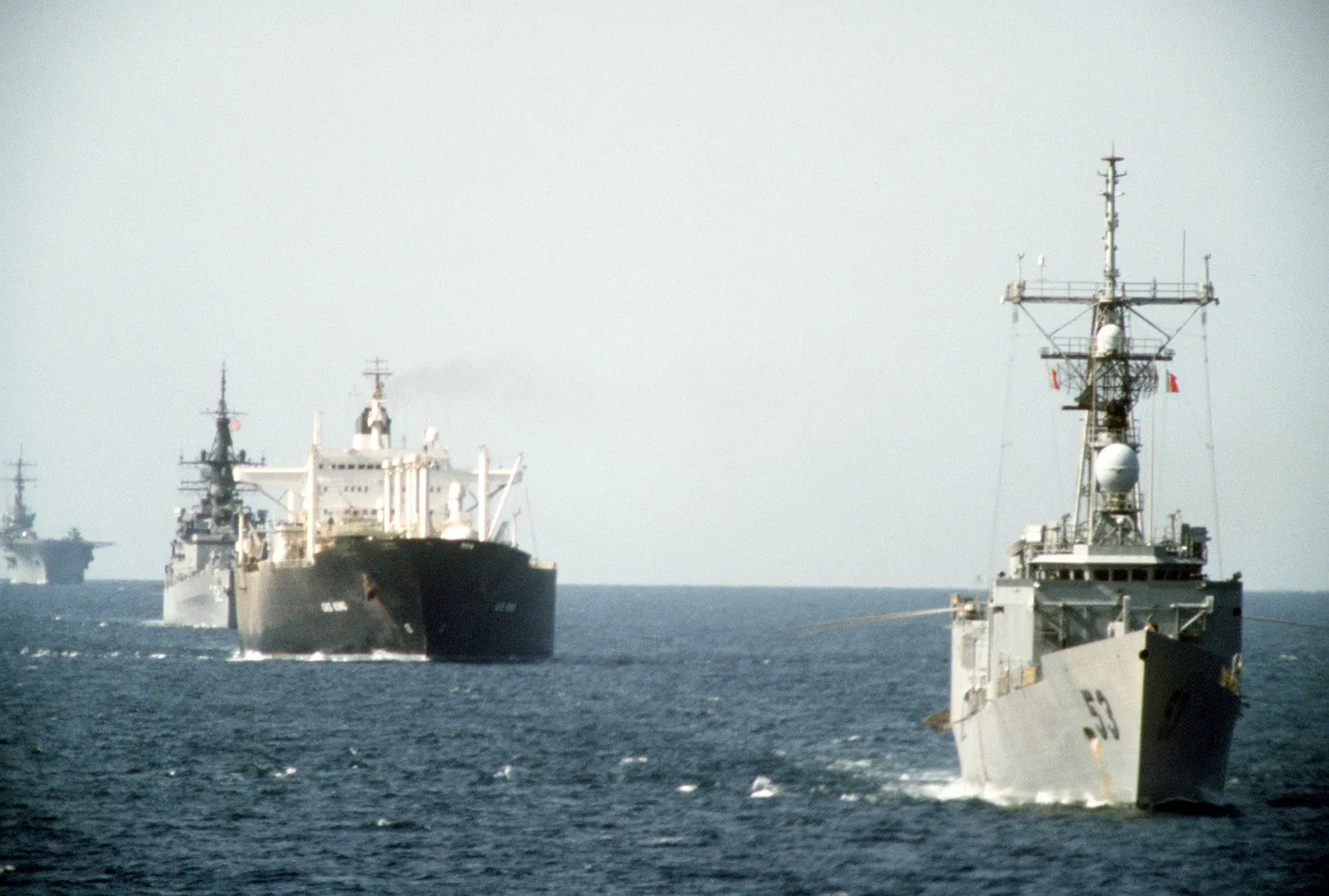
On January 9, 2026, a heavy-lift transport ship in Bahrain took on an unusual cargo: the last four American minesweepers in the Persian Gulf, headed home to be scrapped. The ships were old and slow, with wooden hulls built so they could work inside a minefield without setting it off, and the US Navy had decided to replace them with drones that hunt mines from a safe distance. Seven weeks later, Iran began laying mines in the Strait of Hormuz.
Iran declared the strait closed on March 4, in the war that began when American and Israeli strikes killed its supreme leader, Ali Khamenei. Hormuz is the most important of the world's eight maritime chokepoints: a fifth of the world's oil leaves through it, along with a fifth of its liquefied natural gas. Five months later, it is still mostly shut. On an ordinary day before the war, more than 70 ships made the passage. On August 2, two did, under naval escort. The most powerful navy on earth has been on the scene the entire time, and it has not been able to change that. The reasons have less to do with firepower than with mines, insurance prices, and trust.
How Iran closed the strait without blocking it
Nothing physically blocks Hormuz. The strait is 21 nautical miles wide at its narrowest, about 39 kilometers, and far too deep to plug with sunken ships. Traffic runs in two lanes, each about two miles across, and every meter of those lanes lies inside Iranian or Omani territorial waters. There is no neutral corridor to retreat to.
Since March, Iran has instead made the passage too dangerous for ordinary shipping. Iranian speedboats and drones attacked tankers in the lanes. Small boats slipped out at night and dropped mines into the water. Iranian forces jammed GPS across the strait, so crews could no longer trust their own position. And patrol boats of the Revolutionary Guard used the emergency radio frequency, which every ship at sea monitors, to announce that no vessel would be allowed through.
The weapon that actually emptied the strait was the insurance market. Before the war, war-risk cover for a Gulf voyage cost about a quarter of one percent of a ship's value, roughly $250,000 for a $100 million tanker. By July, underwriters were quoting 7.5 to 10 percent, which is three to ten million dollars for a single passage. Within four days of the closure, the major shipping lines had stopped coming, and traffic through the strait fell by more than 90 percent. Yemen's Houthis had already shown the same mechanism at work in the Red Sea: a shipping lane closes when captains and insurers stop believing in it, whether the thing that killed their confidence is a state navy or a militia with drones. Iran spent perhaps $50 million on the mines, small boats, and missiles that did all of this.
Why the mines are so hard to clear
A modern bottom mine does not float on a chain waiting to be cut loose. It sits on the seabed, where sonar can mistake it for a rock, and it detonates only when it detects the sound and magnetic field of a real ship passing overhead. That design defeats most of the tricks minesweepers traditionally used to trigger mines from a safe distance, so each one has to be found individually, by sonar, divers, or underwater robots, in a strait full of currents and old wrecks. By early April the US Navy had destroyed 16 Iranian minelaying boats and cleared more than a hundred mines, and still could not say how many were left, because nobody outside Iran knows how many went in. The Pentagon's own estimate for clearing the strait properly is six months, and that estimate assumes Iranian crews stop laying new mines at night, which they have not.
The US Navy learned in 1988 what a single missed mine costs. In April of that year, during the Iran-Iraq War, the American frigate USS Samuel B. Roberts was returning from escort duty in the Gulf when it struck an Iranian mine. The blast tore a 15-foot hole in the hull, broke the ship's keel, and threw both engines off their mounts. The crew, under Commander Paul Rinn, fought fire and flooding for five hours and held the cracking ship together with steel cables. The mine that nearly sank a modern warship was built to a Russian design from 1908 and cost about $1,500; repairing the Roberts cost about $90 million. Four days later the US Navy retaliated by sinking or crippling half of Iran's operational fleet in a single day, and none of that removed a single mine from the water.
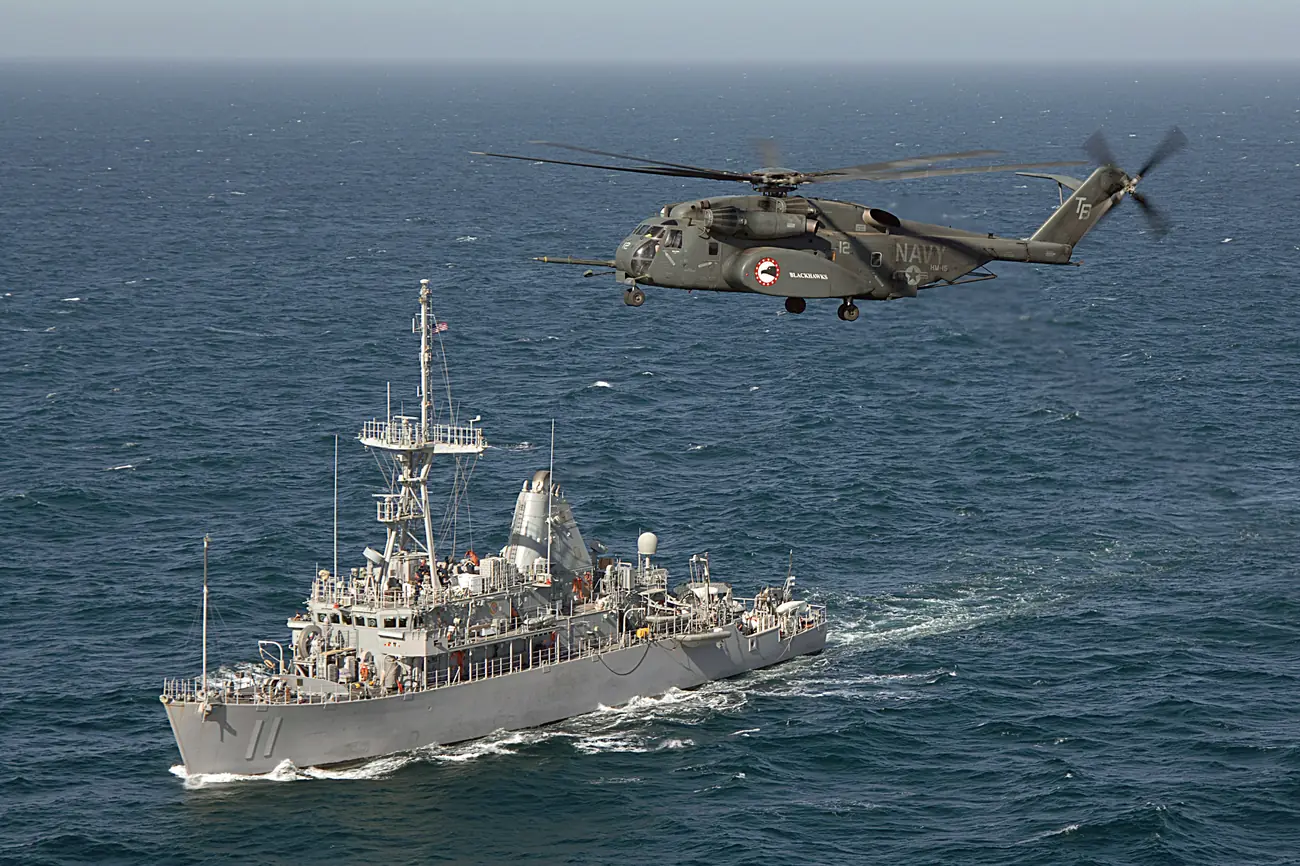
Set against that history, the scrapping of the minesweepers in January looks expensive. The four wooden-hulled Avenger-class ships based in Bahrain were built for exactly this job, and the drone system that replaced them had never been used in a war before March.
Why escort convoys are not enough
If the whole strait cannot be cleared, a narrow path through it can be, at least for a day. That is what a convoy is: minehunters check a single corridor just before the run, the tankers follow it in line, and warships around them guard against missiles and drones. American convoys have been crossing this way since May. A leaked US Navy assessment from late March put numbers on what that takes: escorting three or four merchant ships a day through Hormuz requires seven or eight destroyers. The Fifth Fleet has about fifteen. Moving even a tenth of the strait's normal traffic would occupy essentially every American warship in the region, indefinitely.
The United States has run this operation before, and the precedent shows where the ceiling is. In 1987 and 1988, Operation Earnest Will, the largest convoy operation since the Second World War, protected eleven reflagged Kuwaiti tankers. On the very first convoy, the supertanker Bridgeton struck an Iranian mine, and because no minesweepers had arrived yet, the escorting warships fell in line behind the tanker they were supposed to be guarding: a loaded supertanker survives a mine better than a frigate does. And the fleet that ran this operation was near its Cold War peak, roughly twice the size of today's US Navy.
Today's convoys have good days. On one Sunday in July, escorts pushed more than 8 million barrels of oil through the strait, and some headlines briefly announced a reopening. It was not one. A convoy can move a handful of ships on a chosen day; commerce needs seventy ships a day, every day, sailing without permission or protection.
Even Iran cannot reopen the strait it closed
The clearest measure of how hard reopening is came from Iran's own attempts. On June 17, Washington and Tehran signed a memorandum meant to end the standoff, and tanker traffic surged back within days. In early July, after fresh attacks on commercial ships, the deal collapsed and the strait closed again. One round of shooting undid a month of diplomacy, because a reopening only lasts as long as captains believe it will. It did not help that the two governments doing the signing have distrusted each other since the CIA overthrew Iran's elected prime minister in 1953.
Iran had already discovered that it could not even open the strait for its friends. China buys almost all the oil Iran manages to sell, so on March 26 Iran's foreign minister announced that ships from China, India, and Russia would be let through. The next day, Iranian forces turned back two Chinese container ships. Mines do not check flags, and once the war-risk quote has risen fortyfold, no friendly government can talk a ship owner into sailing. China imported 11.7 million barrels of crude a day in February. By May it was importing under 8 million, the lowest since 2016, and covering the gap from the stockpile it had spent a decade building. Iran could declare the strait closed with a radio broadcast. Opening it again, even a little, even for its best customer, turned out to be beyond its power.
Reopening means ending the war
The last five months point to one conclusion: the strait reopens when the shooting stops, and not before. The shipping lanes run through Iranian territorial waters, and every mine swept can be replaced the next night from a shore a few miles away. That is why the real reopening effort in August 2026 is not a naval operation but a negotiation, with Iran and Oman working out the coordinates of a safe corridor and every oil trader on earth watching. Brent crude is back near $80, close to where it started, but that price measures confidence in the talks, not ships in the water. Some of the calm was bought: the International Energy Agency released 400 million barrels from emergency reserves in March, its largest release ever, and current estimates say the stockpiles will not be refilled before 2029.
Most of the oil the US Navy is protecting is not even American. Almost 90 percent of Hormuz oil goes east, to China, India, Japan, and South Korea, while the United States imports about 400,000 barrels a day through the strait, close to nothing. America runs the escorts anyway, because oil is priced in a single world market, and a barrel stopped in Hormuz raises the price of every barrel everywhere. The Gulf states have drawn their own conclusion about what protection is worth: the United Arab Emirates is now spending $3 billion to double its pipeline around the strait by 2027.
The US Navy has sunk minelayers and shot down drones since March, and it would win any open battle Iran chose to fight. None of that reopens the strait, because what keeps the ships out is not Iranian firepower. It is the doubt that firepower has planted in every ship owner's risk calculation. The strait will reopen when owners and insurers believe the shooting has stopped for good, and no fleet can create that belief. It has to be negotiated.
Test what you learned
6 questions on this article. About two minutes, no signup.