
Battle of Actium
The Battle of Actium was the 31 BC naval battle where Octavian defeated Mark Antony and Cleopatra, ending the Roman Republic.
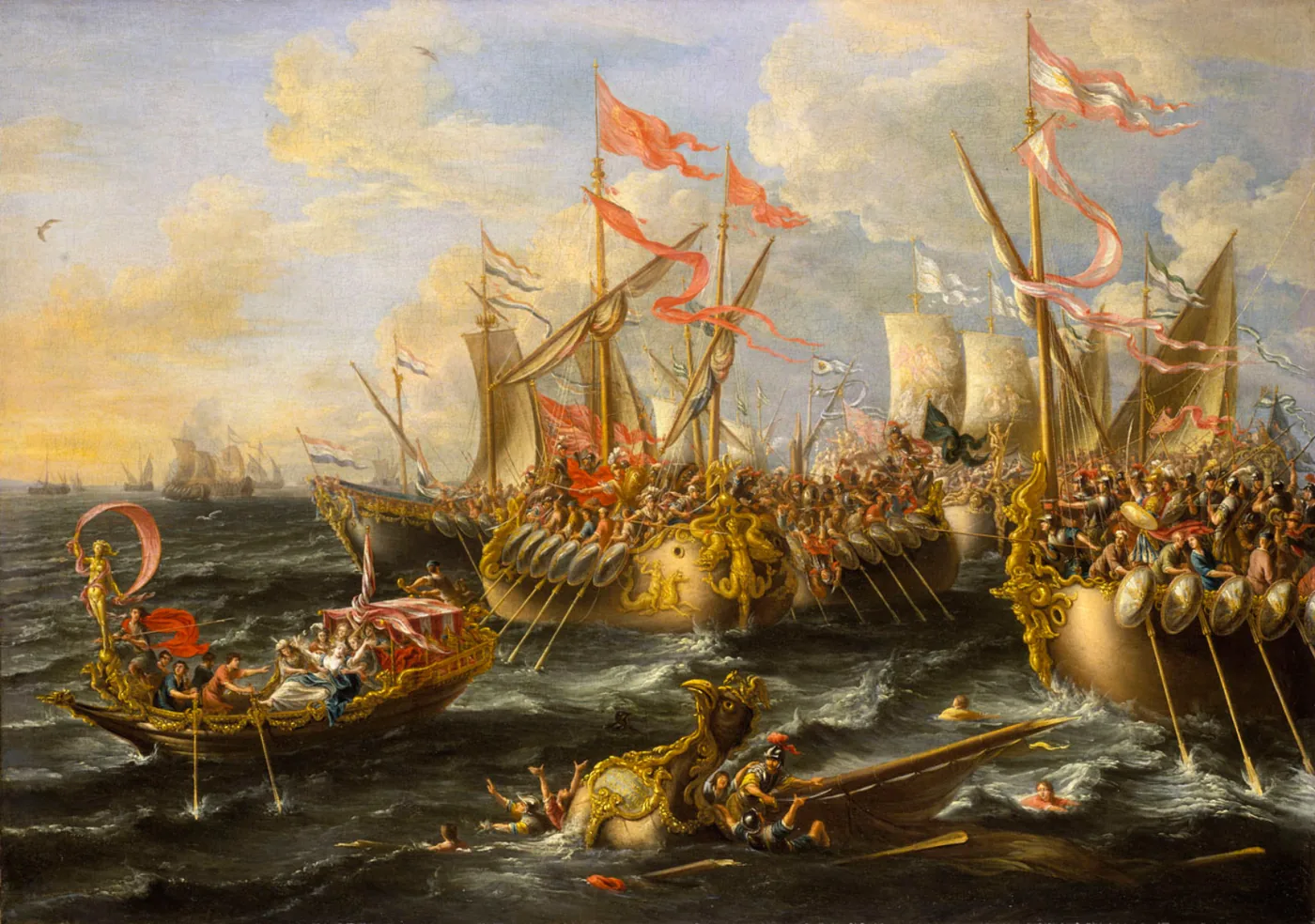
The Battle of Actium was a naval battle fought on September 2, 31 BC, off the western coast of Greece. Octavian, the adopted heir of Julius Caesar, sent his fleet under the admiral Marcus Agrippa against Mark Antony and Cleopatra, queen of Egypt. The fighting lasted a single afternoon. Antony abandoned his fleet in the middle of the battle and followed Cleopatra's ships as they sailed for Egypt. His forces surrendered, and within a year both Antony and Cleopatra were dead. The battle brought more than a hundred years of Roman civil wars to an end. Four years later, Octavian took the name Augustus and became Rome's first emperor.
Why Octavian and Antony went to war
After Julius Caesar was assassinated in 44 BC, three men divided the Roman world between them: Octavian in the west, Mark Antony in the east, and Marcus Lepidus in North Africa. This arrangement, called the Second Triumvirate, held for about a decade. By 36 BC, Octavian had pushed Lepidus aside. That left two rivals.
Antony moved his base to Egypt, where he and Cleopatra lived together and had three children. He divorced Octavian's sister Octavia, and in a public ceremony in Alexandria he distributed Roman territories to Cleopatra's children. Octavian used this to turn Roman opinion against Antony, presenting him as a man who had abandoned Rome for a foreign queen. In 32 BC, the Roman Senate stripped Antony of his authority and declared war on Cleopatra.
How Agrippa won the Battle of Actium
Antony and Cleopatra brought their fleet and army to Actium, a promontory on the Ambracian Gulf in western Greece. Octavian's admiral, Marcus Agrippa, did not attack the position directly. He captured the nearby harbors and shipping lanes, cutting off Antony's supplies.
Agrippa came from a humble family with no political connections. According to Pliny the Elder, his cognomen, Agrippa, meant he had been born feet first. He met Octavian as a teenager, and the two became lifelong allies. By 31 BC Agrippa was already an experienced naval commander. He had defeated the fleet of Sextus Pompey at the Battle of Naulochus five years earlier.
Through the summer of 31 BC, the blockade wore Antony's camp down. His troops went hungry, disease spread, and soldiers deserted. Antony was short of rowers, so he burned ships he did not have enough rowers to man. By September, Antony needed to fight his way out by sea or lose his army entirely.
On the morning of September 2, Antony's fleet sailed out. His ships were heavy quinqueremes, powerful but slow. Agrippa had roughly 400 lighter and faster Liburnian warships built for ramming. As the lines met, Agrippa worked around Antony's flank. Then Cleopatra's Egyptian squadron of about sixty ships, held in reserve at the rear, hoisted sail, passed through an opening in the middle of the battle line, and headed for the open sea. Antony transferred to a smaller ship and followed Cleopatra, leaving his fleet and his legions behind.
Without a commander, Antony's ships surrendered. Within days, his army on shore surrendered to Octavian.
Why did Antony follow Cleopatra?
Historians have debated this question for two thousand years. The ancient sources, most of them written by the winning side, said Antony was so in love with Cleopatra that he chose her over his army. Some modern historians argue that Antony and Cleopatra planned the breakout together before the battle started. The fight was already going badly, and the Egyptian squadron's escape was a prearranged retreat to save what they could. Others think Antony saw Cleopatra's ships leaving and made a desperate choice in the middle of a battle he was losing.
Whatever the reason, the result was the same. Antony reached Alexandria, but most of his remaining forces surrendered or switched sides over the following months. In August 30 BC, as Octavian's armies closed in on Alexandria, Antony killed himself. The ancient historian Plutarch wrote that Antony heard a false report that Cleopatra was dead and fell on his sword, then was carried to her and died in her arms. Cleopatra killed herself shortly after. Egypt was annexed as a Roman province.
Why was the Battle of Actium important?
After the battle, Octavian kept Egypt's grain wealth as his own property, not the Senate's. No Roman had ever held that kind of independent power.
Actium closed more than a hundred years of Roman civil wars. The peace that followed, the Pax Romana, lasted roughly two hundred years and became one of the longest periods of stability in the ancient world. If Antony had won, Rome's center of gravity would probably have shifted east toward Alexandria. Instead, the empire looked west, and Rome remained its capital for more than three centuries. The system of one-man rule that Augustus built outlasted the Roman Empire itself, shaping how Europe was governed for more than a thousand years after Rome fell.