
Mark Antony
Mark Antony was a Roman general who served under Julius Caesar, ruled the eastern Roman world, and lost a civil war to Octavian at the Battle of Actium.
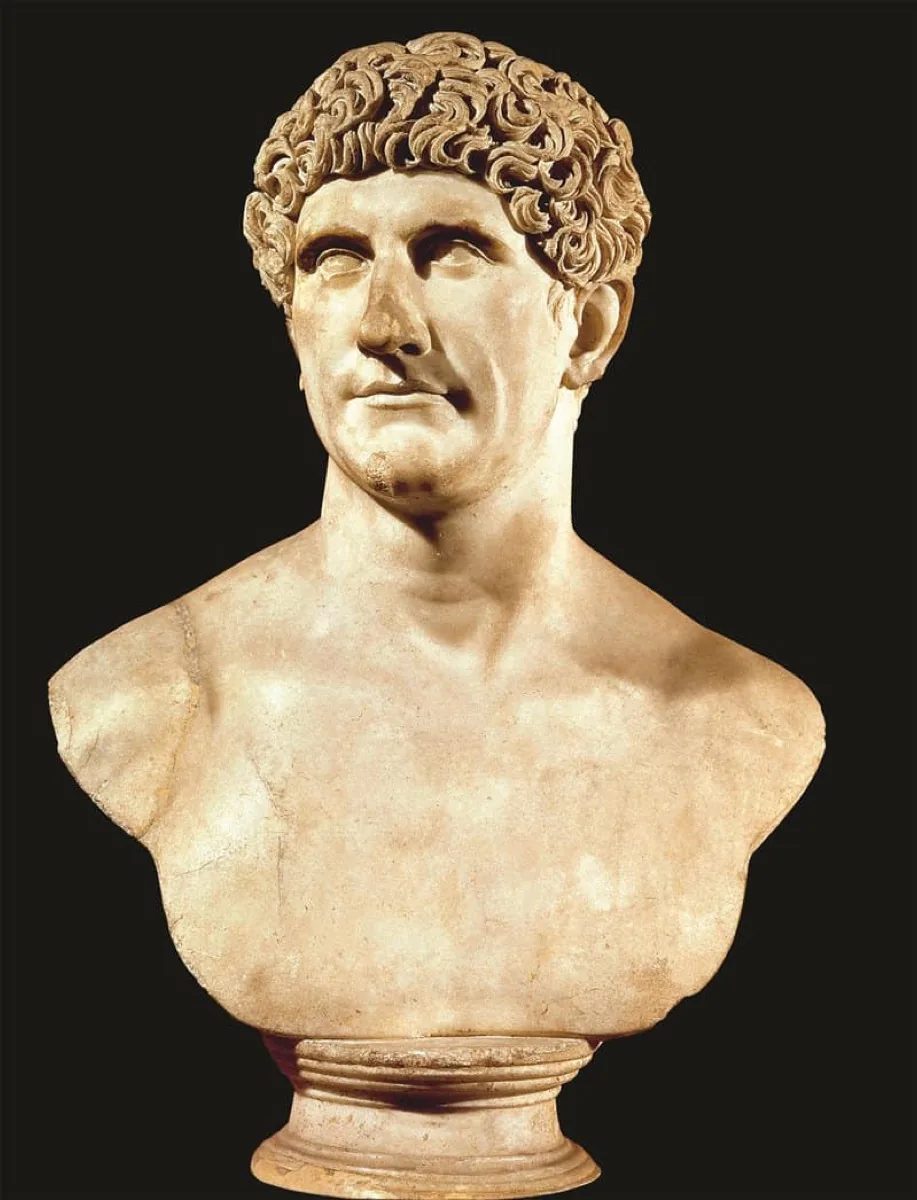
Mark Antony (Marcus Antonius, c. 83–30 BC) was a Roman general and politician who fought under Julius Caesar in Gaul and the civil war, then ruled the eastern half of the Roman world for a decade. He was physically imposing, popular with soldiers, and a better battlefield commander than his rival Octavian. After Caesar's assassination in 44 BC, Antony and Octavian spent years as allies before turning on each other. Their war was decided at the Battle of Actium in 31 BC. Antony killed himself in Alexandria the following year, and Octavian went on to rule Rome as Augustus for 44 years.
How Antony rose under Caesar
Antony came from an aristocratic Roman family. He was a spendthrift who lived well beyond his means. He first proved himself leading cavalry in Judea and Egypt, then served under Caesar during the wars in Gaul, and Caesar kept promoting him.
In 49 BC, as tribune, Antony vetoed the Senate's attempt to strip Caesar of his command. When the Senate overrode him, he fled Rome. His flight gave Caesar a pretext to cross the Rubicon and start the civil war. At the Battle of Pharsalus in 48 BC, Antony led the left wing of Caesar's army. By 44 BC he shared the consulship with Caesar, the highest elected office in Rome.
At the Lupercalia festival in February 44 BC, Antony publicly offered Caesar a crown. Caesar refused it twice, to applause from the crowd. Whether this was staged, and what either man intended by it, has never been satisfactorily explained.
After Caesar's murder
The conspirators who killed Caesar on the Ides of March, 44 BC, chose to spare Antony. He negotiated an amnesty with them, then secured Caesar's papers and personal fortune from Caesar's widow, Calpurnia. He delivered the funeral oration for Caesar. The speech set the Roman public against the conspirators, who soon fled Italy.
Caesar's will surprised Antony. It named Caesar's eighteen-year-old great-nephew, Octavian, as heir and adopted son. Octavian arrived in Italy, took Caesar's name, and used Caesar's money to win over Caesar's veterans. Cicero hated Antony and attacked him in a series of speeches, backing Octavian in the hope of using the young man and discarding him.
After fighting briefly, Antony and Octavian reached an agreement. In late 43 BC they formed the Second Triumvirate with a third general, Lepidus. It was a legalized dictatorship of three, financed by proscriptions: published death lists that let the triumvirs seize their enemies' property and pay their soldiers. Antony insisted on adding Cicero to the list. Soldiers cut off Cicero's head and hands and displayed them on the speaker's platform in the Forum.
At the Battle of Philippi in 42 BC, Antony and Octavian defeated the assassins Brutus and Cassius. Antony led the fighting in both engagements. Octavian was reportedly too ill to command his own troops. Afterward the two men divided the Roman world: Octavian took the west, and Antony took the east and the planned war against Parthia.
Antony, Cleopatra, and the road to Actium
In 41 BC Antony summoned Cleopatra, the queen of Egypt, to Tarsus to account for her actions during the civil war. They became lovers and, over time, political partners. Egypt's grain and money financed Antony's eastern campaigns.
To keep the peace with Octavian, Antony married Octavian's sister Octavia. He later abandoned her for Cleopatra, which gave Octavian a personal grievance on top of a political rivalry.
Antony's invasion of Parthia in 36 BC ended in failure. He marched with roughly 100,000 men, failed to take the fortified city of Phraaspa, and lost about 32,000 soldiers to fighting, illness, and the long retreat through the Armenian mountains.
In 34 BC Antony staged the Donations of Alexandria, a public ceremony in which he gave parts of the eastern provinces to Cleopatra and the three children he had with her. Octavian used this against him in Rome. Octavian was not a strong general, but he was skilled at political messaging. He described Antony as a Roman controlled by a foreign queen, set on ruling from Alexandria rather than Rome. To prove it, in 32 BC he obtained Antony's will, which the Vestal Virgins held in custody, and published its contents. It showed that Antony wanted burial in Alexandria.
The Senate declared war on Cleopatra, not on Antony, so that it would not look like another civil war. On September 2, 31 BC, the two navies fought off Actium, on the coast of western Greece. By then, Antony's forces had been blockaded for months, and his soldiers were deserting or falling ill. During the battle, Cleopatra's squadron broke through the line and sailed south. Antony followed her.
Did Mark Antony betray Caesar?
No. Antony was one of Caesar's most loyal allies. He served under Caesar for years in Gaul, risked his career to veto the Senate on Caesar's behalf, fought at Pharsalus, and shared the consulship with Caesar in 44 BC. After Caesar's assassination, Antony used his position to turn public opinion against the assassins and drive them from Rome.
The question likely comes from Antony's later conflict with Octavian, Caesar's adopted heir. That was a rivalry between two men who both claimed to be Caesar's true successor, not a betrayal of Caesar himself.
How did Mark Antony die?
The summer after Actium, Octavian's army reached Alexandria. Antony's cavalry and ships went over to Octavian's side. A false report reached Antony that Cleopatra was dead, and he stabbed himself with his sword. He was carried, still alive, to where Cleopatra was hiding, and died on August 1, 30 BC. He was 53. Cleopatra killed herself shortly afterward.
Octavian executed Caesarion, Caesar and Cleopatra's son, and annexed Egypt as a Roman province. Most of what survives about Antony, the portrait of a drunkard controlled by a foreign queen, was shaped by Augustus and repeated by Plutarch and later by Shakespeare. Antony held the eastern Roman world for a decade, and his defeat meant Rome would have a single ruler instead of an empire split between east and west. That division did eventually happen, about three centuries later.