
Battle of Cannae
The 216 BC battle where Hannibal's outnumbered Carthaginian army encircled and destroyed the largest force Rome had ever fielded.
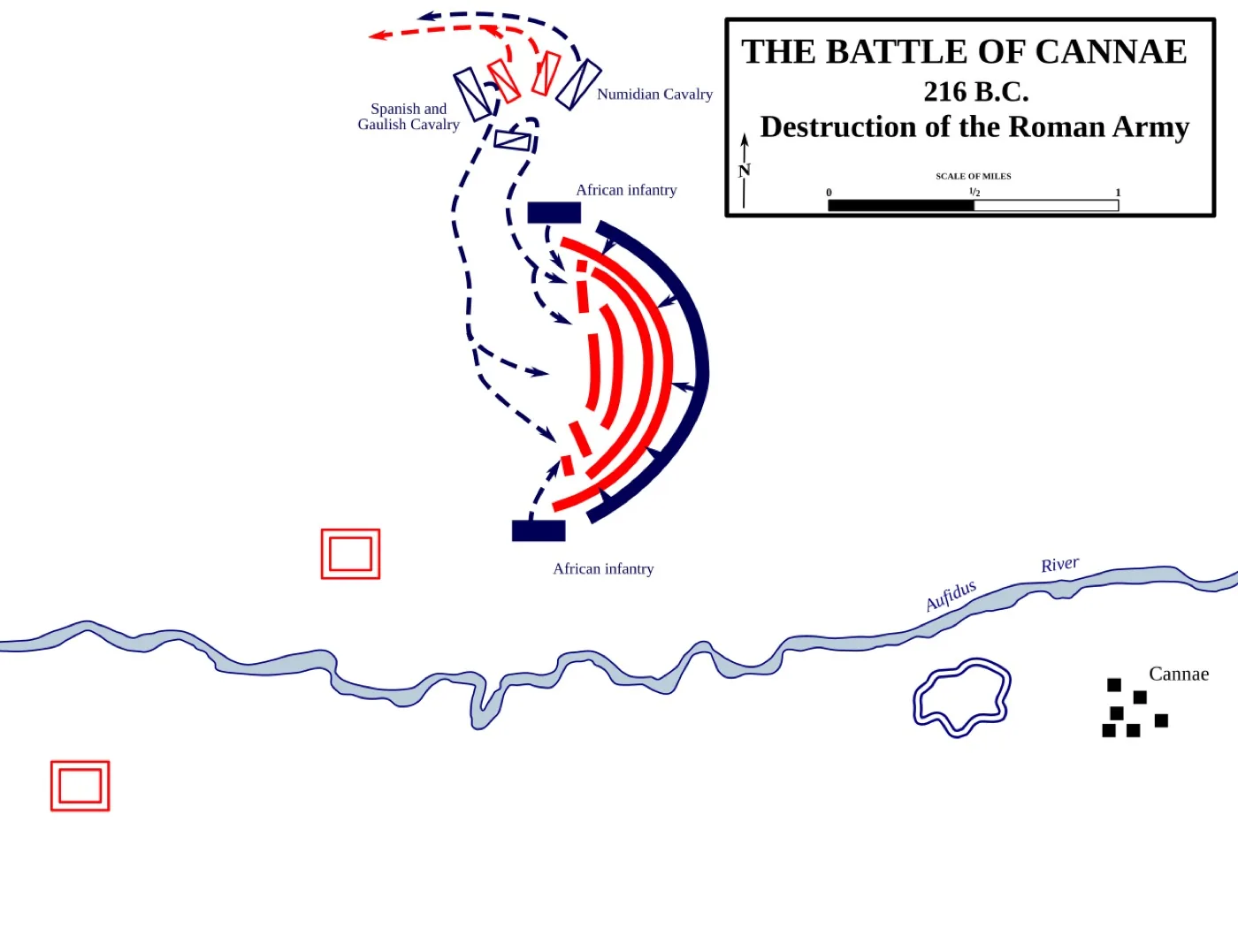
On August 2, 216 BC, a Carthaginian army of about 50,000 men surrounded and killed most of a Roman army nearly twice its size on a plain in southeastern Italy. The Battle of Cannae was one of the worst defeats in Roman history. The ancient sources disagree on the exact toll: Livy counted about 48,200 Roman dead and 20,000 captured, while Polybius put the dead closer to 70,000. One of the two commanding consuls died on the field, along with roughly 80 senators. The battle gave military history its most famous tactical idea, the double envelopment, where a smaller force wraps around a larger one and destroys it from all sides. More than two thousand years later, military academies still teach it.
How Hannibal trapped the Roman army
Hannibal had crossed the Alps into Italy two years earlier, opening a new front in the Second Punic War between Carthage and Rome. He had already beaten Roman armies at the Trebia and at Lake Trasimene. Rome's answer was to raise the largest army it had ever fielded, about 80,000 men in eight legions plus allied troops, and send it south under two consuls: Lucius Aemilius Paullus and Gaius Terentius Varro. The plan was to crush Hannibal with weight of numbers.
Hannibal had about 50,000 troops, a mix of Africans, Spaniards, Gauls, and Numidian cavalry. He chose the ground at Cannae, on the Apulian plain near the Aufidus River, and arranged his infantry in a crescent shape that bulged toward the Romans. He placed his least reliable soldiers, the Gauls and Spaniards, at the center of that crescent. His best troops, experienced African infantry, stood on both flanks, held back. His cavalry, which outnumbered Rome's, took the wings.
When the dense Roman column hit the center, the Gauls and Spaniards gave ground slowly. The crescent bent inward. The deeper the Romans pushed, the more the line curved around them, and the tighter their own ranks became. Then Hannibal's African infantry on both flanks turned inward and attacked the sides of the Roman column. At the same time, his cavalry, having routed the Roman horsemen on both wings, rode around to the rear and closed off the last escape route.
The Romans were surrounded. So tightly packed that many soldiers could not lift their arms to use their weapons, they were killed where they stood. The fighting went on for hours. Consul Paullus died on the field. Varro escaped with a few dozen cavalry. Among the dead were 29 of the army's 48 military tribunes and about 80 members of the Roman Senate, roughly a quarter of its membership. Hannibal lost about 6,000 men.
Why didn't Hannibal march on Rome after Cannae?
According to Livy, Hannibal's cavalry commander Maharbal urged him to ride for Rome immediately, promising they could be dining in the city within five days. When Hannibal refused, Maharbal told him: "You know how to gain a victory, Hannibal, but you do not know how to use it."
Hannibal had practical reasons for refusing. His army had no siege equipment, and Rome was a walled city about 250 miles away. His troops were exhausted, and he had no reliable supply line. He expected that a defeat this catastrophic would force Rome to negotiate. By the normal rules of ancient warfare, a state that lost most of its army in a single day sued for peace.
Rome refused. The Senate would not negotiate and would not even ransom its captured soldiers. Instead, Rome began raising new legions. The Senate turned to the general Quintus Fabius Maximus, whose approach gave the Fabian strategy its name: do not fight Hannibal in open battle, but follow his army, destroy his foragers, and let time do the work. Rome had a far larger population than Carthage and could replace its losses. Hannibal could not.
Hannibal spent thirteen more years in southern Italy, winning battles but never taking Rome. He was recalled to Africa in 203 BC to defend Carthage itself, and the Roman general Scipio Africanus defeated him at the Battle of Zama in 202 BC. The war that Cannae should have ended lasted another fourteen years.
Why do military academies still study Cannae?
Cannae became the standard example of what soldiers call a battle of annihilation: a victory so complete that the losing army ceases to exist. Commanders have tried to replicate it ever since, and almost none have succeeded.
Alfred von Schlieffen, who ran Germany's general staff from 1891 to 1906, spent years analyzing Cannae and wrote a book about it. He studied battles from Frederick the Great through the Franco-Prussian War, reading each one as a variation on Hannibal's double envelopment. Schlieffen concluded that encirclement and total destruction of the enemy was the highest aim of battle. That idea became the foundation of the Schlieffen Plan, Germany's strategy for opening World War I. The plan failed, but the concept survived. German officers carried it into World War II, and American commanders pursued versions of it in the 1991 Gulf War.
Cannae also teaches a harder lesson. Hannibal won the most complete battlefield victory in ancient history, and it did not win the war. Rome lost its army and kept fighting. Military academies still teach both sides of that story: Hannibal's tactics on the field, and Rome's refusal to accept the result.