
Punic Wars
The Punic Wars were three wars between Rome and Carthage, from 264 to 146 BCE, that made Rome the dominant power in the Mediterranean.
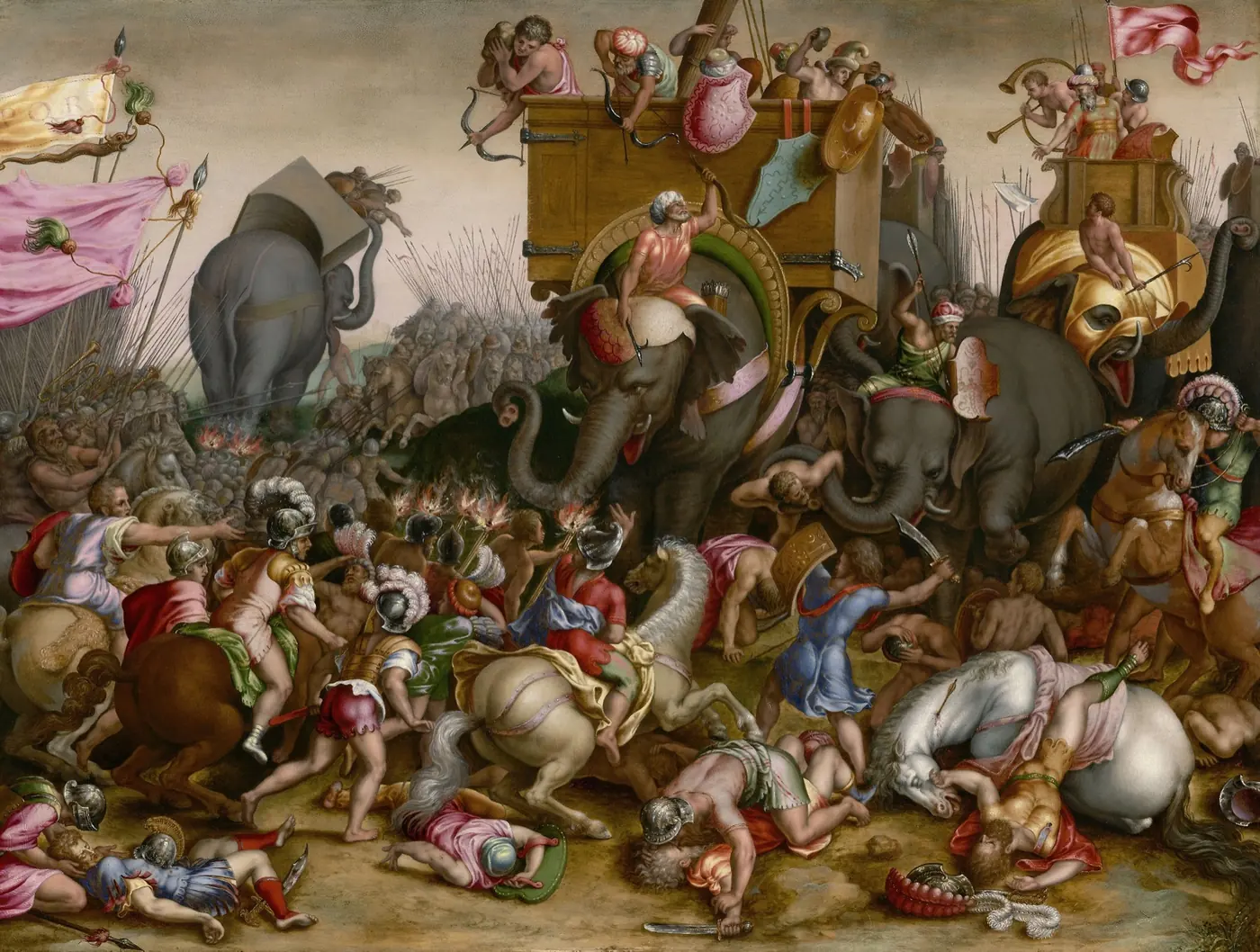
The Punic Wars were three wars between Rome and Carthage, fought from 264 to 146 BCE. "Punic" comes from the Latin word "Punicus," meaning Phoenician, because Carthage was founded by Phoenicians in modern-day Tunisia. When the wars began, Rome controlled most of the Italian peninsula and Carthage controlled the western Mediterranean's richest trade routes. When the wars ended, Carthage had been burned to the ground and Rome held territory stretching from Spain to North Africa to Greece. The Punic Wars are the turning point at which Rome went from a regional Italian power to the center of an empire.
How Rome built a navy to fight Carthage
The First Punic War (264–241 BCE) started as a dispute over Sicily, which sat between the two powers. Rome fought its wars on land and had barely any warships. Carthage was the strongest naval force in the western Mediterranean. To compete, Rome built a navy from nothing. According to the ancient historian Polybius, Roman shipbuilders used a wrecked Carthaginian warship as their model. They also added a device called the corvus, a boarding bridge that locked onto an enemy ship and let Roman soldiers cross over to fight hand to hand. The corvus turned naval battles into infantry fights, which Rome's legions were trained to win.
The war lasted twenty-three years, and both sides took heavy losses. In 241 BCE, Carthage accepted defeat. It surrendered Sicily and paid Rome a heavy indemnity.
Hannibal's invasion of Italy
The Second Punic War (218–201 BCE) was Carthage's attempt at revenge, and it brought Rome closer to defeat than it had ever been. The war was driven by Hannibal, the son of the Carthaginian general Hamilcar Barca. When Hannibal was nine years old, his father took him to a temple in Carthage and made him swear an oath of eternal hatred toward Rome. He kept it for the rest of his life.
In 218 BCE, Hannibal marched an army from Spain, across southern France, and over the Alps into Italy. He started over the Alps with roughly 46,000 soldiers and 37 war elephants. The crossing cost him nearly half his force to cold, rockfalls, and attacks by mountain tribes. Once in Italy, he destroyed one Roman army after another. At the Battle of Cannae in 216 BCE, Hannibal encircled and destroyed a Roman force that far outnumbered his own. Ancient sources put the Roman dead at between 48,000 and 70,000 in a single day. It was one of the worst military defeats Rome ever suffered.
Rome refused to surrender. A Roman general named Quintus Fabius Maximus, nicknamed "the Delayer," shadowed Hannibal's army without fighting a pitched battle. The strategy was deeply unpopular in Rome at first, but it worked. Hannibal could win battles, but he could not force Rome to give in. Meanwhile, Rome raised fresh legions.
The war turned when Rome sent a young general named Publius Cornelius Scipio to attack Carthage directly. Scipio had survived Cannae at about nineteen years old and was about thirty when he was given command. Hannibal was recalled from Italy to defend Carthage, and Scipio defeated him at the Battle of Zama in 202 BCE. Carthage surrendered the following year. Carthage was forced to give up its navy and all overseas territory. Hannibal spent his last years in exile, moving between courts in the eastern Mediterranean. In 183 BCE, cornered in Bithynia and about to be handed over to Rome, he poisoned himself rather than be captured.
Why did Rome destroy Carthage?
By the time of the Third Punic War (149–146 BCE), Carthage was no longer a military threat. It had no navy and no empire. But it was still a prosperous trading city, and some Roman leaders refused to accept even that. Cato the Elder, a member of the Roman Senate, is said to have closed every speech he gave, regardless of topic, with the demand that Carthage be destroyed.
Rome declared war in 149 BCE on a thin pretext and laid siege to the city. The siege lasted three years. When Roman legions finally broke through the walls, they fought street by street. In 146 BCE, Rome burned Carthage to the ground. The survivors were killed or enslaved. The story that the Romans salted the fields around Carthage so nothing would grow was invented centuries later, but the destruction of the city itself was total. In the same year, Roman armies also sacked Corinth in Greece, removing the last resistance to Rome's control of Greece.
What the Punic Wars changed
Before the wars, Rome was a republic built to govern a single city and the farmland around it. After them, Rome controlled Sicily, Spain, and North Africa, and it dominated the sea in every direction. The wealth, slaves, and ambition that flowed into Rome after the wars strained the institutions the republic was built on. Within a century of Carthage's destruction, the Roman Republic was torn apart by civil wars that ended it for good.