
Congress of Berlin
The Congress of Berlin was a meeting of Europe's great powers in 1878 that redrew the map of the Balkans.
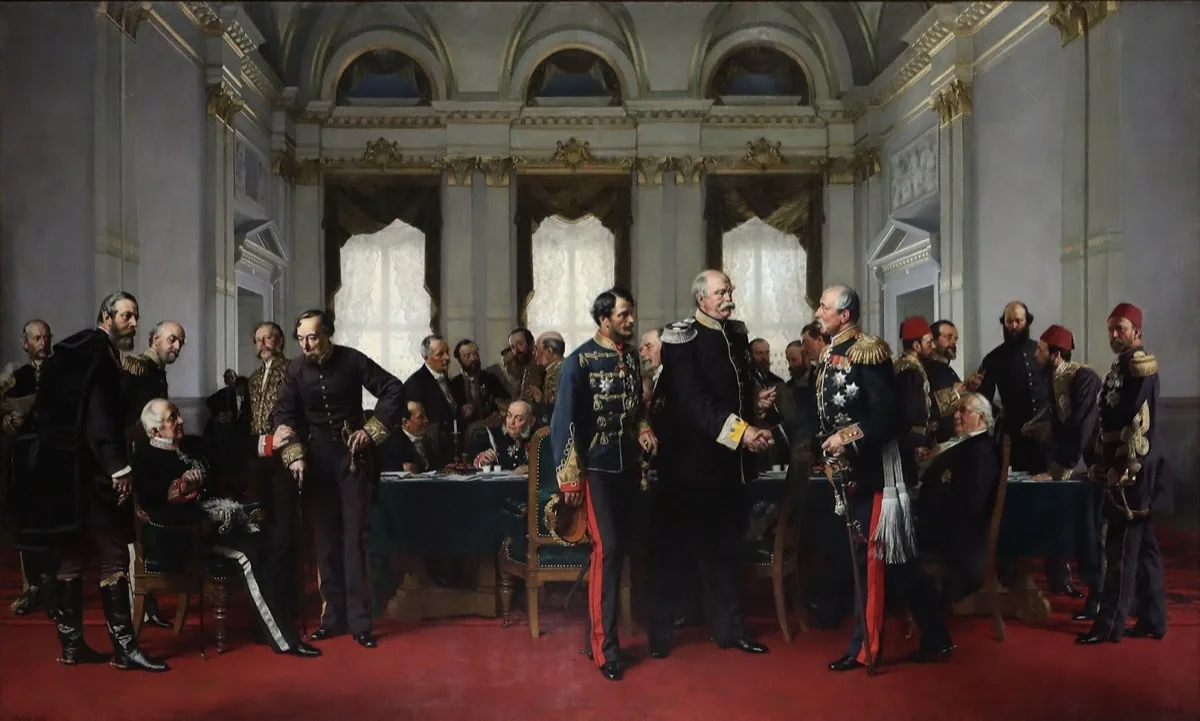
The Congress of Berlin was a meeting of Europe's great powers, held in Berlin from June 13 to July 13, 1878, to redraw the map of the Balkans. Representatives of Britain, Russia, Austria-Hungary, France, Germany, Italy, and the Ottoman Empire attended. Germany's chancellor, Otto von Bismarck, presided. The Balkan peoples whose borders were being redrawn had no meaningful voice in the talks. The resulting treaty kept the great powers from going to war with each other for thirty-six years, but it created the grievances in Bosnia, Bulgaria, and Serbia that led to the outbreak of World War I in 1914.
How the Congress of Berlin came about
The immediate cause was Russia's military victory over the Ottoman Empire in the war of 1877–1878. Russia claimed it was defending Balkan Christians, but its real aim was to extend its influence toward the Mediterranean. In March 1878, Russia imposed a peace on the defeated Ottomans at San Stefano, a town near Istanbul. The Treaty of San Stefano created a large autonomous Bulgaria stretching from the Danube to the Aegean Sea. This new state was widely expected to become a Russian client state, and the treaty stripped the Ottomans of nearly all their control over the Balkans.
Britain and Austria-Hungary rejected the terms. Britain's prime minister, Benjamin Disraeli, would not allow Russia to gain influence near the Mediterranean. Austria-Hungary's foreign minister, Count Gyula Andrássy, would not accept a large Slavic state on his empire's southern border. Both countries hinted at war.
Bismarck agreed to host a conference in Berlin. In a speech to the German parliament, he described his role as that of an "honest broker" with no territory to gain. Much of the real negotiating had already happened in secret deals between individual powers before the Congress opened. But the formal sessions mattered, because they forced each power to accept the compromises publicly.
What the great powers decided in Berlin
The Congress carved up the large Bulgaria that Russia had created at San Stefano. North of the Balkan range, a smaller Bulgarian principality received autonomy under Ottoman oversight. South of the range, Eastern Rumelia became a separate Ottoman province. Macedonia was handed back under direct Ottoman control.
Serbia, Montenegro, and Romania all gained full independence, but each received less land than it had asked for. Serbia was blocked from expanding westward and denied access to the Adriatic Sea.
Austria-Hungary won the right to take control of Bosnia and Herzegovina, even though the Ottoman Empire kept nominal ownership. Britain took Cyprus, arranged beforehand in a secret deal with Istanbul. Russia received Bessarabia's southern districts and Caucasian lands, among them the cities of Kars and Batum.
Russia had won the war, but the Congress took away much of what it had gained at San Stefano. Russia's chancellor, Prince Alexander Gorchakov, turned 80 during the proceedings. He had spent a career building Russian influence in Europe, and he left Berlin convinced his country had been cheated. Russians blamed Bismarck, and the understanding between Germany, Austria-Hungary, and Russia, known as the Three Emperors' League, fell apart.
Disraeli was 73 and in such poor health that his doctor traveled to Berlin to treat his asthma and gout. He returned to London declaring he had brought back "peace with honour." Bismarck reportedly said of him, "The old Jew, that is the man," a compliment to the delegate who had bargained hardest.
Why did Bismarck host the Congress of Berlin?
Bismarck had no interest in the Balkans. What he wanted was to keep Europe's great powers balanced enough to avoid a war that Germany would have to fight in. Russia's sweeping victory over the Ottomans threatened that balance by making a direct conflict between Russia and Austria-Hungary more likely. If the two went to war, Germany would have to choose sides, and either choice would cost it an ally.
By hosting the Congress, Bismarck could shape a settlement that gave each power something without giving any power too much. It worked in the short term but cost him Russia's friendship. In October 1879, Germany and Austria-Hungary agreed to a mutual defense pact, the Dual Alliance. That pact set the pattern for the rival alliance blocs that turned a Balkan crisis into a general European war in 1914.
How the Congress of Berlin led to World War I
The settlement created a set of grievances that no later conference resolved.
Bulgaria never accepted the loss of Macedonia. Regaining it became the central goal of Bulgarian foreign policy for the next forty years. That pursuit led directly to both Balkan Wars (1912–1913). Bulgaria later joined the Central Powers in World War I and the Axis in World War II, choosing the losing side both times.
With no room to expand westward, Serbia focused on Bosnia and Herzegovina, home to more than a million South Slavs living under Habsburg rule. In 1908, Austria-Hungary converted its occupation of Bosnia into outright annexation, triggering a crisis that nearly caused a European war. The annexation gave Serbian nationalists a lasting grievance. In June 1914, Gavrilo Princip, a Bosnian Serb, assassinated Archduke Franz Ferdinand on the streets of Sarajevo.
Christians in Ottoman-ruled Macedonia and Armenia, whose suffering had provided the moral case for Russia's war and for the Congress itself, received only paper guarantees of reform with no means to enforce them.
The Congress of Berlin did what it was designed to do: it kept the great powers from going to war for a generation. But the grievances it left behind, in Bosnia, in Bulgaria, and between Russia and Germany, supplied most of the causes that ended that peace in 1914.