
Mahatma Gandhi
Mohandas Gandhi was an Indian lawyer who led India's independence from British rule through nonviolent resistance called satyagraha.
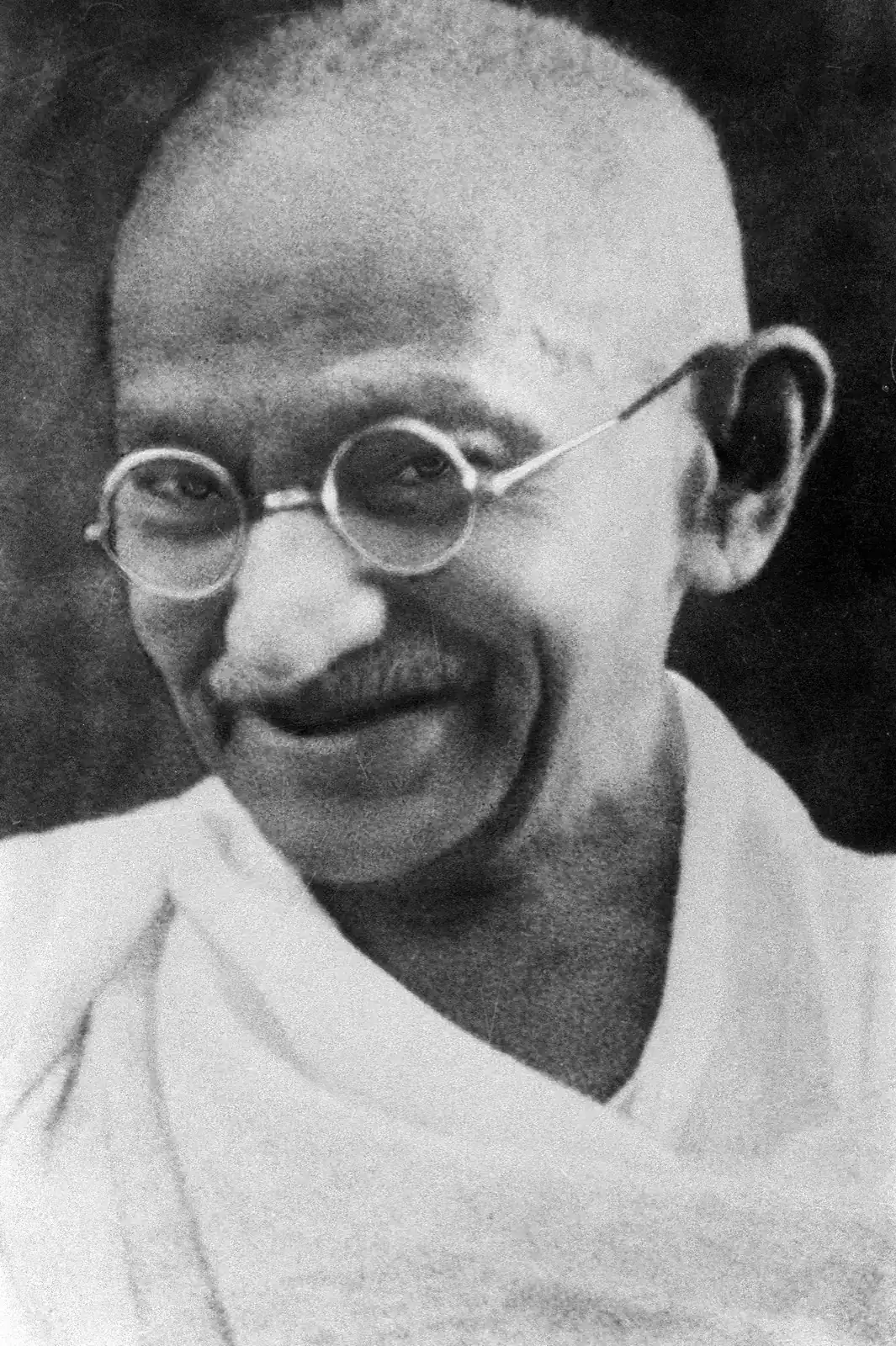
Mohandas Karamchand Gandhi was an Indian lawyer and political leader who led India's independence movement against British rule through nonviolent resistance. He was born on October 2, 1869, in Porbandar, a coastal town in western India. He trained as a lawyer in London, spent 21 years in South Africa, and returned to India in 1915, where he turned a small independence movement run by elite lawyers into a mass movement of millions of people. About 300 million Indians called him "Mahatma," a Sanskrit word meaning "great soul." Winston Churchill mocked him as a half-naked fakir. He was assassinated in 1948, less than six months after India gained independence.
How Gandhi developed nonviolent resistance in South Africa
Gandhi went to South Africa in 1893 as a 23-year-old lawyer on a one-year contract. He stayed for 21 years. Soon after arriving, he was thrown off a train at Pietermaritzburg station for sitting in a first-class compartment reserved for white passengers. That experience, and the racial discrimination built into South African law, changed the course of his life.
In 1906, the Transvaal government passed a law requiring all Indians to register, submit to physical examinations, and carry identification papers at all times. Gandhi organized the Indian community to refuse. Protesters broke the law openly, then accepted arrest and jail without fighting back. Gandhi called this method "satyagraha," from two Sanskrit words: satya, meaning truth, and agraha, meaning holding firmly. He translated it as "truth-force."
The idea was not passive. Practitioners deliberately broke laws they considered unjust, then took the punishment without retaliating. This forced the government to use violence in public against people who were not fighting back.
How Gandhi led India's independence movement
Gandhi came back to India in 1915 and began organizing on a scale no one in the independence movement had attempted. In 1920, he launched a non-cooperation campaign: Indians stopped attending British courts and schools, refused British honors, and gave up imported cloth. He urged Indians to spin their own cloth, called khadi. Every yard of khadi woven in India was a yard of cloth that British mills in Manchester did not sell.
His most famous protest was the Salt March of 1930. British law imposed a tax on salt and banned Indians from collecting it themselves. The tax fell hardest on the poorest people, over a substance they could collect from any beach. On March 12, 1930, Gandhi left his ashram at Sabarmati with 78 followers on a march to the coastal village of Dandi, 240 miles away. When they arrived twenty-four days later, with reporters watching from around the world, Gandhi bent down and scooped a handful of salt from the shore. It was technically a crime. British authorities arrested more than 60,000 people in the months that followed. The Raj's claim to legitimate rule in India never fully recovered.
Gandhi also used fasting as a form of protest, nearly dying several times. He campaigned against untouchability throughout his life. He called untouchables "Harijans," meaning "children of God." In 1932, he fasted to oppose a British proposal for separate elections for untouchables, which he believed would divide Hindu society. His approach drew criticism from B. R. Ambedkar, the most prominent leader from the untouchable community. Ambedkar considered Gandhi's methods paternalistic and argued that real change required legal rights and political power, not appeals to upper-caste conscience.
Who killed Gandhi?
Gandhi had opposed the partition of India into separate Hindu-majority and Muslim-majority states, but in August 1947 it happened anyway. The division triggered one of the largest mass migrations in history. Hindus fled to India and Muslims fled to Pakistan. The violence that followed killed hundreds of thousands of people, by some estimates more than a million. On the day India became independent, Gandhi did not celebrate. He was fasting in riot-torn Calcutta, trying to stop the killing. The full story of how partition happened is told in this article about the Radcliffe Line.
On January 30, 1948, Gandhi was on his way to evening prayers in New Delhi when Nathuram Godse, a Hindu nationalist, stepped forward and shot him three times at close range. Gandhi was 78 years old. Godse believed Gandhi had been too accommodating toward Muslims and toward Pakistan. He was tried, convicted, and hanged in November 1949.
What is satyagraha?
Satyagraha is the method of nonviolent resistance that Gandhi developed in South Africa and used throughout the Indian independence movement. The word combines the Sanskrit "satya" (truth) and "agraha" (holding firmly). Gandhi translated it as "truth-force."
The method works by making injustice visible. Protesters break a law they consider unjust, do so openly, and accept the consequences without fighting back. When a government beats or jails people who are not resisting, the violence is exposed for what it is. That shifts public opinion and puts pressure on the government to change.
Gandhi did not invent civil disobedience. Henry David Thoreau wrote about it decades earlier. But Gandhi turned it into an organized mass strategy and proved it could work against the largest empire in the world. Martin Luther King Jr. studied Gandhi's campaigns and applied satyagraha to the civil rights struggle in America. Nelson Mandela in South Africa and the Solidarity movement in Poland drew on the same tradition. The method Gandhi developed to fight a registration law in South Africa in 1906 is still the basis for nonviolent protest movements around the world.