
Indian Rebellion of 1857
The Indian Rebellion of 1857 was a massive uprising against the East India Company that ended Company rule and brought India under the British Crown.
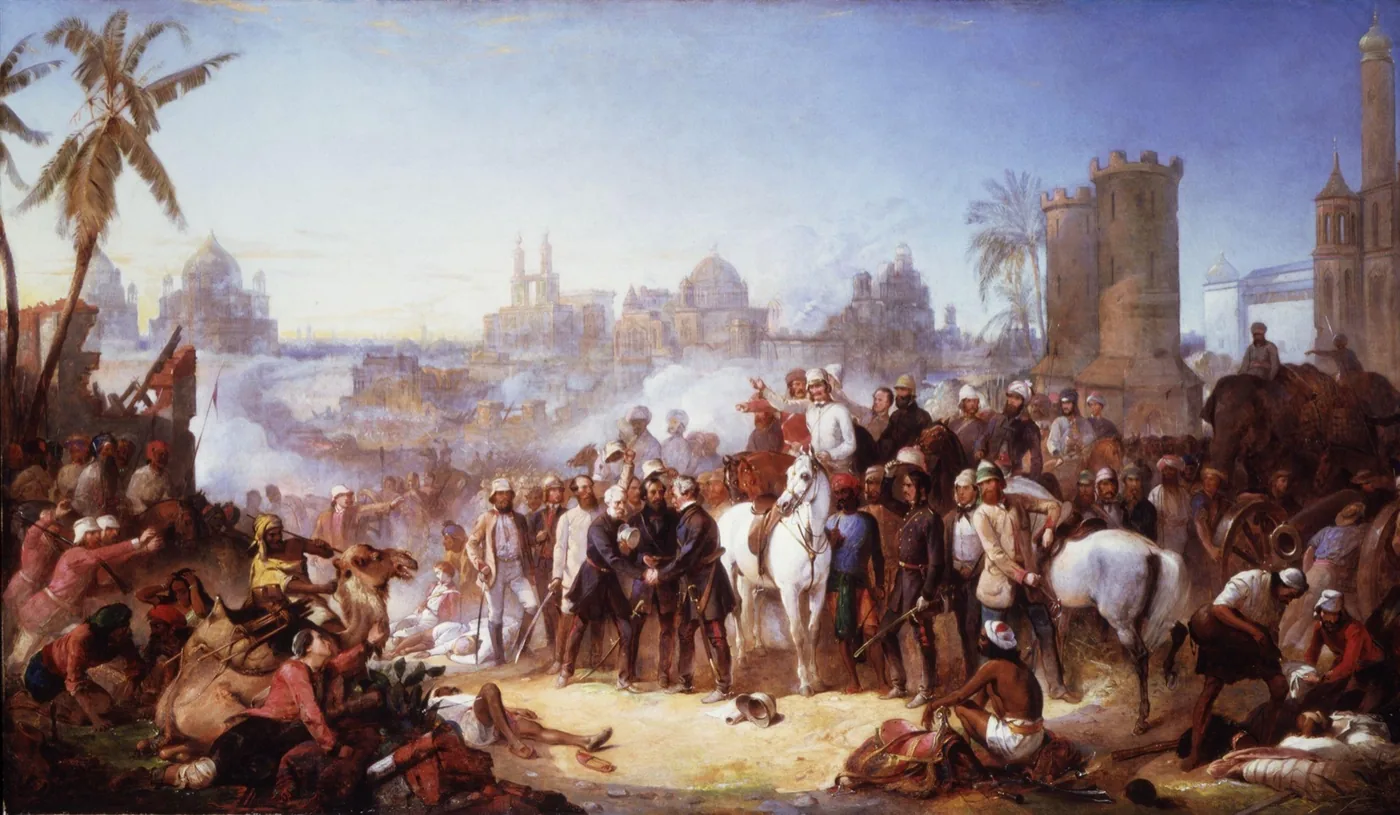
The Indian Rebellion of 1857 was the largest armed uprising against British rule in India. It began on May 10, 1857, when Indian soldiers in the Bengal Army, called sepoys, revolted at the garrison town of Meerut, about 70 kilometers northeast of Delhi. Within weeks the rebellion spread across the Gangetic plain, drawing in not just soldiers but princes, peasants, and landholders. The East India Company, the British trading corporation that governed much of India with its own private army, could not contain it for more than a year. By the time British forces crushed the last resistance in 1859, hundreds of thousands of people were killed, the vast majority Indian. The British Parliament responded by stripping the East India Company of its power and placing India under direct rule by the Crown.
How the rebellion started at Meerut
The immediate trigger was a rumor about rifle cartridges. In early 1857, the Company began issuing the new Pattern 1853 Enfield rifle, which used a paper cartridge that a soldier had to bite open before loading. Word spread through the barracks that the cartridge grease contained cow fat and pig fat. Cows are sacred to Hindus, and pigs are forbidden to Muslims. Hindu and Muslim sepoys alike concluded that the Company was trying to destroy their faith and force them toward Christianity. Whether the grease actually contained cow or pig fat has never been established. But when British officers offered to let sepoys prepare their own cartridges with ghee or vegetable oil, that only confirmed the suspicion that the issued ones were tainted.
The cartridges were only the spark. Grievances had been building for years. The Company's governor-general, Lord Dalhousie, had used a policy called the Doctrine of Lapse to annex Indian kingdoms whose ruler died without a natural-born male heir, overriding the traditional right to adopt a successor. Harsh land-revenue policies squeezed peasants and landholders. And many Indians feared that British missionaries and social reforms were a deliberate campaign to undermine Hinduism and Islam.
On May 10, 1857, the garrison at Meerut mutinied. The sepoys freed soldiers who had been jailed for refusing the new cartridges, killed British officers and civilians, and marched on Delhi. There they entered the Red Fort and proclaimed Bahadur Shah Zafar, the Mughal emperor, as their sovereign. Bahadur Shah was 81 years old and had spent his life not as a ruler but as one of the great Urdu poets of his time, writing many ghazals under the pen name Zafar, which means "victory" in Urdu. He had no real power and accepted the role reluctantly, but his name gave the uprising a symbol that united Hindu and Muslim rebels under one banner.
How Britain crushed the 1857 rebellion
The rebellion spread fast. At Kanpur, rebels under Nana Sahib, a Maratha prince whose title and pension the Company had refused to recognize under the Doctrine of Lapse, besieged the British garrison. After the garrison surrendered, most of the soldiers were killed. About 200 British women and children were held at a villa called the Bibighar and killed in July 1857. At Lucknow, the capital of Awadh, a small British force held out in the Residency compound for months under siege.
At Jhansi, Rani Lakshmibai became one of the rebellion's most famous leaders. She was born Manikarnika Tambe in Varanasi in 1828 and had been trained in horsemanship, sword fighting, and shooting from childhood. She had her own reason to fight: her husband, the Maharaja of Jhansi, had died in 1853, and the Company had annexed Jhansi under the Doctrine of Lapse, refusing to recognize their adopted son as heir. The British general Hugh Rose called her "the most dangerous of all the rebel leaders." Rani Lakshmibai died fighting at the Battle of Gwalior in June 1858, at age 29.
The war was brutal on both sides. After retaking Kanpur and discovering the Bibighar killings, British forces carried out mass hangings, burned villages, and executed prisoners by tying them to the mouths of cannon and firing. Rebel forces killed British officers, soldiers, and civilians wherever they found them.
The rebellion had no single command structure. Some rebels wanted to restore Mughal authority, some wanted their kingdoms back, and many peasants simply wanted relief from Company taxes. The British had better organization and fresh reinforcements arriving from Britain by late 1857. Sikh and Gurkha regiments, which had their own reasons to distrust the Mughal court and the Bengal Army, fought on the British side. By early 1859, the British had retaken Delhi, Kanpur, and Lucknow, and suppressed the last resistance in the Awadh countryside. About 6,000 British soldiers and civilians were killed. No reliable count of Indian dead exists, but estimates run into the hundreds of thousands.
What changed after the Indian Rebellion of 1857?
The rebellion's most immediate result was the end of East India Company rule. In 1858, the British Parliament took India away from the Company, which had governed it for over a century. India was placed under direct rule by the British Crown, a government later called the British Raj.
The British put Bahadur Shah Zafar on trial, convicted him, and exiled him to Rangoon (now Yangon, Myanmar). He died there in 1862 at the age of 87, and the British buried him in an unmarked grave near the Shwedagon Pagoda. His exile ended the Mughal dynasty after more than three centuries.
Queen Victoria issued a proclamation in 1858 promising religious non-interference and equal treatment for Indian subjects. In practice, these promises were often not honored. In 1877, Queen Victoria was proclaimed Empress of India.
The rebellion also changed how India remembered itself. Indians later called 1857 the "First War of Independence," and the uprising became a founding story of Indian nationalism, one that would lead, about ninety years later, to the end of British rule and the partition of India and Pakistan.
Why is it called the Sepoy Mutiny?
The event has several names, and the choice usually says something about the writer's view of it. The British long called it "the Mutiny" or "the Sepoy Mutiny," treating it as a military rebellion by disloyal soldiers. The word "sepoy" comes from the Urdu and Persian word sipahi, meaning soldier.
Indian historians, especially after independence in 1947, began calling it the "First War of Independence." The Indian nationalist Vinayak Damodar Savarkar first called it a "War of Independence" in a 1909 book, and India's first prime minister, Jawaharlal Nehru, adopted the name "First War of Independence." The Indian government uses that name today.
Most modern historians use "Indian Rebellion of 1857" as a compromise. The uprising involved far more than soldiers, which makes "mutiny" too narrow. But it also lacked the unified command and shared goals of a national independence movement. The name a writer chooses still carries an argument about what happened in 1857.