
Casus Belli
Casus belli is a Latin term for the event or justification a state points to as its reason for going to war.
Casus belli is Latin for "occasion for war." It means the specific event, act, or grievance that a state names as its reason for going to war. The term has been used in diplomacy and international law for centuries, and it still appears in foreign policy debates today.
A casus belli should not be confused with why a war actually happened. The real reasons behind a conflict are usually structural: rivalry, fear, economic interest, or shifting power. A government's casus belli, by contrast, is whatever incident or grievance it puts forward to justify the fighting. A government at war must convince its own people to pay and fight, its allies to honor their treaties, and neutral countries to stay cooperative. In many of history's most consequential wars, the stated justification was chosen, or manufactured, after the decision to fight had already been made.
How Bismarck started a war with a telegram
The Ems Dispatch of 1870 is the best-known case of a manufactured casus belli. Otto von Bismarck, the Prussian chancellor, wanted a war with France. He needed France to be the one that declared it, so that the southern German states would join Prussia as allies defending against French aggression rather than as partners in a war Bismarck had chosen.
On July 13, 1870, Bismarck received a telegram from the king's staff at the spa town of Bad Ems. It described a polite exchange between King Wilhelm I and the French ambassador. The ambassador had asked the king to promise that no member of the Hohenzollern family would ever be a candidate for the Spanish throne. The king declined but did so courteously.
Bismarck shortened the telegram. He removed words until the exchange sounded like a mutual snub, with the king dismissing the ambassador and the ambassador pressing an unreasonable demand. He released the edited version to the press.
France declared war six days later, on July 19. Because France had issued the declaration, the southern German states joined Prussia. The Franco-Prussian War ended with a Prussian victory and the creation of the German Empire in 1871.
Manufactured pretexts from the USS Maine to the Gulf of Tonkin
The pattern Bismarck used repeated over the next century.
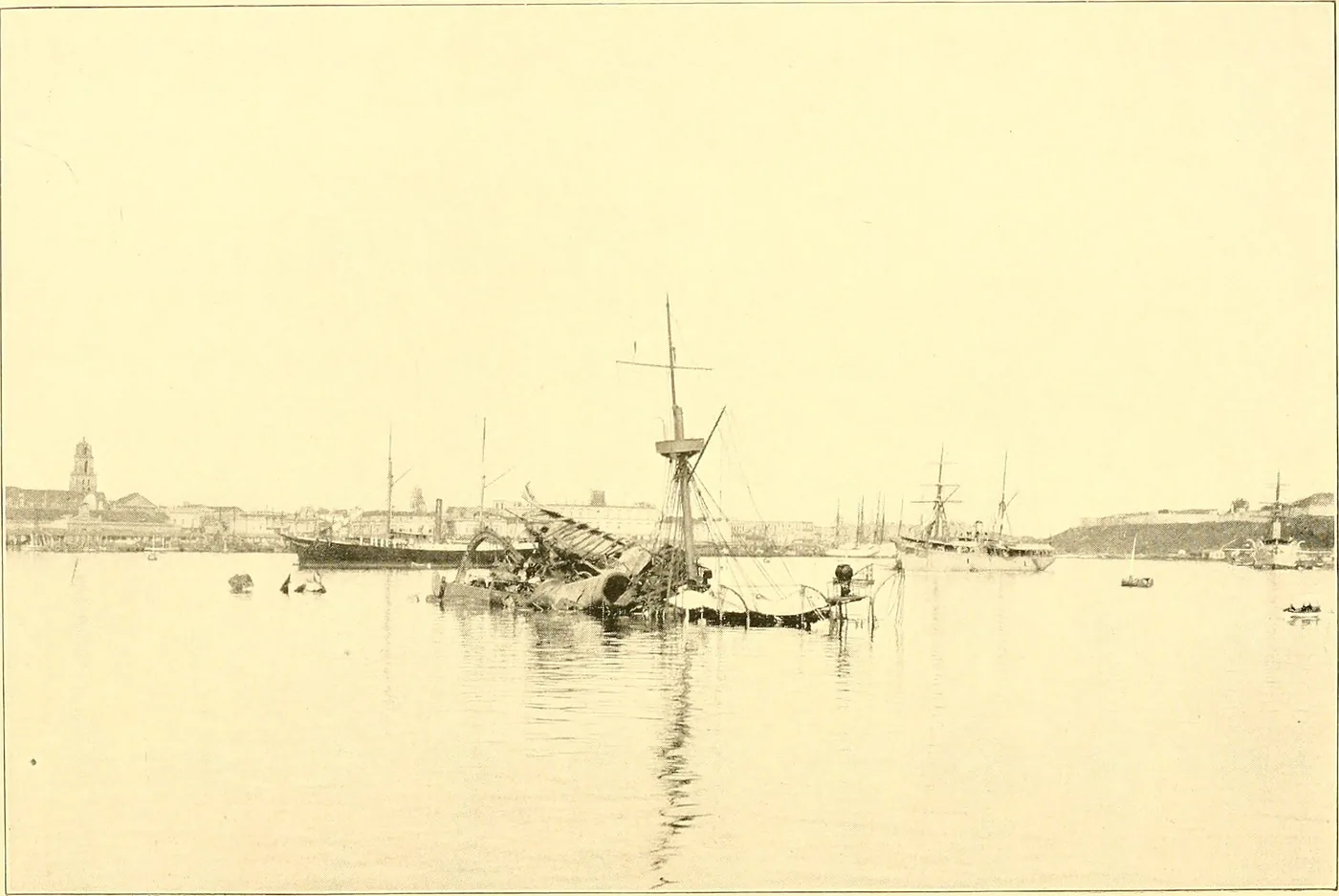
In February 1898, the American battleship USS Maine exploded in Havana harbor, killing 266 crew members. A naval board blamed a mine, and American newspapers, already pushing for intervention in Cuba, blamed Spain. "Remember the Maine" became the rallying cry of the Spanish-American War. The United States won and gained control of the Philippines, Guam, and Puerto Rico. Decades later, investigators concluded that a coal bunker fire most likely ignited a gunpowder magazine. No evidence of Spanish involvement has ever been found.
On September 18, 1931, officers in Japan's Kwantung Army set off a small explosive on a railway they controlled near Mukden, in northeastern China. They blamed Chinese soldiers. The blast was so weak that a train passed over the track minutes later. Japan used the incident to seize all of Manchuria.
Late on August 31, 1939, a team of German SS men posing as Polish insurgents stormed a radio transmitter in the town of Gleiwitz. They broadcast a brief announcement in Polish and left behind a murdered man dressed as a Polish saboteur. Germany invaded Poland at dawn the next day, with Hitler claiming that Poland had attacked first.
On November 26 of the same year, Soviet guns fired on Mainila, a village on the Soviet side of the Finnish border. Moscow blamed Finland and invaded four days later, starting the Winter War.
In August 1964, American destroyers in the Gulf of Tonkin reported a second attack by North Vietnamese torpedo boats. A real engagement had taken place two days earlier, on August 2. The second, on August 4, almost certainly never occurred. Radar and sonar operators in rough seas reported contacts that later analysis found to be false. Congress passed the Gulf of Tonkin Resolution within days, and the United States spent the next decade fighting in Vietnam.
How international law changed casus belli
Until the early 1900s, war was considered a legitimate instrument of state policy, and a casus belli was mainly about establishing legitimacy and managing alliances. A related term, casus foederis, described the specific event that would activate a treaty of mutual defense. States worded these clauses carefully so that a partner's reckless adventure would not automatically drag them into a fight.
The United Nations Charter, adopted in 1945, rewrote those rules. Under Article 2(4), states may not threaten or use force against the territory of another state. Article 51 preserves a state's inherent right to defend itself when attacked. Together, these articles mean that a state can legally fight on its own only in self-defense.
But the Charter did not stop governments from inventing pretexts. It changed the vocabulary. Every modern military intervention is announced in the language of national defense, humanitarian rescue, or protecting citizens abroad. In February 2022, Russia launched a full-scale invasion of Ukraine and justified it by alleging that Russian-speaking Ukrainians in the east faced genocide and that the country needed what Moscow called "denazification." Neither claim was supported by evidence.
The casus belli still serves the same purpose it has served for centuries. A government going to war needs a justification that holds for its own population, its allies, and the wider world. The UN Charter changed the required vocabulary, but not the practice.