
Court Eunuchs
Castrated men who served rulers in China, the Ottoman Empire and Byzantium, often becoming the most powerful officials at court.
Court eunuchs were castrated men who served in the palaces of rulers across China, the Byzantine Empire, Persia, and the Ottoman Empire. They began as servants and guards, but over centuries they became advisers, generals, spymasters, and, in some cases, the people who actually ran the government. The reason rulers kept turning to them was simple: a eunuch could not have children, could not found a dynasty, and had no family network competing with the crown. His entire career depended on one person, the ruler who employed him. That made eunuchs, in theory, the most trustworthy people in the palace. In practice, it made some of them the most powerful.
How eunuchs gained power in China
Eunuchs served Chinese emperors from the earliest dynasties, but their political role grew largest under the Ming (1368-1644). The Ming court was built around a rivalry between two groups: the Confucian scholar-officials, who earned their posts through the imperial examination system, and the eunuchs, who served the emperor's household directly. The emperor needed the scholars to run the country, but he did not always trust them. Eunuchs became the counterweight. Ming emperors gave eunuchs control of a secret police, the system for delivering petitions and documents, and eventually the collection of taxes and the supply of armies. By the late Ming, the eunuch establishment had grown into a parallel government of tens of thousands, organized into twenty-four agencies within the palace walls.
The most famous Ming eunuch was Zheng He, the admiral who led seven expeditions across the Indian Ocean between 1405 and 1433, reaching East Africa. Zheng He had been captured as a ten-year-old boy in Yunnan in 1381 when Ming armies invaded the province. He was castrated and sent to serve the prince who later became the Yongle Emperor. His voyages commanded fleets larger than anything Europe had at the time, and they were planned and led by a palace eunuch.
The most notorious was Wei Zhongxian, who effectively ruled China from 1624 to 1627. The Tianqi Emperor, who took the throne at fifteen, preferred carpentry to government and left the business of ruling to Wei. Wei purged hundreds of officials who opposed him, built a network of spies across the empire, and had temples erected in his own honor. He was even compared to Confucius in official memorials. When the emperor died in 1627, Wei's power collapsed within weeks. The new emperor banished him, and Wei hanged himself before he could be tried.
The Qing dynasty, which replaced the Ming in 1644, studied what had gone wrong. The Shunzhi Emperor ordered a public warning posted that eunuchs must stay out of government. His successor, the Kangxi Emperor, kept the eunuch corps to about 3,300, down from tens of thousands under the Ming. Eunuchs remained in the Forbidden City as household servants, but held far less political power under the Qing. The last imperial eunuch, Sun Yaoting, outlived the system entirely. He was castrated in 1911, served Puyi, the last emperor, and died in Beijing in 1996 at the age of 93.
The two eunuch corps of the Ottoman Empire
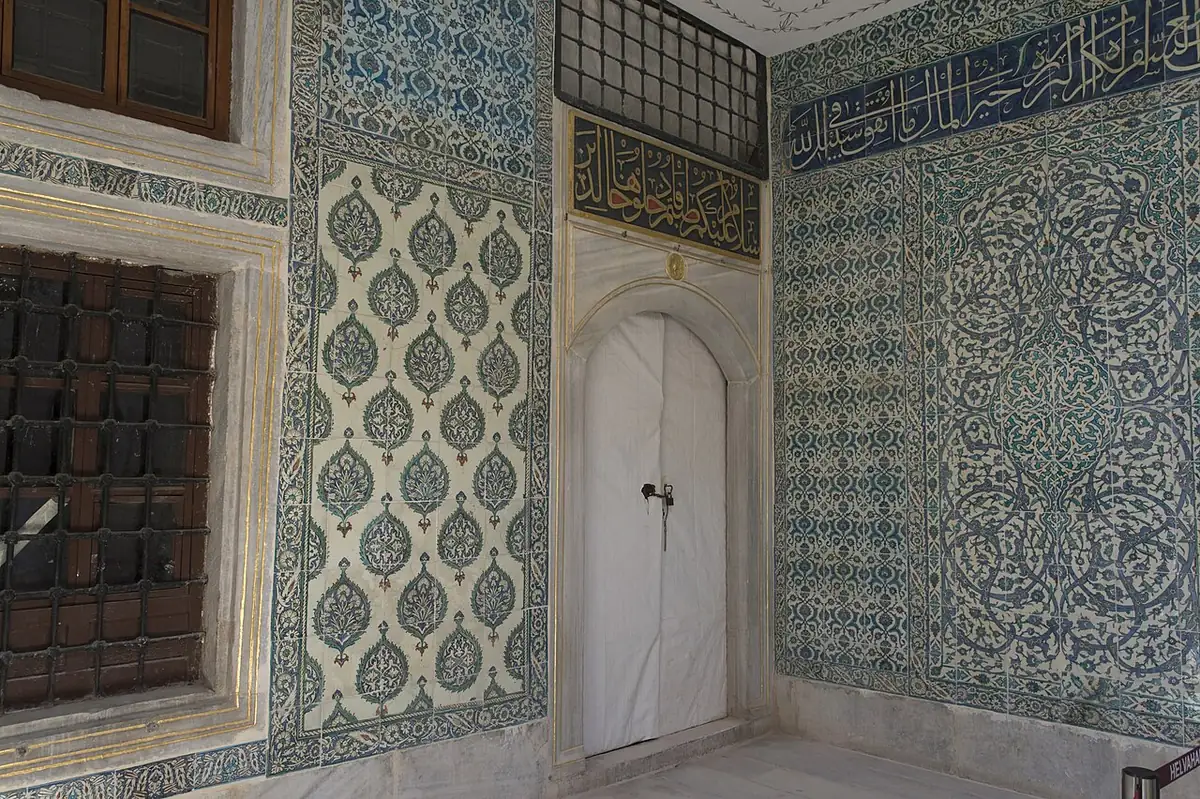
The Ottoman palace at Topkapi maintained two separate groups of eunuchs, divided by origin and role. The white eunuchs were drawn from the Balkans and the Caucasus region. Their chief, the Kapi Agha, ran the palace school where boys recruited through the devshirme system were trained to become the empire's administrators and military commanders.
The black eunuchs were enslaved men and boys brought from the upper Nile region and Ethiopia. They guarded the imperial harem, the section of the palace where the sultan's family lived. Their chief held the title Kizlar Agha, and over time he rose to extraordinary influence. The post was created in 1588 under Sultan Murad III, and the Kizlar Agha gained control of the charitable endowments of Mecca and Medina, giving him enormous wealth and patronage. His rank was comparable to that of the grand vizier.
The Kizlar Agha's power peaked in the seventeenth and eighteenth centuries. During part of that period, the mothers of young sultans often governed from the harem in what historians call the "Sultanate of Women." The Kizlar Agha was the link between the harem and the outside government. He decided who could see the sultan, carried messages between the women's quarters and the council chamber, and used his network of eunuchs as informants throughout the palace.
Why did rulers keep using eunuchs?
Every hereditary monarch faced the same problem: the people closest to the throne always tried to turn that closeness into power for their own families. Ministers built political dynasties. Generals married into the aristocracy. In-laws used their access to enrich their clans. Any trusted servant could, given time, found a rival house. A eunuch could not. He had no legitimate heirs and no kinship network that could threaten the ruling family.
That gave rulers two things they could not easily get from anyone else. First, loyalty that had nowhere else to go, because a eunuch's career ended the moment his patron fell. Second, control over access. A palace that housed the ruler's wives and children required male attendants who posed no risk to the line of succession. Eunuchs filled that role, and it gave them physical proximity to the ruler and control over who could reach him. Proximity and gatekeeping together are the ingredients of political power in any court, and eunuchs held both.
Rulers in China, Persia, Byzantium, and the Ottoman Empire arrived at the same solution, separated by thousands of miles and centuries. The institution ended when the monarchies that created it ended. It depended on the castration of children, who were often enslaved and often foreign. As many as nine in ten boys died from the procedure itself. Nearly every surviving account of eunuchs was written by the scholars and nobles who competed with them for power, which is why eunuchs appear in most histories as scheming and corrupt. The structural reason rulers kept choosing them tells a different story.