
D-Day (Normandy Landings)
D-Day was the Allied invasion of Normandy on June 6, 1944, the largest amphibious military operation in history.
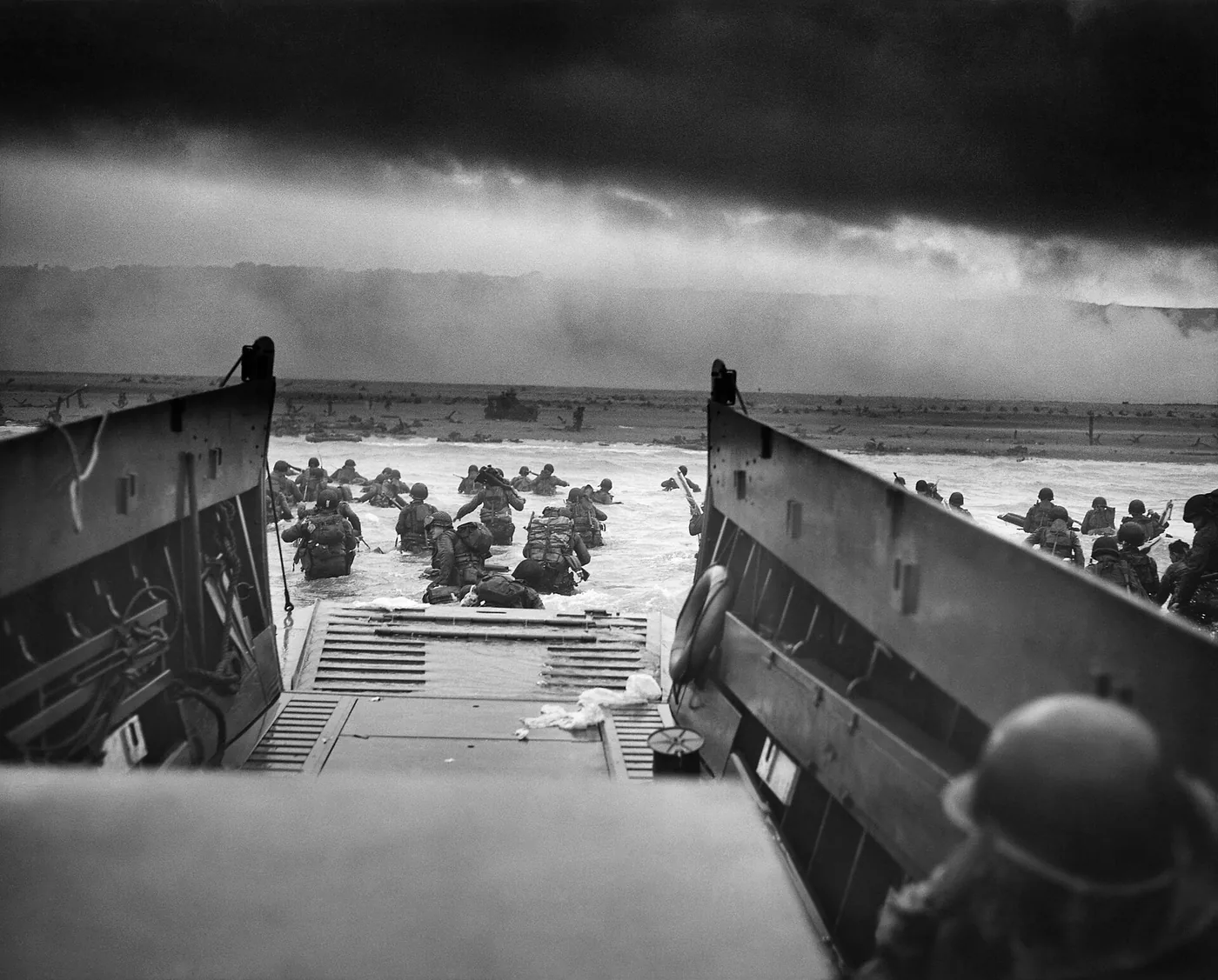
D-Day, June 6, 1944, was the Allied invasion of Normandy, France. About 156,000 soldiers from the United States, Britain, and Canada landed along fifty miles of coast in the largest seaborne invasion ever attempted. Nearly 7,000 ships carried them across the English Channel, and about 11,000 aircraft supported them from above. The invasion opened a western front against Nazi Germany at a time when the Soviet Union had already turned the war around on the Eastern Front. By nightfall the Allies held a strip of the Normandy coast. The campaign that followed led to the liberation of France, the defeat of Germany, and a postwar order that divided Europe between the Western democracies and the Soviet Union.
Why it took until 1944 to invade
Stalin had been demanding a second front since 1941. The Soviet Union was bearing most of the war's cost in lives, and Stalin suspected Britain and the United States of letting Russians do most of the dying. Winston Churchill resisted. He remembered the Somme from the First World War and watched the costly 1942 raid on Dieppe fail. He kept steering Allied effort toward North Africa and Italy instead.
Allied leaders agreed to launch the invasion in the spring of 1944. Dwight Eisenhower was named supreme commander. Bernard Montgomery, the British general who had beaten Rommel in North Africa, would lead the ground assault. Five beaches along the Normandy coast were assigned: Utah and Omaha for the Americans, Gold and Sword for the British, Juno for the Canadians.
There was no usable port on the Normandy coast, so the Allies built two prefabricated harbors, called Mulberry harbors, and towed them across the Channel in sections. Tanks were modified to swim, clear mines, and lay bridges. But the deception effort may have mattered as much as the engineering. Operation Fortitude placed a fake army in southeast England with inflatable tanks, false radio traffic, and the American general George Patton in nominal command. The goal was to convince the German high command that the Normandy landing was a diversion and that the real invasion would hit the Pas de Calais, 150 miles to the northeast. Intelligence decoded at Bletchley Park confirmed the Germans believed it. Hitler held back his armored reserves for weeks after the landing, waiting for an attack at Calais that never came.
What happened on June 6
A storm over the English Channel forced a 24-hour delay. On the evening of June 4, Eisenhower's chief meteorologist, Group Captain James Stagg of the Royal Air Force, forecast a brief break in the weather on June 6. Eisenhower gave the order to go. He drafted a note for use if the landing failed: "If any blame or fault attaches to the attempt it is mine alone."
The Germans, who had fewer weather stations, assumed no one would cross the Channel in such conditions. Several top German commanders had left their headquarters. Erwin Rommel, who was responsible for the beach defenses, had traveled to Germany to be with his wife on her birthday.
Paratroopers landed behind the beaches in the hours before dawn and were scattered across the hedgerows. At first light the seaborne assault began. Four of the five beaches went roughly to plan. Omaha did not. The beach sat below high bluffs, and the German 352nd Infantry Division defending it was at full strength. Allied planners had not expected that unit to be there. The first waves were pinned down on the sand, and for hours the assault nearly failed. Omaha cost roughly 2,400 casualties before the day was over.
When darkness fell, every beach was in Allied hands. The day's confirmed dead numbered 4,436. Total casualties, including wounded and missing, came to about 10,000. But the landing was the start of a long fight. Breaking out of the hedgerow country took another seven weeks. Paris was liberated on August 25.
Why is it called D-Day?
"D-Day" is a standard military planning term, not a name invented for the Normandy invasion. In U.S. Army usage, "D" is a placeholder for the day an operation begins, just as "H-Hour" marks its starting time. Planners used these placeholders so that units could coordinate their schedules before an actual date was set. The U.S. Army was already using the term in field orders during the First World War. Because June 6, 1944, was the most important D-Day by far, the name became permanently attached to the Normandy landings in public memory.
How many soldiers died on D-Day?
Confirmed Allied dead on June 6 totaled 4,436, including 2,519 Americans. Total Allied casualties for the day, counting killed, wounded, and missing, were about 10,000. German casualties are harder to determine, with estimates ranging from 4,000 to 9,000. The heaviest losses fell on Omaha Beach, with about 2,400 American casualties. Exact figures for the day are uncertain because record-keeping during the invasion was incomplete.
How D-Day shaped the postwar world
Later that June the Soviet Union launched Operation Bagration on the Eastern Front and wiped out a full German army group. By winter, Allied armies from the west had reached the Rhine, and Soviet armies from the east were deep into Poland. When the two sides met in the spring of 1945, the line between them became roughly the border of the Cold War.
The Marshall Plan, NATO, the division of Germany, and the occupation zones agreed at the Yalta Conference all followed from the Western Allies having armies on the ground in Europe. If D-Day had failed or been postponed by a year, the Red Army would likely have reached further west before the war ended. The postwar map of Europe was decided in large part on June 6, 1944.