
Yalta Conference
The Yalta Conference was a February 1945 meeting between Roosevelt, Churchill, and Stalin that divided postwar Europe into rival blocs.
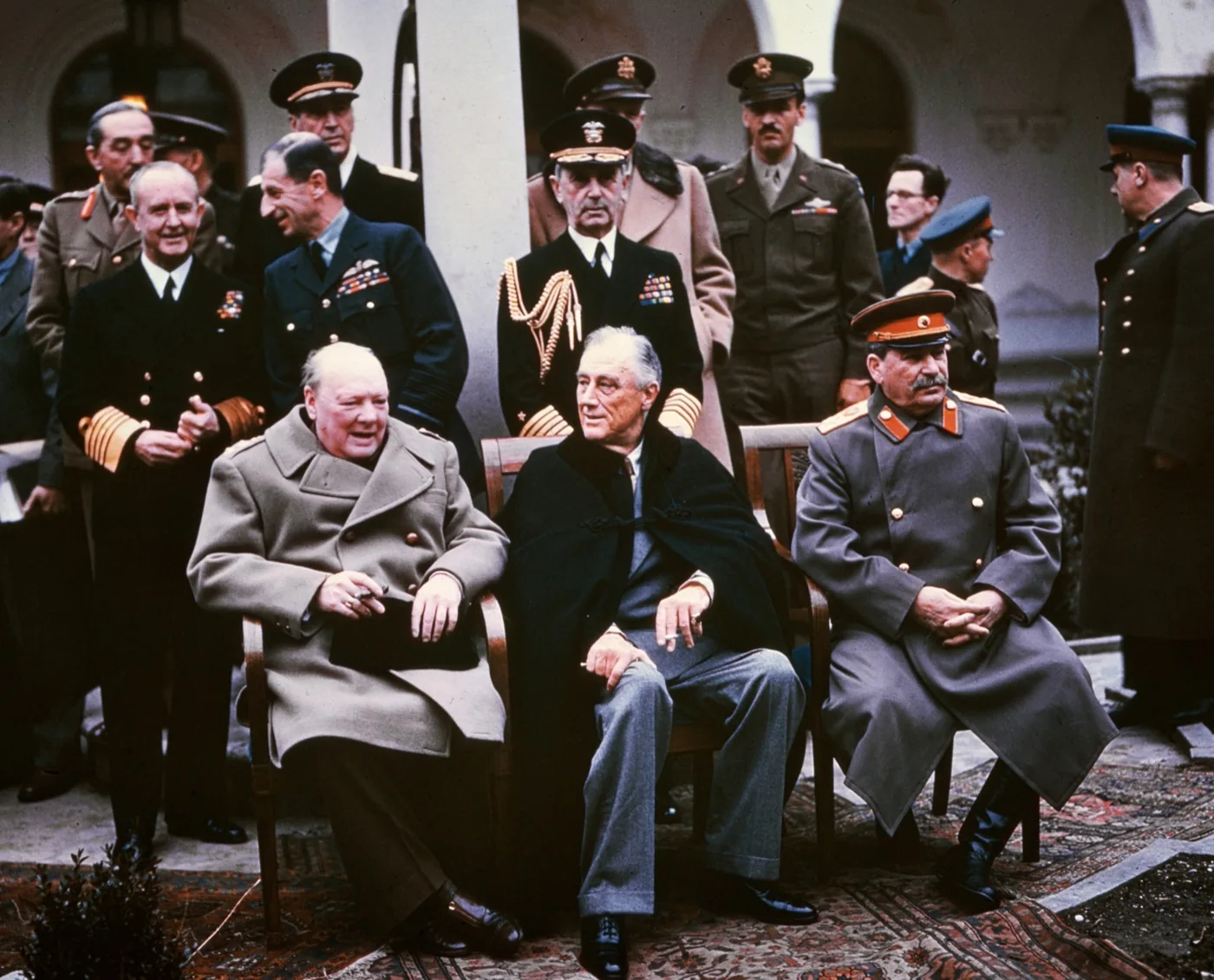
The Yalta Conference was a meeting between US President Franklin Roosevelt, British Prime Minister Winston Churchill, and Soviet leader Joseph Stalin held from February 4 to 11, 1945, at Livadia Palace in Crimea. The three came together to decide what would happen to Europe and Asia once Nazi Germany fell, which by February 1945 was only months away. Their agreements divided Germany into occupation zones, brought the Soviet Union into the war against Japan, and settled the voting rules that still govern the United Nations Security Council. The conference also produced a pledge from Stalin to allow free elections in Eastern Europe. He broke that pledge within three years. The word "Yalta" later became shorthand for powerful countries dividing the world without asking the people who lived there.
How Roosevelt, Churchill, and Stalin came to Yalta
Roosevelt was 63 and had been president for twelve years. He had won a fourth term the previous November, but his health was failing. He had heart disease and high blood pressure, and at his fourth inauguration on January 20 he spoke for just five minutes. Three days later he boarded the cruiser USS Quincy for a ten-day voyage across the Atlantic, then flew from Malta to Crimea. He would be dead about two months later.
Churchill, 70, had led Britain through the worst of the war but arrived at Yalta in a weaker position than at earlier summits. Britain was running out of money, and the balance of power had shifted toward Washington and Moscow.
Stalin, 66, was the host. He chose Yalta, on the Black Sea coast, partly because he refused to fly. He held the strongest position of the three. The Red Army had advanced more than a thousand miles westward since Stalingrad and by February 1945 was less than fifty miles from Berlin. Soviet troops occupied most of Eastern Europe, and nothing short of a new war could push them out.
The conference took place in Livadia Palace, a white stone building overlooking the sea that had been the summer residence of Tsar Nicholas II. The Germans had used it as a headquarters during their occupation of Crimea and stripped it bare. The Soviets refurbished it in weeks for the meeting. Roosevelt stayed in the palace, Churchill at the nearby Vorontsov Villa, and Stalin at the Koreiz Palace a few miles away.
What was decided at the Yalta Conference?
The conference produced three major agreements.
First, Germany would be divided into occupation zones. Roosevelt, Churchill, and Stalin each took a zone, and Churchill insisted that France receive a fourth. This division lasted forty-five years and produced two separate German states, West Germany and East Germany.
Second, Stalin committed to attacking Japan within about ninety days of Germany's surrender. In return, the Soviet Union would receive the southern half of Sakhalin Island, which Russia had lost to Japan in the Russo-Japanese War of 1904-05, and the Kurile Islands, along with special privileges in Manchuria. Roosevelt and Stalin negotiated this part privately. Churchill signed the agreement but played little role in shaping it. China's leader, Chiang Kai-shek, was not told about the deal until months later, even though China lost territory under its terms.
Third, the Soviet Union would take part in the new United Nations. The three leaders settled the voting formula for the Security Council: the five permanent members, the United States, the Soviet Union, Britain, France, and China, would each hold the power to veto any major decision. That formula has not changed since.
The hardest dispute at the conference was over Poland. Britain entered the Second World War in 1939 over Poland's independence. By February 1945, the Red Army occupied almost the entire country. Stalin insisted that Poland's postwar government be friendly to Moscow. Churchill pushed for genuinely free elections. The compromise was a promise that Poland would hold "free and unfettered elections." In the Declaration on Liberated Europe, all three leaders also pledged to support free elections in every country liberated from Nazi control.
The Yalta Conference and the Cold War
Stalin broke the promise quickly. Within three years, communist governments answering to Moscow controlled nearly every country the Red Army had reached, including Poland, Hungary, and Czechoslovakia. Noncommunist parties were suppressed. Genuinely free elections were not held again until 1989.
In March 1946, the former British prime minister Winston Churchill gave a speech at Westminster College in Fulton, Missouri. He warned that "an iron curtain has descended across the continent." The phrase described what the Yalta agreements had failed to prevent.
Critics, especially in the United States and among the nations trapped behind the Iron Curtain, have argued that Roosevelt gave away Eastern Europe at Yalta. Their case is that the Declaration on Liberated Europe was a paper promise with no way to enforce it, and that signing it gave Stalin the appearance of Western consent for what he planned to do regardless.
Defenders point to the situation Roosevelt and Churchill actually faced. Soviet troops already occupied Eastern Europe. Forcing Stalin out would have meant starting a new war against the Soviet Union, which no Western government was willing to fight. A written commitment to free elections, even one Stalin might break, was the best outcome available without more bloodshed.
Roosevelt did not live to see whether the promise would be kept. He died of a stroke on April 12, 1945, two months after Yalta and less than a month before Germany surrendered.
The broken promises that followed the conference drew the line that divided Europe for the next four decades. The occupation zones hardened into the Iron Curtain. The Soviet-controlled governments formed the Warsaw Pact. The Western response became the policy of containment. That division held until the Berlin Wall fell in 1989.