
Manchukuo
Manchukuo was a Japanese puppet state in northeast China, ruled in name by the last Qing emperor but run by Japan's army from 1932 to 1945.
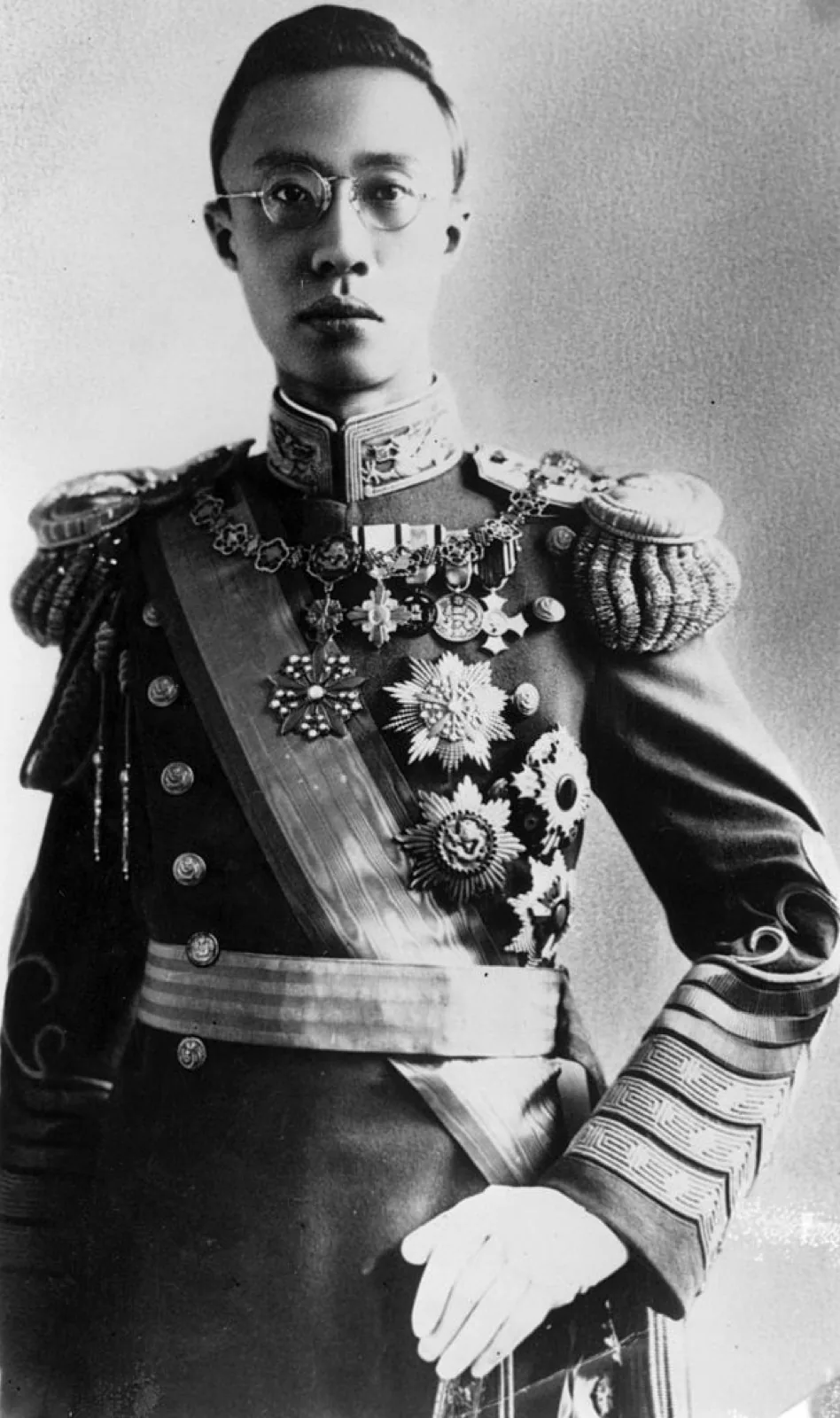
Manchukuo was a state that Japan created in northeast China in 1932 and controlled until 1945. It had its own flag, currency, and emperor, but the Japanese army ran every part of its government. It was the biggest territory in Japan's planned empire across Asia, and the first one it seized. The territory covered about 1.3 million square kilometers, bigger in area than France and Germany put together. Japan constructed railways, steel plants, and hydroelectric dams there, and the region became one of the most industrialized parts of Asia. But Manchukuo was also a place of forced labor, secret police, and covert biological weapons experiments. It lasted thirteen years and collapsed in about a week when the Soviet Union invaded in August 1945.
How Japan created Manchukuo
On the night of September 18, 1931, officers of Japan's Kwantung Army set off a small explosive charge on the South Manchuria Railway near the city of Mukden. The explosion barely damaged the track, but the officers blamed Chinese soldiers and used it as a pretext to seize all of Manchuria within a few months. The government in Tokyo had not authorized the attack. The public in Japan supported the conquest, and the government endorsed it after the fact.
In March 1932, Japan announced that the conquered territory was now an independent country called Manchukuo, with its capital at Changchun, renamed Hsinking, meaning "new capital." For its ruler, Japan chose Puyi, the last emperor of China's Qing dynasty. Puyi had lost the throne as a six-year-old in 1912, when the dynasty fell. After being expelled from the Forbidden City by a warlord in 1924, he had spent years living under Japanese protection in the city of Tianjin. Puyi became Manchukuo's chief executive in 1932 and was made emperor in March 1934. His Japanese overseers arranged the enthronement ceremony. He wore a Western-style military uniform, signed documents as instructed, and held no real authority.
How Japan ran Manchukuo
Real power belonged to the Kwantung Army's commander, who also held the title of Japan's ambassador to Manchukuo. Japanese officials filled every ministry.
Japan invested heavily in the region. It built railways across Manchuria, opened coal and iron mines, and constructed steel mills and hydroelectric dams. Japan rebuilt Hsinking with broad boulevards and modern government buildings, and the city's population grew fourfold between 1932 and 1939.
Starting in 1936, Japan launched a twenty-year program to send a million farming families to Manchukuo. The settlers, most of them poor tenant farmers, were given land taken from Chinese owners. By 1945, more than a million Japanese civilians lived in the territory. Japanese control also brought forced labor and a widespread secret police. Near the city of Harbin, Japan operated Unit 731, a covert biological warfare program that conducted lethal experiments on prisoners.
Manchukuo's official ideology, called the "kingly way," advertised racial harmony among the peoples of northeast Asia. In practice, it was propaganda covering a military occupation.
Why did the League of Nations reject Manchukuo?
In 1932, the League of Nations sent a commission to Manchuria, led by the British diplomat Lord Lytton. The commission concluded that Japan had no right of self-defense to justify the invasion and that Manchukuo was not a genuine independence movement. In February 1933, the League adopted the report and refused to recognize Manchukuo as a legitimate state. Japan responded by withdrawing from the League entirely.
For the rest of its existence, Manchukuo was recognized mainly by Japan's wartime allies. By 1943, twenty-two countries had extended recognition, most of them Axis powers or their satellites. The United States, Britain, and most of the world never did.
How Manchukuo collapsed
On August 9, 1945, with World War II days from ending, roughly 1.5 million Soviet troops invaded Manchukuo. The Kwantung Army had been weakened by years of troop transfers to the Pacific and collapsed under the assault.
Puyi tried to flee to Japan. On August 19, Soviet paratroopers landed at the Mukden airfield and captured him as he waited to take off. The Soviets held him for five years, then handed him to the People's Republic of China. After a decade of political re-education, Puyi was released in 1959. He spent a year working as a gardener at the Beijing Botanical Garden and died in 1967 at age 61.
The more than a million Japanese civilians were abandoned by the retreating army. Roughly 245,000 died from fighting, exposure, starvation, and disease before the survivors were repatriated to Japan over the following two years. Manchukuo's territory returned to China. In China, the occupation of Manchuria remains part of what the government calls the century of humiliation, the long period of foreign interference that ended with the Communist victory in 1949.