
Fiat Money
Fiat money is currency that has value because a government declares it legal tender, not because it can be exchanged for gold or silver.
Fiat money is currency that has value because a government says it does, not because it can be exchanged for gold or silver. The word "fiat" comes from Latin and means "let it be done." A US ten-dollar bill is made of cotton and linen. The only reason it buys anything is that the United States government accepts it for tax payments, and businesses accept it for everyday purchases. Since 1971, when the United States stopped exchanging dollars for gold, every major currency on earth has operated on this basis. But governments have been trying to make paper money work for more than a thousand years, and for most of that time, they failed.
How paper money kept failing
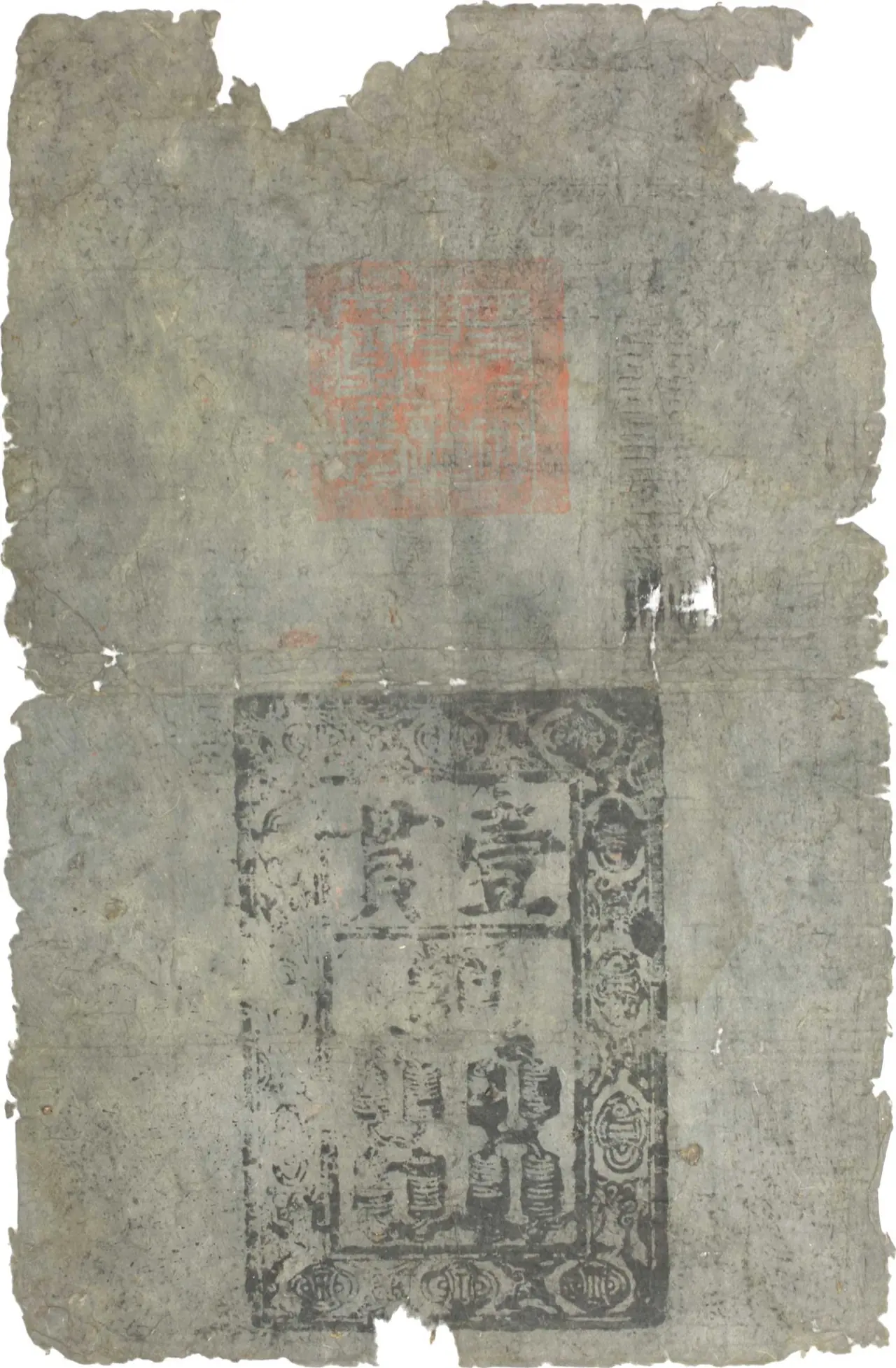
The first paper money appeared in China. By the eleventh century, merchants in the Song dynasty were using printed notes called jiaozi in Sichuan province, where the local iron coins were too heavy to carry in large quantities. The Song government took over the printing in 1023 and made jiaozi an official state currency. Later dynasties went further. In 1375, the Ming dynasty issued the Da Ming Baochao, a paper note that could not be exchanged for gold, silver, or anything else. The Ming government did not collect enough of the notes back through taxation, so the supply kept growing. Within a few decades, the notes had lost most of their face value. After this failure, China gave up on paper currency and used silver as its main form of money for roughly five centuries.
The same pattern played out in the West. During the American Revolution, the Continental Congress printed a paper currency called the Continental to pay for the war. It printed so many that the phrase "not worth a Continental" entered the language as a way of calling something worthless. During the French Revolution, the government issued paper notes called assignats, backed by confiscated church land. France printed too many of those as well, and the assignats became worthless. In each case, a government facing enormous expenses printed money until nobody trusted it.
How fiat money replaced the gold standard
For most of the nineteenth and early twentieth centuries, major currencies were tied to gold under the gold standard. A government promised to convert its paper money into a set amount of gold on demand, which limited how much it could print. The problem was that the total money supply depended on how much gold had been mined, and that had no connection to how much money an economy actually needed. During the Great Depression of the 1930s, the gold standard pushed interest rates up and wages down at exactly the wrong time. The countries that left the gold standard earliest recovered earliest.
Governments suspended gold convertibility during the First World War, brought it back in the 1920s, and dropped it again through the 1930s. After World War II, the Bretton Woods system created a compromise. Other countries fixed their currencies to the US dollar, and the US dollar could be exchanged for gold at $35 an ounce, but only by foreign governments, not by individuals. By 1971, foreign governments held far more dollars than the United States had gold to cover. On August 15, 1971, President Richard Nixon ended the dollar's convertibility into gold. Every major currency has been pure fiat money since.
What gives fiat money its value?
Three things keep fiat money valuable, and none of them is gold.
The first is taxation. Governments require people and businesses to pay taxes in their own currency. That creates a constant demand for the currency, because everyone needs it.
The second is legal tender laws. Governments declare their currency the official form of payment, which means creditors must accept it to settle debts.
The third, and most important, is the central bank's willingness to keep the currency scarce. A central bank controls how much money exists in the economy. If it creates too much, prices rise and the currency loses value. If it keeps the supply in check, prices stay stable and people trust the money. In 1990, New Zealand's central bank became the first to set a formal inflation target, committing to keep price increases within a fixed range. Dozens of other central banks followed. Inflation targeting gave fiat money a discipline similar to what the gold standard once provided. The difference is that a group of people sets the limit, not the amount of gold that happens to exist.
When fiat money fails
When a government cannot borrow money and will not cut its spending, it sometimes prints money to cover the gap. If it prints enough, the result is hyperinflation: prices rise so fast that the currency becomes nearly worthless. Weimar Germany in the early 1920s, Zimbabwe in the late 2000s, and Venezuela in the late 2010s all went through it. In every case, the cause was a government using the printing press to pay for spending it could not fund any other way.
But the same ability to create money makes fiat systems useful in a crisis. In 2008, central banks created large amounts of money to keep the financial system from collapsing. They did it again in 2020 during the pandemic. Both responses were far larger than anything possible under a gold standard. The inflation that followed from 2021 to 2023 tested that arrangement more than anything had in decades, and it renewed debate about whether fiat money gives governments too much power over the currency. Every major currency today still depends on the judgment of the people who control its supply.