
Weimar Republic
Germany's first democracy, the Weimar Republic lasted from 1919 to 1933 and ended when Adolf Hitler was appointed chancellor.
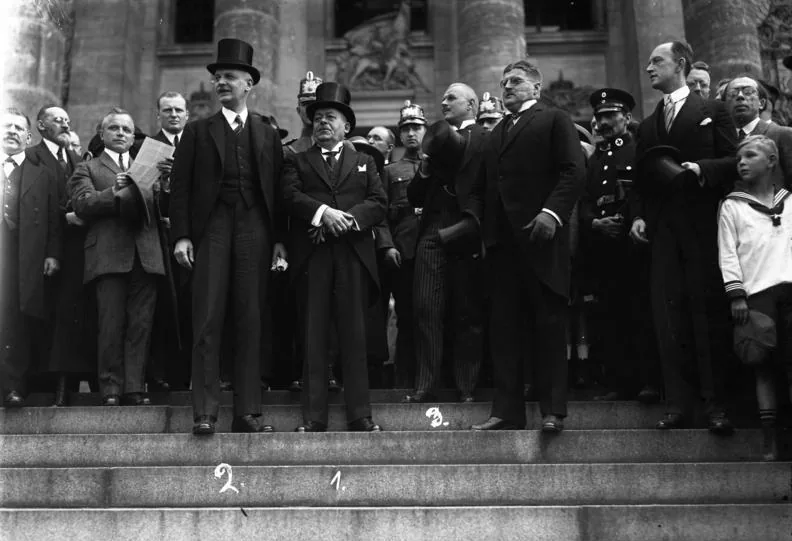
The Weimar Republic was Germany's first democratic government. It was founded in 1919, after Germany lost the First World War, and it ended in 1933, when Adolf Hitler was appointed chancellor. The republic takes its name from the city of Weimar, a small town in central Germany where the national assembly met to write the constitution, because Berlin was too dangerous. Weimar was the city of Goethe and Schiller, and the founders hoped the association with Germany's literary tradition would lend the new state legitimacy. The republic faced economic crises and political violence for most of its fourteen years, and it remains one of the most studied cases of democratic failure in history.
How the Weimar Republic began
The German army was defeated in the field in 1918. The high command, led by Erich Ludendorff and Paul von Hindenburg, told Kaiser Wilhelm II at the end of September 1918 that the army could not hold and an armistice was needed immediately. But Ludendorff and Hindenburg arranged for civilians, not themselves, to sign the ceasefire. Within months, both men were telling the public that the army had never really lost, that politicians, socialists, and Jews had betrayed it from behind. This "stab-in-the-back" myth was a lie, but it spread widely. The politicians who ended the war were labeled "November criminals." Matthias Erzberger, the civilian who led the armistice delegation, was assassinated by right-wing gunmen in 1921. Walther Rathenau, the republic's foreign minister, was murdered by members of the same organization in 1922. The republic had ended the war because the war was lost, but its opponents blamed it for the defeat and never accepted the Treaty of Versailles that followed.
The 1919 constitution was one of the most progressive of its era. It gave the vote to all adults aged twenty and older, men and women alike. It provided for a directly elected president and for national referenda. But two features proved dangerous. Pure proportional representation with no minimum threshold meant any party that won enough votes for a single seat entered parliament. The Reichstag was split among more than a dozen parties, and stable coalitions were almost impossible. Article 48 gave the president the power to govern through emergency decrees, bypassing parliament entirely. President Friedrich Ebert invoked it more than 130 times in the republic's early years. Each use made governing without elected representatives seem more ordinary.
From hyperinflation to the Great Depression
The republic's worst early crisis came in 1923. France occupied the Ruhr, Germany's industrial heartland, to force reparations payments. The German government printed money to support workers who went on strike against the occupation, and the currency collapsed. By November 1923, one US dollar was worth 4.2 trillion marks. The hyperinflation wiped out savings, pensions, and the value of insurance contracts.
After the currency was stabilized, five relatively good years followed. The Dawes Plan brought American lending into Germany and restructured the reparations schedule. Gustav Stresemann, who served as chancellor briefly in 1923 and then as foreign minister until his death in 1929, rebuilt Germany's standing in European diplomacy. Berlin turned into a center of art, theater, and film. Support for extremist parties fell. In May 1928, the Nazi Party won just 2.6 percent of the vote.
The Great Depression ended all of it. More than six million Germans were out of work. In 1928 the Nazis had won 2.6 percent. By September 1930 they had 18.3 percent. In the July 1932 election they took 37.3 percent, making them the largest party in the Reichstag. Communist support climbed at the same time. By the end of 1932, more than half the seats in the Reichstag belonged to parties openly committed to abolishing it.
How did Hitler come to power?
Hitler did not seize power. President Hindenburg offered him the chancellorship on January 30, 1933. The appointment came at the insistence of Franz von Papen and a group of conservative politicians who believed they could control Hitler. His initial cabinet had only two other Nazis out of eleven ministers.
They were wrong. Four weeks later, on February 27, the Reichstag building burned. Hitler used the fire as a pretext for an emergency decree that suspended civil liberties across Germany. On March 23, the Reichstag passed the Enabling Act, which gave the cabinet the authority to pass laws on its own. The republic was not overthrown by a revolution or a foreign army. It was undone piece by piece through its own constitutional provisions.
This did not happen suddenly. From 1930, Chancellor Heinrich Bruening governed almost entirely through presidential decrees because no stable coalition would support him. Before Hitler even became chancellor, Germany had been run without parliament for nearly three years, by the same conservatives who thought they could keep him contained.
Why did the Weimar Republic fail?
No single cause explains the collapse. The constitution's lack of an electoral threshold made stable government difficult. Article 48 made rule by decree too easy. The hyperinflation of 1923 destroyed public trust in the republic. The Great Depression created mass unemployment that extremist parties exploited. And the stab-in-the-back myth meant the republic was never fully accepted by large parts of German society, including much of the military and the judiciary.
Postwar Germany built its constitution, the Basic Law, around the memory of what went wrong. Federal election law adds a five percent electoral threshold to keep splinter parties out of parliament. The Basic Law prohibits rule by decree. And it introduced the "constructive vote of no confidence": parliament can only remove a chancellor by electing a successor at the same time. Every one of these rules exists because of Weimar.