
Kwantung Army
Japan's army in Manchuria that repeatedly started wars on its own, dragging the government into conflicts it had not approved.
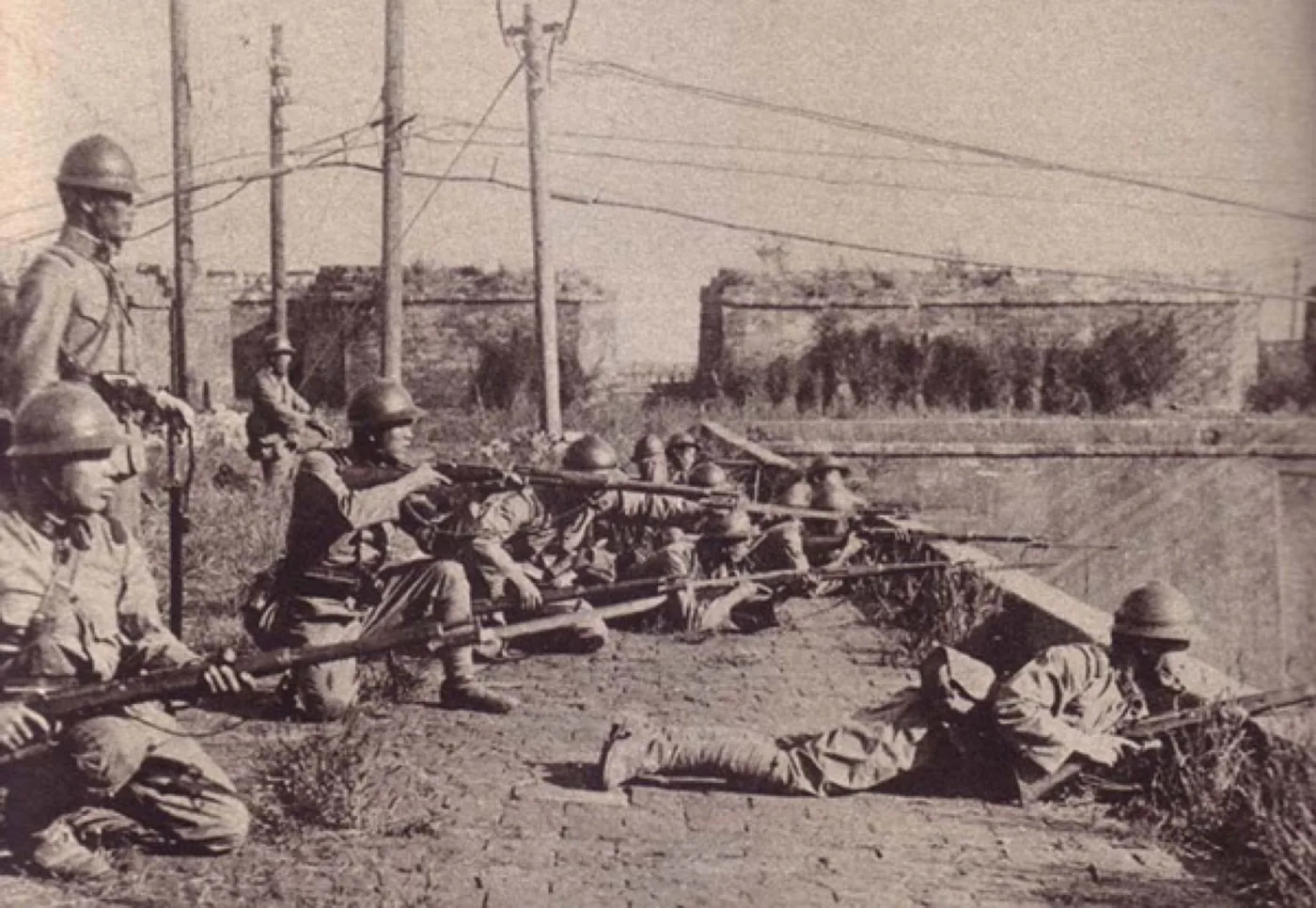
The Kwantung Army was a Japanese military force stationed in Manchuria from 1919 to 1945. Japan had gained a leasehold on the Liaodong Peninsula and control of the South Manchuria Railway after its victory in the Russo-Japanese War of 1905, and the Kwantung Army was created to guard them. What began as a garrison of about 10,000 men grew into the largest Japanese army overseas, with over 700,000 soldiers at its peak. Its officers repeatedly staged attacks, started wars, and overthrew foreign leaders without orders from Tokyo. The civilian government could not or would not stop them. The Kwantung Army seized all of Manchuria in 1931 and 1932, built the puppet state of Manchukuo, and helped push Japan into the wider wars that ended with its destruction in 1945.
How the Kwantung Army took Manchuria
In 1928, Colonel Komoto Daisaku of the Kwantung Army had a bomb planted under a railway bridge near Mukden and killed Zhang Zuolin, the Chinese warlord who controlled Manchuria. Zhang had risen from bandit to the most powerful man in northern China, and the Japanese hoped his death would give them an opening to take the region. It did not. Zhang's son, Zhang Xueliang, took power and aligned Manchuria with the Chinese Nationalist government instead. Tokyo covered up the assassination and barely punished the officer responsible.
Three years later, two Kwantung Army staff officers tried again. On September 18, 1931, Colonel Itagaki Seishiro and Lieutenant Colonel Ishiwara Kanji had soldiers set off a small explosive on the South Manchuria Railway near Mukden, the same railway the army was posted to protect. The blast was so weak that a train passed over the tracks minutes later. But the officers blamed Chinese troops and launched a full invasion of Manchuria without authorization from Tokyo. Within five months the Kwantung Army controlled the entire region, an area larger than France and Germany combined. It installed the last Qing emperor, Puyi, as the nominal ruler of Manchukuo.
The officers who planned the attack were promoted. Japan's civilian government, which had tried to stop the invasion, was left to accept what the army had done.
How the Kwantung Army pushed Japan toward wider war
The Kwantung Army ran on a principle the Japanese called gekokujo, meaning the lower overrules the higher. Junior and mid-level officers made decisions on their own, gambling that success would force Tokyo to go along. The conquest of Manchuria proved them right. Officers who defied civilian authority were rewarded, not punished, and the pattern spread through the rest of the Japanese military.
Manchuria served as a training ground for the officers who would later lead Japan into World War II. Hideki Tojo, who served as the Kwantung Army's chief of staff from 1937 to 1938, became Japan's wartime prime minister in 1941 and led the country into war with the United States at Pearl Harbor. The Kwantung Army also ran Unit 731, a secret biological warfare program based in Harbin that conducted experiments on prisoners. Other officers who served in Manchuria brought its culture of insubordination back to Tokyo and into the highest levels of government.
The Kwantung Army's defeat at Nomonhan
In the summer of 1939, the Kwantung Army picked a fight on the Soviet border at Nomonhan, where Manchukuo met Soviet-allied Mongolia. What started as a skirmish over grazing land escalated into a full-scale undeclared war. The Soviet commander, Georgy Zhukov, launched a combined assault with nearly 500 tanks, over 500 aircraft, and 57,000 troops that encircled and destroyed much of the Japanese force. Japanese troops fought largely with rifles and light weapons against Soviet armor. The Japanese 23rd Division suffered more than 70% casualties, and Japan's official count listed more than 8,600 killed.
The defeat had a lasting consequence for the course of World War II. It steered Japan away from expanding north against the Soviet Union and toward expanding south against the United States and Britain, a decision that led to Pearl Harbor two years later.
What happened to the Kwantung Army?
By 1945, the Kwantung Army's best divisions had been shipped south to fight the Americans in the Pacific. On paper it still had roughly 700,000 men in Manchuria, but many were raw conscripts with little training and outdated equipment. Japanese commanders rated their 24 remaining divisions as equal in fighting power to about eight full-strength ones.
On August 9, 1945, three days after the atomic bombing of Hiroshima, roughly 1.5 million Soviet troops invaded Manchuria from three directions. Soviet tanks and mechanized units crossed deserts and mountains faster than the Japanese had believed possible. The Kwantung Army collapsed in less than two weeks. Its commanders ordered a surrender on August 19.
About 600,000 Japanese soldiers were taken to labor camps in Siberia. Many spent years doing forced labor in extreme cold. The last major group of prisoners was not released until 1956, more than a decade after the war ended. The Kwantung Army is the clearest example of how Japan's military acted beyond its government's control before World War II. The unauthorized wars its officers started helped set Japan on the path to a conflict it could not win.