
Long March
The Long March was the Chinese Red Army's year-long fighting retreat across China in 1934–1935 that brought Mao Zedong to power.
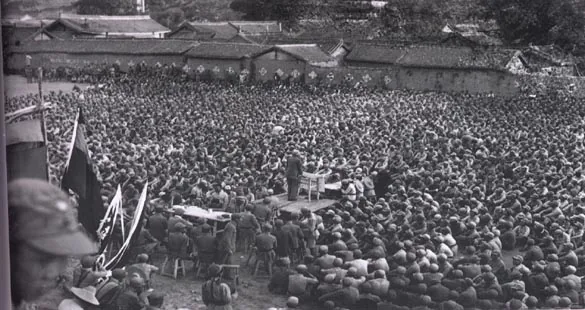
The Long March was the Chinese Red Army's fighting retreat across China from October 1934 to October 1935. Around 86,000 Communist troops and officials fled their base in southern Jiangxi province after Nationalist forces surrounded them. Over the next year they walked roughly 6,000 miles, fighting through Nationalist lines, over snow-covered mountains, and across marshlands where soldiers sank and drowned. Fewer than 8,000 of the original column reached northern Shaanxi province, a loss of more than 90 percent. But during the march, Mao Zedong took control of the Communist Party, and the survivors became the core of leaders who governed China for decades to come.
How the Communists lost their base in Jiangxi
The Chinese Communists had built a base area, the Jiangxi Soviet, in the hills of southern China in the late 1920s. By 1933, Chiang Kai-shek and the Kuomintang were on their fifth campaign to destroy it. This time Chiang's forces built thousands of concrete blockhouses in a tightening ring and slowly cut the base off instead of attacking head-on.
The Communist military leadership was then in the hands of Bo Gu, a Moscow-trained official who was just 27 years old, and Otto Braun, a German military adviser sent by the Comintern. They tried to defend the base with conventional tactics against the blockhouse strategy and failed. By October 1934 the Communists decided to abandon Jiangxi entirely.
The breakout began on October 16, 1934. The column moved slowly, weighed down with printing presses, silver reserves, and crates of files. Mao Zedong, weakened by a bout of malaria, was carried on a litter. Within weeks the column ran into Nationalist blocking forces at the Xiang River. The crossing, from late November to early December, cost more than 30,000 soldiers killed, wounded, or scattered. The Red Army had lost roughly half its strength in one battle. After the Xiang River the survivors dumped the heavy equipment and began moving fast.
How Mao Zedong rose to power during the Long March
The Xiang River disaster discredited the men who had planned the retreat. At a conference in Zunyi, a town in Guizhou province, in January 1935, Mao Zedong challenged the military decisions that had led to the loss of Jiangxi. Mao was 41 and had spent years sidelined by the Moscow-educated leadership. His targets were Bo Gu and Otto Braun. Zhou Enlai, one of the top commanders, sided with Mao. The conference stripped Braun of his military authority and gave Mao a leading role in commanding the Red Army.
Mao was not yet the unchallenged ruler he later became, but the Zunyi Conference began his rise to sole power. Without the catastrophe, his rivals might have held on.
After Zunyi the march continued for nine more months through some of China's most difficult terrain. The column crossed snow mountains in western Sichuan where soldiers froze to death on the passes. It crossed the Great Grasslands, a high-altitude marsh where men died by stepping into hidden sinkholes. The marchers moved after dark, fought skirmishes along the way, and ate whatever they could take or beg from villagers. Famous episodes from this stretch, especially the assault on the Luding Bridge, were embellished over decades of retelling, but they were real. At the Luding Bridge, an iron-chain span over the Dadu River, twenty-two soldiers crawled across the bare chains after Nationalist defenders removed the wooden planks.
On October 19, 1935, the column reached the town of Wuqi in northern Shaanxi. The Communists later settled nearby in Yan'an, where they built a new base that lasted until the end of the civil war in 1949.
How many people died on the Long March?
Of the roughly 86,000 who set out from Jiangxi, fewer than 8,000 from the original column reached Shaanxi a year later. Most were lost to combat, starvation, disease, exposure, and desertion. Other Communist armies made their own marches from different bases between 1934 and 1936. The 86,000 figure and the roughly 8,000 survivors refer to the central column, the one Mao led. That is the march people usually mean when they say "the Long March."
How the Long March became China's founding story
The Communists who survived were a smaller but more committed group. Many of them went on to run China for the next fifty years. The Party turned their ordeal into its central story of revolutionary endurance, taught in schools, shown in films, and carved on monuments. The Party's official count of 25,000 li (about 8,000 miles) is the distance it claims for the central column. That figure is printed on memorials today, though the central column's route was closer to 6,000 miles.
American journalist Edgar Snow brought the story to the outside world in Red Star Over China, published in 1937. Snow traveled to the Communist base in Shaanxi and interviewed Mao and the survivors. His sympathetic account shaped how Western readers understood the Chinese revolution for a generation.
Chinese leaders still invoke the Long March by name. In 2019, President Xi Jinping called on the nation to begin a "new Long March" as trade tensions with the United States rose. In June 2026 he used the phrase again. The march destroyed most of the army that began it. It also gave the Party the leaders who built the People's Republic and the story they have used to justify their rule ever since.