
Siege of Vienna (1683)
The siege of Vienna in 1683 ended when a Polish-led relief army broke the Ottoman siege and permanently reversed Ottoman expansion into Europe.
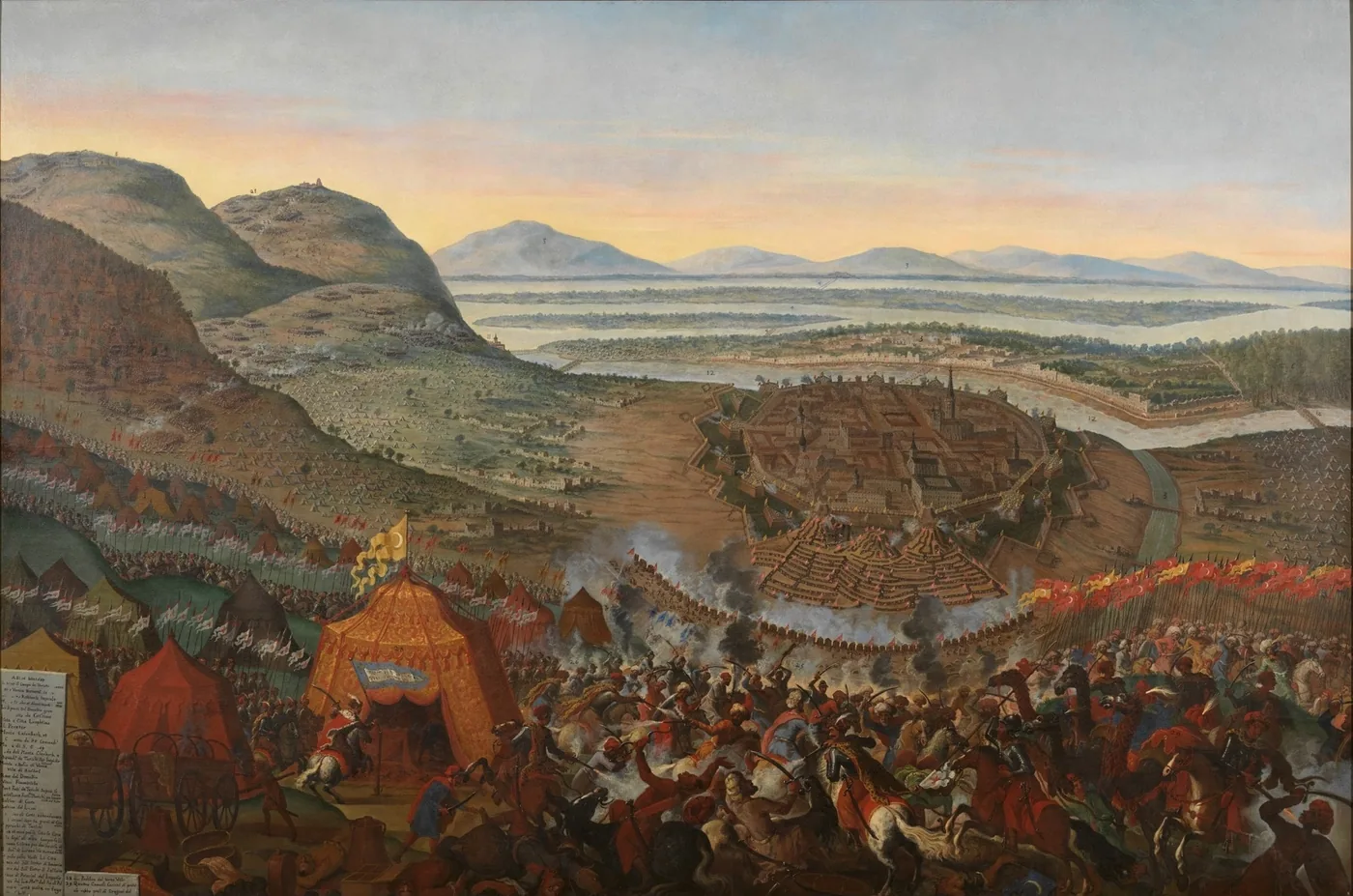
The Siege of Vienna in 1683 was the Ottoman Empire's second and last attempt to capture the Habsburg capital. For about two months, roughly 90,000 Ottoman troops under Grand Vizier Kara Mustafa Pasha besieged the city while a garrison of about 15,000 held the crumbling walls. By early September the defenders were starving and had lost half their number to fighting, disease, and hunger. On September 12, a Christian relief army led by Jan III Sobieski, king of Poland-Lithuania, attacked from the wooded hills northwest of the city. The battle ended with a massed cavalry charge of about 18,000 horsemen, led by Poland's winged hussars, that shattered the Ottoman army. It may have been the largest cavalry charge in history. The defeat permanently ended Ottoman expansion into Central Europe.
How the Ottomans besieged Vienna
In 1529, Suleiman the Magnificent had marched on Vienna and failed. A century and a half later, Grand Vizier Kara Mustafa Pasha decided to try again. Kara Mustafa believed that capturing the Habsburg capital would secure his legacy. In July 1683 he arrived at Vienna with an army of about 90,000 soldiers. The Habsburg emperor, Leopold I, had already fled the city.
Count Ernst Rüdiger von Starhemberg took charge of the defense with a garrison of about 15,000 soldiers. Rather than launching a direct assault, the Ottomans dug approach trenches and underground tunnels, filling them with gunpowder to blast holes in Vienna's bastions. The siege turned into a slow, grinding war underground. Starhemberg's men dug counter-tunnels, trying to find and collapse Ottoman mines before they could be detonated. Above ground, the garrison fought off repeated attempts to storm the gaps that the explosions opened.
For sixty days the garrison held. By early September, the defenders had lost about half their strength to combat, dysentery, and hunger. The city's walls were cracked in several places. Starhemberg's men launched rockets into the sky at night, signaling for rescue. Vienna was days from falling.
How Jan Sobieski broke the siege
Pope Innocent XI had spent months putting together a Christian coalition to save Vienna. He persuaded the German princes of the Holy Roman Empire to send troops and convinced Jan III Sobieski, king of Poland-Lithuania, to join the coalition. Sobieski was an experienced soldier who had spent years fighting Ottoman and Tatar raids along Poland's southern borders. The relief army, drawn from Poland, Austria, and several German states, totaled about 70,000 men.
On September 11, the relief army reached the Kahlenberg heights, a wooded ridge northwest of Vienna. The next morning, infantry began pushing down the slopes, and the fighting lasted all day. Late on September 12, Sobieski sent in the cavalry. About 18,000 horsemen charged downhill into the Ottoman lines, led by Poland's winged hussars, heavy cavalry who wore large wooden frames mounted with feathers on their backs. It was the decisive blow. The Ottoman line broke, and Kara Mustafa's army collapsed into a retreat that became a rout. The Ottomans abandoned their camp and everything in it. Sobieski's Polish-Lithuanian cavalry swept through the camp, capturing Kara Mustafa's personal tent and the grand vizier's banner.
Sobieski reported the victory to Pope Innocent XI with the Latin words "Venimus, vidimus, Deus vicit," meaning "We came, we saw, God conquered." It was a deliberate echo of Julius Caesar's famous phrase.
What happened after the siege of Vienna?
Kara Mustafa fled south toward Belgrade. On Christmas Day 1683, the sultan had him executed by strangulation with a silk cord.
The following year, in 1684, Pope Innocent XI organized the remaining coalition into a formal military alliance called the Holy League. The war that followed, known as the Great Turkish War, lasted until 1699 and ended with the Treaty of Karlowitz. It was the first treaty in which the Ottoman Empire, defeated in war, signed away large amounts of territory. The treaty stripped the Ottomans of Hungary and most of their remaining Central European lands.
The siege marked a permanent turning point. Before 1683, the Ottoman Empire had been expanding into Europe for more than two centuries, conquering the Balkans and twice reaching the walls of Vienna. After 1683, the Ottomans never threatened the city again. Their advance into Europe stopped and began a long, steady retreat that continued until the empire collapsed after World War I. By the nineteenth century, European diplomats were calling the Ottoman Empire the "sick man of Europe."
Two popular legends surround the battle. One claims that Viennese bakers created the croissant, curving it to resemble the crescent on the Ottoman flag, to mark the victory. Another says Vienna's first coffeehouse opened using coffee beans found in the Ottoman camp. Historians have debunked both stories, but they remain part of the city's folklore.
The siege of Vienna in 1683 is remembered as the moment the military balance between the Ottoman Empire and Christian Europe shifted for good. Before the battle, the Ottomans had been advancing. After it, they were in retreat.