
Simon Bolivar
Simon Bolivar was a Venezuelan general who led the wars that freed six South American nations from Spanish rule in the early 1800s.
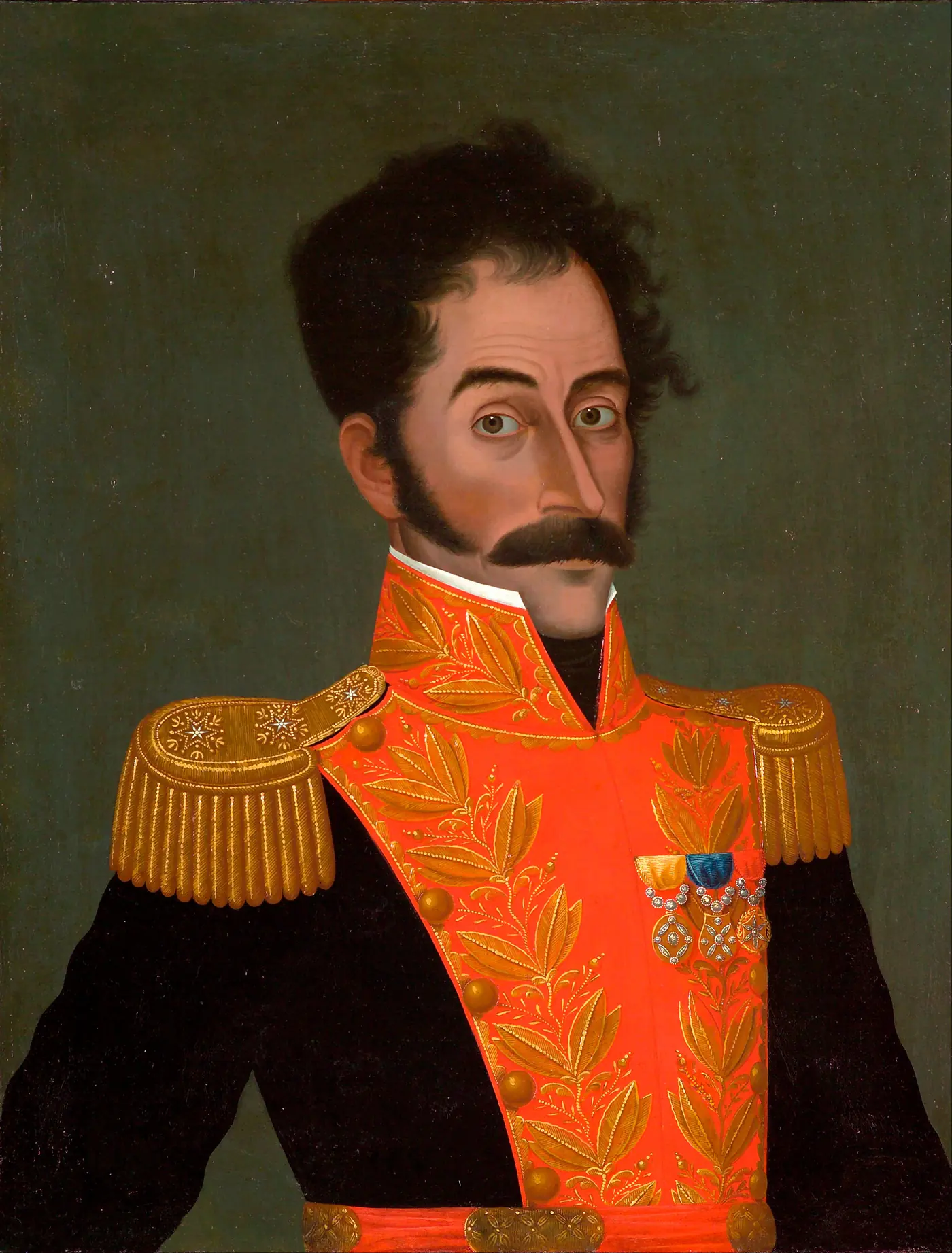
Simon Bolivar was a Venezuelan general who led the independence of six South American nations from Spain between 1819 and 1825. Known as El Libertador, Bolivar freed the territory of modern Venezuela, Colombia, Ecuador, Peru, Bolivia, and Panama. Bolivia is one of the few countries in the world named for a single person. Bolivar was born in Caracas on July 24, 1783, into one of the wealthiest families in the colony. He dreamed of uniting Spanish America into a confederation strong enough to stand on its own in the world. That dream collapsed before he died. On December 17, 1830, at the age of 47, Bolivar died of tuberculosis at a hacienda near Santa Marta, Colombia, with almost nothing to his name.
How Bolivar became a revolutionary
Bolivar's father died when he was two, his mother when he was eight. Raised by relatives and tutors, he was sent to Spain as a teenager. In Madrid he married Maria Teresa Rodriguez del Toro in 1802. She died of yellow fever eight months later, back in Caracas. Bolivar was nineteen. He later said her death changed the course of his life.
He returned to Europe and absorbed the ideas of the Enlightenment. In August 1805, Bolivar stood on the Monte Sacro hill outside Rome with his tutor Simon Rodriguez. There he reportedly swore he would not stop fighting until America was free of Spain. He went home to a continent that was ready to fight. Spain's colonies in the Americas had resented three centuries of rule from Madrid, and Napoleon's invasion of Spain in 1808 gave the independence movements their opening.
How Bolivar freed South America
Bolivar spent years leading campaigns in Venezuela that failed as often as they succeeded. After a defeat in 1815, he fled to Haiti, where the Haitian Revolution had created the hemisphere's first independent Black republic. Haiti's president, Alexandre Petion, gave Bolivar ships, weapons, soldiers, and a printing press. Petion asked one thing in return: that Bolivar abolish slavery in the lands he freed. Bolivar agreed and sailed back to fight.
His breakthrough came in 1819. Instead of attacking the Spanish where they expected him in Venezuela, Bolivar led his army out of the lowland plains, across flooded rivers, and over freezing Andean passes into New Granada, modern Colombia. The crossing killed hundreds of men and nearly all the horses. The Spanish commander in New Granada had not imagined anyone would attempt the route in the rainy season. Bolivar attacked from behind and defeated the royalist forces at the Battle of Boyaca on August 7, 1819. New Granada was free.
In June 1821, Bolivar won the Battle of Carabobo and took Venezuela. Antonio Jose de Sucre, his most trusted general, defeated the Spanish at the Battle of Pichincha in May 1822 and took Ecuador. Bolivar pushed south into Peru, where Spain still held its strongest position on the continent. At the Battle of Junin in August 1824, his cavalry routed the Spanish in a short, fierce fight on a plateau at more than 13,000 feet. Four months later, Sucre destroyed the last major Spanish army at the Battle of Ayacucho. Spanish rule on the South American continent was over. In 1825, a congress in Upper Peru declared independence and named the new republic Bolivia in Bolivar's honor.
Why Bolivar's dream of a united continent fell apart
Independence alone was not enough for Bolivar. He wanted the freed nations to form a union, partly modeled on the United States, strong enough to keep Spain from coming back and to carry weight in world affairs. He created Gran Colombia, which brought Venezuela, Colombia, Ecuador, and Panama under one government, and hoped to extend the confederation across Spanish America.
It did not hold. Regional strongmen, known as caudillos, pulled the new nations apart into rival states. Venezuela and Ecuador broke away, and Gran Colombia dissolved in 1830. Bolivar, sick with tuberculosis and stripped of power, wrote that year that "those who serve a revolution plow the sea." He resigned and planned to leave for Europe. He never made it. On December 17, 1830, Bolivar died at the Quinta de San Pedro Alejandrino, a hacienda near Santa Marta on the Colombian coast. Unlike George Washington, he never achieved a peaceful transfer of power.
Why Simon Bolivar still matters
Bolivar is commemorated across South America, with statues and plazas named for him from Caracas to La Paz. Nearly every political movement in the region has claimed him. In 1999, Venezuela's president Hugo Chavez renamed the country the "Bolivarian Republic of Venezuela" through a new constitution. He later organized a socialist political movement in Bolivar's name. The collapse of that movement is something Venezuela is still working through.
Bolivar freed what would become six independent countries, fighting across thousands of miles of mountains, plains, and jungle. He is the most important figure in South American independence. The nations he created honor him as their founder, even though their separation as independent countries is exactly what he spent his final years trying to prevent.