
Nationalism
Nationalism is the belief that humanity divides into nations and each nation deserves its own state. The idea emerged around 1800 and reshaped the world.
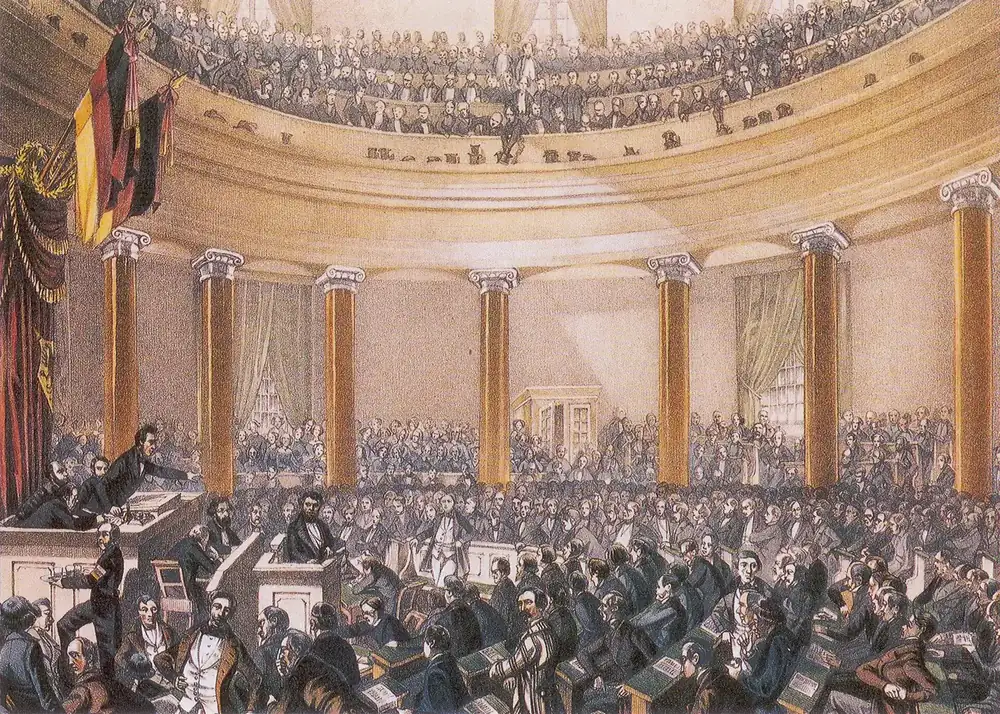
Nationalism is the belief that humanity divides naturally into nations and that each nation deserves its own state. Before 1800, almost nobody in Europe held this belief. People defined themselves by who ruled them, what god they worshipped, and where they lived. A farmer on Habsburg land served the emperor. The idea of "Austria" as a nation would not have made sense to him. Nationalists argued that a shared language and a shared past create a bond between strangers that outranks any loyalty to a dynasty. The idea appeared around the time of the French Revolution, spread across Europe in a single generation, and then spread across the world. Today 193 countries sit in the United Nations, nearly all of them built on the claim that their people are a nation. No political idea since 1800 has been adopted more widely.
How nationalism began
Three developments came together around 1800.
The first was the French Revolution. In 1789, the revolution turned the king's subjects into citizens of the nation. In 1793, the revolutionary government introduced the levee en masse, a system of mass conscription that drafted ordinary citizens into the army. The citizen soldiers fought harder than the professional armies they faced, because they believed the country was theirs.
The second was German romantic philosophy. Johann Gottfried Herder, a scholar born in East Prussia in 1744, argued that each people has a distinct spirit expressed in its language and folklore. The idea became known as the Volksgeist, the spirit of the people. Herder meant it as cultural pluralism: every people's traditions deserved respect. Later thinkers turned his argument into something harder, a claim that nations are defined by blood and ancestry.
The third was Napoleon. His armies occupied Germany, Italy, Spain, and Poland. Everywhere they went, they showed that a nation in arms wins wars. And everywhere they went, the people they conquered organized resistance using the same nationalist vocabulary that France had supplied. Napoleon spread nationalism by trying to dominate Europe, and Europe used nationalism to push him back.
How nationalism remade the map
Over the course of a century, nationalism destroyed the old multinational empires. The Habsburg, Ottoman, and Romanov empires ruled dozens of peoples under one crown. None of them could hold together once their subjects started demanding countries of their own.
The 1848 revolutions, which swept across Europe from Paris to Budapest, failed as uprisings but set the agenda for what followed. Italy proclaimed itself a kingdom in 1861. Germany unified in 1871 under Otto von Bismarck. The Balkans spent decades pulling away from Ottoman rule.
It was in the Balkans that nationalism set off the largest war the world had yet seen. On June 28, 1914, a Serbian nationalist named Gavrilo Princip shot Archduke Franz Ferdinand, the heir to the Habsburg throne, in Sarajevo. Princip and his group wanted Bosnia, which Austria-Hungary had annexed in 1908, to become part of Serbia. The assassination pulled Europe's alliance system into the First World War. By 1922, the Habsburg Empire, the Ottoman Empire, and the Russian Empire had all collapsed.
After the war, American president Woodrow Wilson made self-determination a guiding principle of the peace. The Treaty of Versailles and its companion treaties carved new nation-states out of the old empires: Poland, Czechoslovakia, Yugoslavia, and others. Wilson intended the principle for Europe. But educated people in the colonies heard it too. The same logic that broke up Austria-Hungary in 1918 ended British rule in India in 1947 and French rule in Africa and Southeast Asia soon after. Within a generation, European colonial rule across Africa and Asia collapsed. Gandhi and Kwame Nkrumah used the language of national self-determination just as the European nationalists of 1848 had.
What is the difference between civic and ethnic nationalism?
Civic nationalism holds that the nation includes anyone who lives in the country and agrees to its laws and principles. It does not matter where you were born or what language your parents spoke. France and the United States are the standard examples. In 1882, the French scholar Ernest Renan gave a lecture at the Sorbonne in which he called a nation "a daily plebiscite," meaning that a nation exists because its members choose, every day, to continue belonging to it.
Ethnic nationalism holds that the nation existed before the state and is defined by language, descent, and shared memory. The state exists to unite that nation within borders. Germany is the classic case: no unified German state existed before 1871, but German nationalists insisted the German nation was real long before any government represented it.
The distinction matters because of what each version does to people who do not fit. Under civic nationalism, anyone can join the nation by accepting its laws. Under ethnic nationalism, minorities who do not share the dominant group's ancestry or language become a problem. The answers that ethnic nationalism has produced for that problem include population transfer, forced assimilation, and ethnic cleansing. These are not distortions of ethnic nationalism. They follow directly from its logic.
Nationalism today
In the 1990s, many observers expected globalization to weaken nationalism. The opposite happened. The United Kingdom voted to leave the European Union in 2016, a decision known as Brexit. Catalonia held an independence referendum in 2017. Scotland nearly voted to leave the United Kingdom in 2014 and kept the question alive for years afterward. Hindu nationalism became the governing ideology of India, the world's largest democracy. And in 2022, Russia invaded Ukraine, with President Vladimir Putin justifying the war partly on the argument that Ukrainians and Russians are really one people.
In 1983, the political scientist Benedict Anderson called a nation an "imagined community": a group whose members will never all know each other, yet who feel bound together strongly enough to go to war for it. Anderson did not mean the nation is fake. He meant that nations are made, not found, but they are as real as money, because enough people act as if they are. When a government cannot deliver prosperity or security, it can still offer people a sense of who they are. Nationalism provides that more simply than any other political idea, and that is why it never goes away.