
Brezhnev Doctrine
The Brezhnev Doctrine was Moscow's declared right to invade any socialist country whose socialism it judged to be in danger.
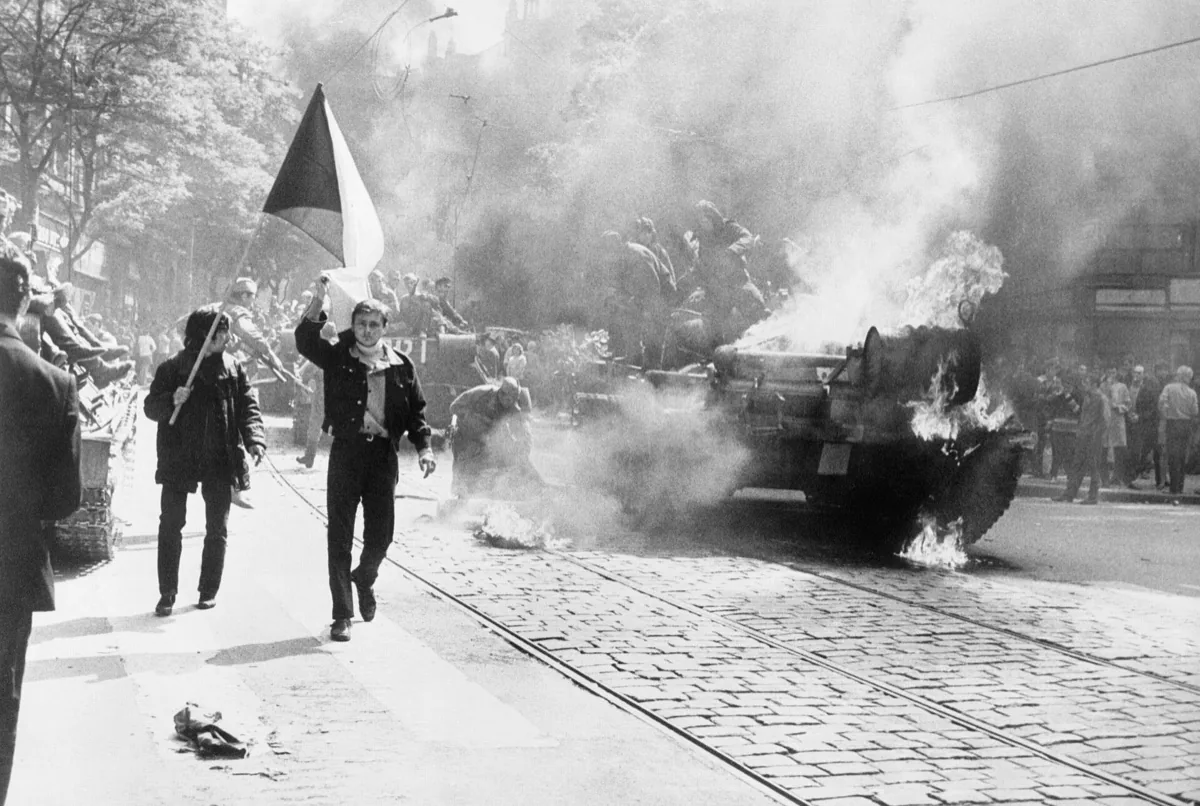
The Brezhnev Doctrine was the Soviet Union's declared policy that it had the right to invade any socialist country whose socialism it judged to be in danger. Soviet leader Leonid Brezhnev announced the principle in November 1968, three months after Warsaw Pact troops invaded Czechoslovakia to crush the Prague Spring. The logic was straightforward: once a country had become socialist, it could not go back. For two decades, the doctrine kept every government in the Soviet bloc in line. Moscow alone decided what counted as a threat to socialism, and Moscow alone decided when to act. The doctrine collapsed in 1989, when Mikhail Gorbachev refused to enforce it and six communist governments collapsed within months.
How the Brezhnev Doctrine began
Alexander Dubcek became first secretary of the Czechoslovak Communist Party in January 1968. He had spent much of his childhood in the Soviet Union, where his family moved in 1925 to join an industrial cooperative in Kyrgyzstan, and he later studied at the Higher Party School in Moscow. None of that stopped him from trying to change the system he had grown up in. Under Dubcek, the party abolished censorship, allowed public debate, and introduced reforms that Dubcek described as "socialism with a human face." Czechoslovakia was not trying to leave the Warsaw Pact, and Dubcek said so repeatedly.
Moscow decided that Dubcek's assurances did not matter. Late on August 20, 1968, about 250,000 troops from five Warsaw Pact countries crossed into Czechoslovakia. The total force eventually reached about 500,000. Dubcek was arrested, flown to Moscow, and forced to sign an agreement reversing his reforms. He was kept in office for several months, then quietly removed and given a job as a forestry inspector in Slovakia, where he spent the next twenty years.
What set this invasion apart from 1956, when Soviet tanks ended Hungary's uprising, was that Moscow turned the principle into official policy. On September 26, 1968, an article appeared in Pravda under the name Sergei Kovalev. It argued that the sovereignty of any individual socialist country could not override the interests of socialism as a whole. When socialism was threatened in one country, all socialist countries had the duty to act. Brezhnev repeated the point at the Fifth Congress of the Polish United Workers' Party on November 12, 1968. Western commentators called it the Brezhnev Doctrine. They described the principle as "limited sovereignty," meaning that a socialist country could run its own affairs only until Moscow decided its socialism was at risk.
How the Brezhnev Doctrine shaped the Cold War
The doctrine worked as a deterrent for two decades. No Eastern European government seriously challenged it. In Poland in 1980 and 1981, the rise of Solidarity, a labor movement with ten million members, brought the country to the edge of Soviet intervention. Poland's leader, General Wojciech Jaruzelski, imposed martial law on December 13, 1981, arresting Solidarity's leaders and banning the movement. Jaruzelski acted in part to prevent a Soviet invasion he believed was coming.
The doctrine also damaged the Soviet Union's reputation far beyond Eastern Europe. Communist parties in Western Europe, especially Italy's, publicly condemned the invasion of Czechoslovakia. The Italian Communist Party, under Enrico Berlinguer, broke with Moscow and moved toward what became known as Eurocommunism, a form of socialism that rejected Soviet authority. In China, which was already splitting from the Soviet Union, the doctrine confirmed Beijing's view that the USSR was an imperial power. The Chinese government responded by reinforcing its military positions along the Soviet frontier.
In 1979, Moscow sent troops into Afghanistan to overthrow a government it no longer trusted. The Brezhnev Doctrine supplied the justification, extended beyond Eastern Europe for the first time. The Soviet-Afghan War lasted nine years and became one of the burdens that helped weaken the Soviet state in its final decade.
How did the Brezhnev Doctrine end?
The doctrine required a willingness to use force, and by the late 1980s the Soviet leader, Mikhail Gorbachev, was not willing. From 1988 onward, Gorbachev privately told Eastern European leaders that Soviet troops would not come to save them. Most did not believe him.
In 1989, events proved him serious. Poland held partly free elections in June, and Solidarity won nearly every seat it contested. Hungary opened its border with Austria in September, letting thousands of East Germans flee west. The Berlin Wall fell on November 9. Czechoslovakia had its Velvet Revolution in late November. Romania's communist dictator, Nicolae Ceausescu, was overthrown and executed in December. Not one Soviet division moved.
On October 25, 1989, a journalist on the American television program Good Morning America asked Soviet foreign ministry spokesman Gennadi Gerasimov what had replaced the Brezhnev Doctrine. Gerasimov answered: "We now have the Frank Sinatra Doctrine. He has a song, 'I Did It My Way.' So every country decides on its own which road to take." The joke spread worldwide and became the closest thing to an official announcement that the policy was over.
The Soviet garrisons in Eastern Europe stayed in place for several more years. But without Moscow's willingness to use them, the governments the Brezhnev Doctrine had protected could not hold power on their own.