
Prague Spring
The Prague Spring was a 1968 reform movement in Czechoslovakia, crushed when the Soviet Union led a Warsaw Pact invasion.
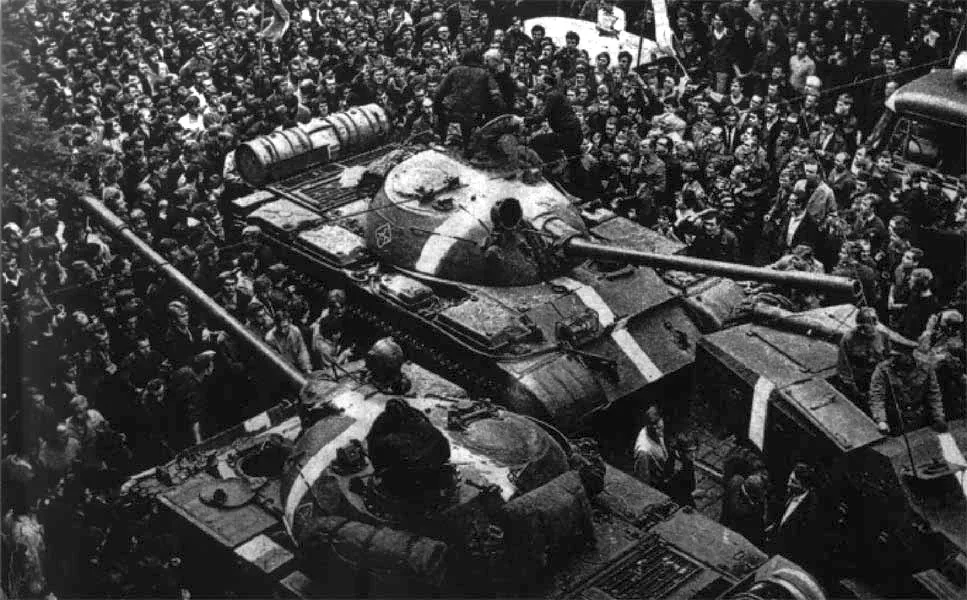
The Prague Spring was a period of political reform in Czechoslovakia that lasted from January to August 1968. Alexander Dubček, the country's new Communist Party leader, relaxed censorship, loosened travel restrictions, and promised freedoms that no Soviet-bloc country had allowed. Dubček was a lifelong communist. He did not want to end the system. He wanted to make it popular, and he called the program "socialism with a human face." Late on August 20, the Soviet Union and three Warsaw Pact allies invaded with about 250,000 troops and thousands of tanks. Dubček was taken to Moscow and forced to reverse his reforms. Czechoslovakia spent the next twenty-one years under tighter political control than before.
How Dubček tried to reform Czechoslovakia
Dubček was born in 1921 in Uhrovec, in western Slovakia. His parents were committed communists who had lived in the United States before World War I, in Chicago and Cleveland, where they were active in the socialist movement. When Dubček was three, his father moved the family to Soviet Central Asia because he could not find work at home. Dubček grew up in Kyrgyzstan, where he saw famine and poverty firsthand. The family returned to Czechoslovakia in 1938.
Dubček rose through the Communist Party ranks and became its leader in January 1968. He believed the system could survive only if it earned public support rather than demanding it. In April, the party published its Action Programme. It promised freedom of the press, freedom of assembly, and an independent judiciary. It said the Communist Party would need to win public trust through its actions, not demand obedience. It did not call for multiparty democracy or for leaving the Warsaw Pact.
The reforms moved faster than Dubček expected. Newspapers printed open criticism of the government for the first time. In June, the writer Ludvík Vaculík published "The Two Thousand Words," a public manifesto signed by dozens of intellectuals, demanding faster change. Citizens debated the country's future openly. The kind of openness Czechoslovakia practiced in 1968 would not appear in the Soviet Union itself for another two decades, when Mikhail Gorbachev introduced glasnost.
The Soviet invasion of Czechoslovakia
Soviet leader Leonid Brezhnev watched the reforms with alarm. The Action Programme's promises were moderate, but the public response went much further than the document itself. Students in Warsaw demanded similar freedoms, and Brezhnev feared the movement would spread across the bloc. He had the example of Hungary in 1956, where the Soviet Union had crushed a similar uprising by force, and he decided the same response was needed.
On the night of August 20, about 250,000 troops from the Soviet Union, Poland, Hungary, and Bulgaria crossed into Czechoslovakia. The force eventually grew to about half a million soldiers. Czechoslovaks did not fight back with weapons. They surrounded tanks, argued with soldiers, and waved bloodied flags in Wenceslas Square. More than a hundred people were killed in the months that followed.
Dubček was arrested and flown to Moscow. Under pressure, he signed an agreement reversing his reforms. He returned to Prague and remained as party leader for several more months, but he had no real power. In January 1969, Jan Palach, a twenty-year-old university student, doused himself in gasoline and set himself alight in front of the National Museum in Wenceslas Square to protest the occupation. He died three days later. His funeral drew tens of thousands of people into the streets.
The Soviet Union justified the invasion with what became known as the Brezhnev Doctrine: the Soviet Union claimed the right to use military force against any socialist country that tried to change its political system. The doctrine governed Soviet policy toward Eastern Europe for the next twenty years.
Who replaced Dubček?
In April 1969, Gustáv Husák replaced Dubček as leader of the Communist Party. Husák reversed almost every reform under a policy he called "normalization." Censorship returned. The government expelled more than 300,000 people from the party and barred many of them from professional work. Teachers, scientists, and writers who refused to condemn the Prague Spring were demoted or fired. Czechoslovakia became one of the most tightly controlled states in the Soviet bloc.
Dubček was briefly sent to Turkey as ambassador, then recalled and expelled from the party in 1970. He spent more than a decade working as a forestry inspector in Bratislava, watched constantly by the secret police. He refused to say the Soviet invasion had been necessary.
The Prague Spring and the fall of communism
In November 1989, twenty-one years after the invasion, Czechoslovaks rose up again in what became the Velvet Revolution. This time, the Soviet leader was Gorbachev, and he chose not to send troops. Communist rule ended within weeks. Some of the same people who had lived through the Prague Spring were part of the revolution. Dubček returned to public life as chairman of the federal parliament. He died in 1992 from injuries in a car accident, at the age of seventy.
The Prague Spring showed that the Soviet system could not tolerate reform, even reform led by a loyal communist who wanted to save it rather than end it. Communist rule in Czechoslovakia ended only after the Soviet Union itself gave up on enforcing it.