
Velvet Revolution
The Velvet Revolution was the peaceful overthrow of Czechoslovakia's communist government in late 1989, making playwright Václav Havel president.
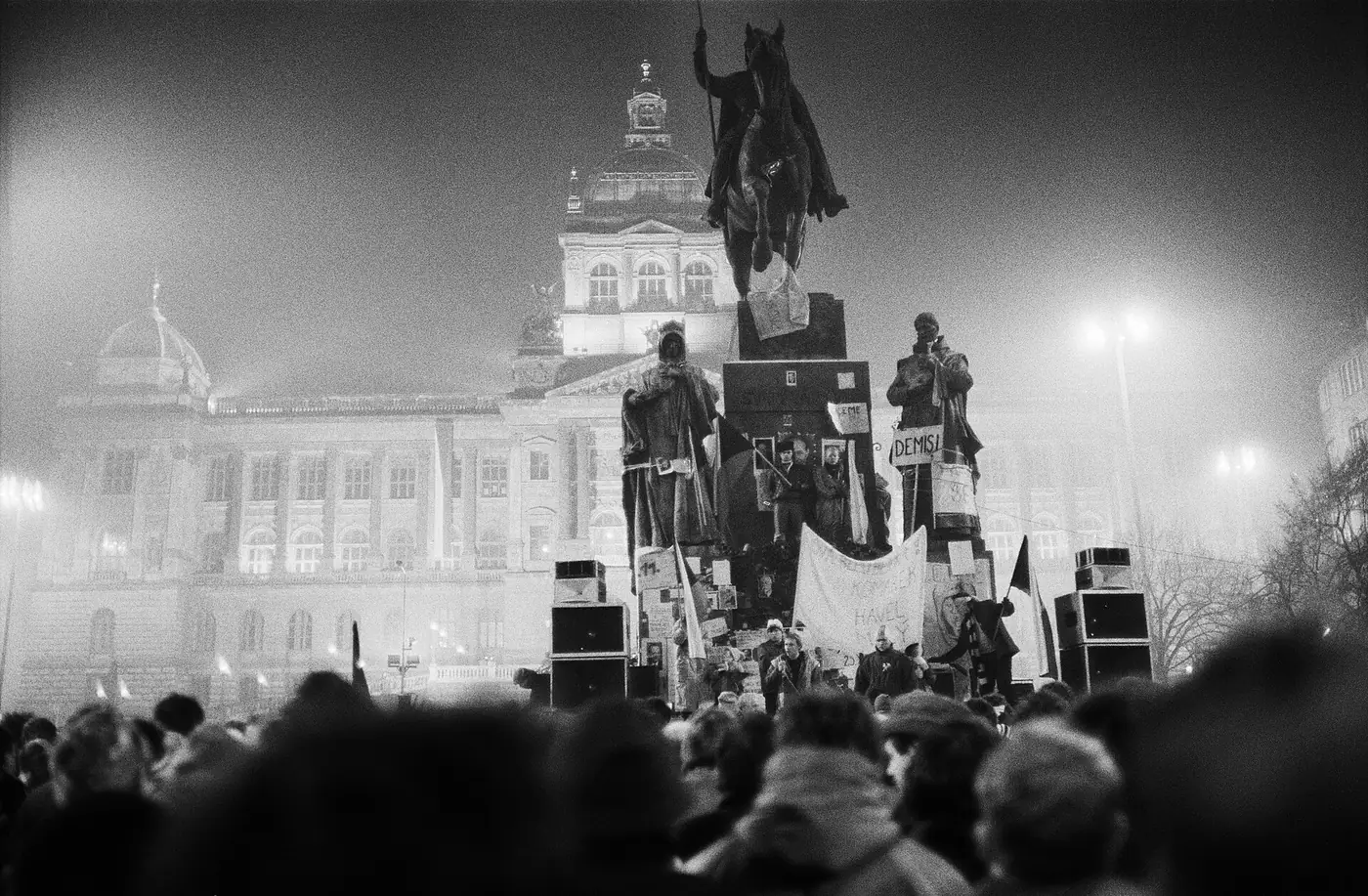
The Velvet Revolution was the nonviolent overthrow of Czechoslovakia's communist government in November and December 1989. It lasted 43 days, from a student march in Prague on November 17 to the election of the dissident playwright Václav Havel as president on December 29. Nobody was killed. The Communist Party had been in power for 41 years. It maintained a secret police network with tens of thousands of informants. Yet it collapsed after a two-hour nationwide work stoppage showed that even the working class it claimed to represent wanted it gone.
How the Velvet Revolution began
On November 17, 1989, about 15,000 students gathered in Prague for a permitted commemoration: the fiftieth anniversary of the day Nazi Germany shut down Czech universities. Instead of dispersing, the crowd headed for the city center and turned the event into a political protest. On Národní třída, riot police blocked both ends of the street and beat the trapped marchers. About 600 people were injured.
The next day, word went around that a student called Martin Šmíd was dead. The report was false. It may have started with a security officer who collapsed during the crackdown. Whether the whole episode was staged by officials within the party who wanted to replace the existing leadership remains an open question. Radio Free Europe and the BBC picked up the story, and by the next morning Czechoslovakia believed its government had beaten a young man to death.
Two days later, on November 19, Havel and other dissidents founded Civic Forum in a Prague theater. Havel was 53, born into a wealthy Prague family whose property the communists had confiscated after their 1948 takeover. Barred from studying the humanities because of his class background, he worked his way into theater as a stagehand. He became one of Czechoslovakia's best-known playwrights before his works were banned after 1968. A parallel group, Public Against Violence, took shape at the same time across the border in Slovakia. Playhouses nationwide cancelled their shows and opened their doors as public assembly spaces. By November 20, the crowds in Wenceslas Square had grown to hundreds of thousands, jangling their keys to tell the government its time was up.
How Czechoslovakia's communist government fell
The party leadership resigned on November 24, but the decisive moment came three days later. On November 27, workers across the country put down their tools for a two-hour general strike. The stoppage ended the regime's last hope, that the unrest was confined to Prague students and intellectuals. The working class, in whose name the state justified its existence, had joined the opposition.
On November 29, parliament removed the constitutional clause reserving political power for the Communist Party. Alexander Dubček, the leader of the 1968 Prague Spring who had spent much of the twenty years since as a forestry inspector in Slovakia, stepped onto a balcony with Havel to address the crowd below. On December 10, President Gustáv Husák appointed a cabinet in which communists were the minority, then stepped down. On December 29, the same parliament that had served the regime for decades voted to make Havel president.
Why was it called the Velvet Revolution?
It was called "velvet" because the transfer of power was so smooth it looked choreographed, and because no one on the government's side was ready to use force.
The groundwork came from Charter 77, a human rights declaration published in January 1977 with the signatures of 242 Czechoslovak citizens. Its three main spokespeople were Havel, the philosopher Jan Patočka, and the former foreign minister Jiří Hájek. The signers were harassed, fired from their jobs, and jailed for years. Havel spent nearly four years in prison between 1979 and 1983. In 1978 he wrote an essay called "The Power of the Powerless." It argued that the communist order ran not on genuine conviction but on the routine pretense of loyalty. The whole structure, Havel claimed, could collapse if enough people simply refused to keep pretending. Charter 77 showed no outward effect for more than a decade, but when the crisis arrived in 1989, it gave the revolution an organized opposition whose credibility the regime could not challenge.
The reason no one fired came from beyond Czechoslovakia's borders. Gorbachev had signaled that Moscow would not send tanks, the opposite of what had happened in 1968. Poland's Solidarity movement and Hungary had already begun their own political transitions. The Berlin Wall had fallen on November 9, just eight days before the student march. Czechoslovakia's hardliners searched for a patron willing to back a crackdown and found none.
The contrast was Romania, where Nicolae Ceaușescu's forces opened fire on protesters in December 1989. Over a thousand people were killed, and Ceaușescu was executed on Christmas Day.
What happened after the Velvet Revolution?
Havel's presidency turned out to be harder than his revolution. Within three years, Czech and Slovak politicians negotiated what became known as the Velvet Divorce. On January 1, 1993, Czechoslovakia split into the Czech Republic and Slovakia. The public was never consulted, and the split was not especially popular, but it happened without conflict. Havel became the first president of the Czech Republic and served until 2003.
The Velvet Revolution also became a model for nonviolent political change. Its pattern of mass, symbol-heavy protest that draws away a regime's own base was repeated in Serbia's Bulldozer Revolution in 2000, Georgia's Rose Revolution in 2003, and Ukraine's Orange Revolution in 2004 and Euromaidan in 2014. Today's authoritarian governments counter the same approach with laws that label opposition groups as foreign agents, state control of television, and the arrest of organizers before protests can begin.