
Queen Victoria
Queen Victoria ruled the United Kingdom from 1837 to 1901 and became Empress of India, giving her name to the Victorian era.
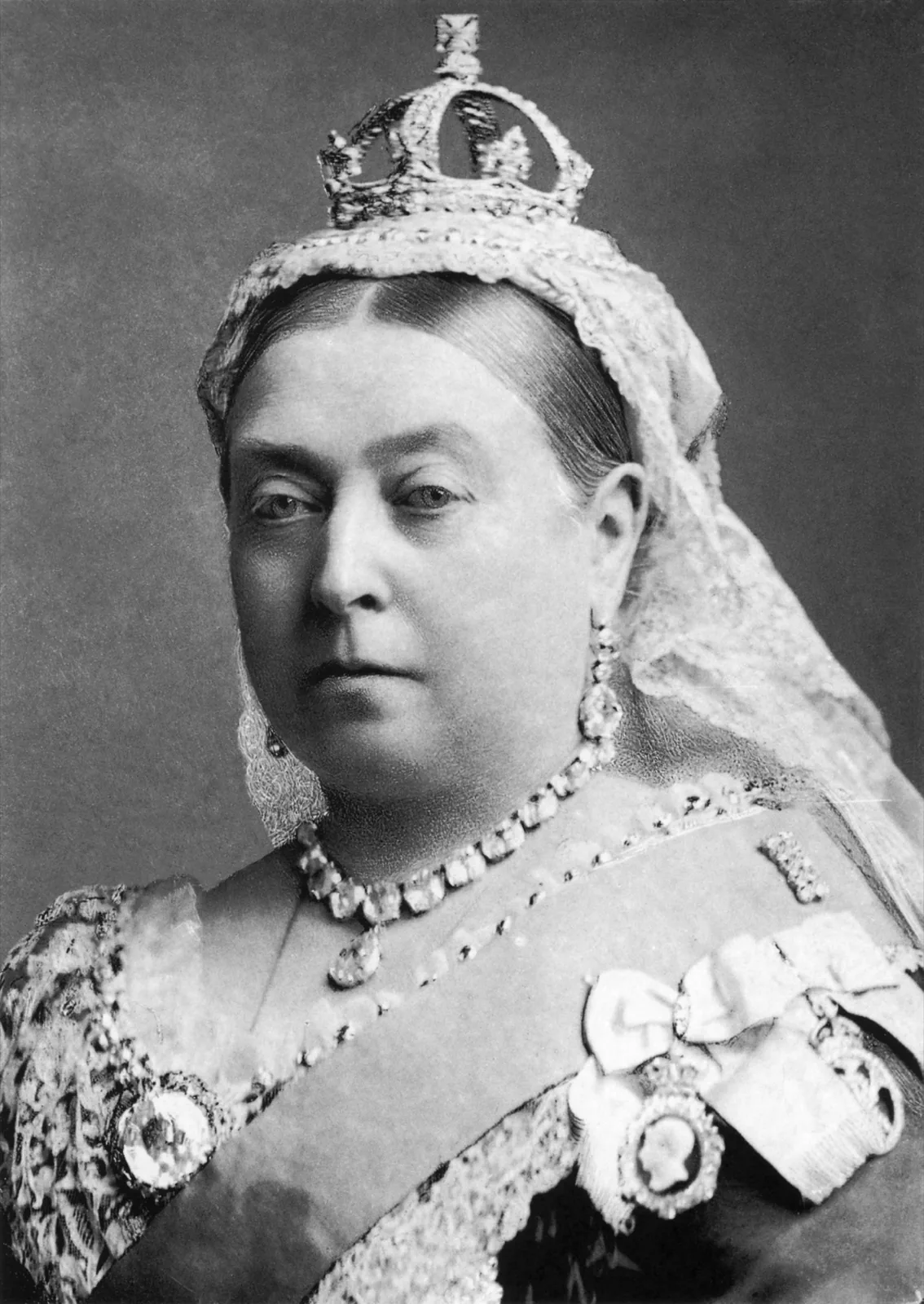
Queen Victoria was the queen of the United Kingdom from 1837 to 1901. She was born on May 24, 1819, at Kensington Palace in London. She became queen at eighteen and reigned for sixty-three years and seven months until her death on January 22, 1901. No British monarch before her had ruled that long. Elizabeth II surpassed the record in 2015. Victoria was five feet tall, had nine children, and outlived her husband by nearly forty years. Her name labels an entire age. The Victorian era saw Britain reach its peak as the world's leading industrial power and build an empire stretching across roughly a quarter of the world's land area and population. Victoria herself held almost no real political power during any of this. She could advise and warn her prime ministers, but she could not command government policy. The age bears her name because she sat at the center of it as its symbol, not because she directed it.
Victoria and Prince Albert
Victoria was the only child of the Duke of Kent, the fourth son of King George III. Her father died when she was eight months old, and she grew up at Kensington Palace under her mother's close supervision. She was eighteen when her uncle, King William IV, died in June 1837 and she inherited the throne.
In February 1840 she married her first cousin, Prince Albert of Saxe-Coburg and Gotha. Victoria proposed to him, as protocol required, since no one could propose to a reigning queen. They had nine children between 1840 and 1857.
Albert died on December 14, 1861, at the age of forty-two. The official cause was typhoid fever. Victoria's grief defined the rest of her life. She wore black for nearly forty years, withdrew from public appearances, and kept Albert's rooms at Windsor Castle exactly as he had left them. The press called her the "Widow of Windsor." Her lifelong mourning gave the nation a figure who embodied its own ideals of duty, respectability, and hard work. The word "Victorian" still describes those values.
Victoria and the British Empire
During Victoria's reign, real political power belonged to Parliament and to prime ministers like Lord Palmerston, Benjamin Disraeli, and William Gladstone. Victoria's constitutional role was to advise, to warn, and to represent the nation. She had strong opinions and made them known, but decisions belonged to her ministers.
The empire grew enormously under her name. Britain had taken direct control of India from the East India Company following the Indian rebellion of 1857, and by 1901 it ruled roughly 300 million Indians through a system of British officials known as the British Raj. In 1876, Prime Minister Disraeli persuaded Parliament to grant Victoria the title Empress of India. She took the role seriously. She learned Hindustani from an Indian servant named Abdul Karim, whom she promoted to her personal teacher, and she kept Indian attendants at court. She never visited India.
At Victoria's Diamond Jubilee in 1897, the crowds cheered her as a symbol of British power, not as an active ruler. The later decades of her reign saw the Scramble for Africa, in which European powers divided up nearly the entire continent. The British Empire reached its territorial peak around 1920, about two decades after Victoria's death, when it gained mandates after World War I. Victoria had been queen while Britain rose to global dominance, but the empire was built by ministers, generals, and traders, not by the crown.
Why is Queen Victoria called the grandmother of Europe?
Victoria and Albert married eight of their nine children into royal families across the continent, a deliberate strategy to bind Europe's monarchies together. By 1914, Victoria's grandchildren occupied the thrones of seven countries: Britain, Germany, Russia, Spain, Greece, Romania, and Norway. Kaiser Wilhelm II of Germany was her oldest grandchild. Tsarina Alexandra of Russia, born a German princess, was also Victoria's granddaughter. King George V of Britain was her grandson. The three men who led Europe's greatest powers into World War I were all cousins.
Victoria was also a carrier of hemophilia B, a genetic disorder that prevents blood from clotting properly. She passed it, through her daughters, into the royal families of Russia and Spain. Her great-grandson Alexei, heir to the Russian throne, had the disease, and the family's desperation to treat him helped draw the mystic Grigori Rasputin into the Russian court.
The family strategy did not keep the peace Victoria and Albert had hoped for. In August 1914, Germany and Russia went to war against each other. Personal telegrams between the royal cousins did nothing to prevent it. Victoria had used family ties to hold Europe together. Thirteen years after her death, those ties counted for nothing against the alliances, armies, and grievances that pulled the continent into war.