
How Russia became the largest country on Earth
In 1300, Moscow was smaller than Portugal. Today Russia covers one-eighth of the world's land, most of it taken in four centuries of eastward expansion.
When the city of Tver rebelled against Mongol tax collectors in 1327, the prince of Moscow did not join the uprising. Ivan Kalita traveled to the Mongol capital at Sarai and offered to lead the punitive expedition himself. The Mongols accepted. Ivan crushed Tver with Mongol backing, absorbed much of its territory, and came home richer and more powerful. That deal set the tone for the next four centuries. Moscow became the world's largest country through patience, opportunism, and expansion into land that had almost no one to defend it.
How Moscow outgrew the Mongols
Moscow spent over two centuries as a loyal client of the Golden Horde, the western wing of the Mongol Empire. Its princes served as the Horde's tax collectors across the Russian lands, skimming a cut for themselves. The job paid well: political protection, wealth, and a growing territory. By the time Ivan III took power in 1462, Moscow controlled most of northeastern Russia, and the Horde had fractured into weaker successor states.
In 1480, Ivan stopped paying tribute. The Mongol khan Akhmat marched an army to the Ugra River, southwest of Moscow. The two armies stood on opposite banks for several weeks. Then Akhmat's forces turned around and left. There was no battle. That was the end of 240 years of Mongol authority over Russia: not a dramatic victory, but a standoff the Mongols decided was not worth fighting.
Ivan absorbed the rival city-states of Novgorod in 1478 and Tver in 1485, tripling Moscow's territory. His wife, Sophia Palaiologina, was the niece of the last Byzantine emperor, who had died defending Constantinople when the Ottomans took it in 1453. Ivan adopted the Byzantine double-headed eagle as Russia's state symbol and began calling Moscow the Third Rome, the last seat of Orthodox Christian power. By 1505 Moscow was the only major power in the Russian lands, free of Mongol control and claiming a civilizational mission that has never entirely gone away.
Ivan the Terrible opened the road east
Ivan IV, Ivan III's grandson, crowned himself the first tsar of Russia in 1547. He was intelligent, violent, and unpredictable. He built Russia's first standing army, reformed the legal code, and personally led the siege of Kazan in 1552. Kazan was the capital of a Tatar khanate on the Volga, one of the successor states of the same Golden Horde that had once ruled Russia. Ivan took it in six weeks. Four years later, in 1556, he took Astrakhan at the Volga's mouth on the Caspian Sea.
These two conquests changed Russia's direction. Control of the entire Volga, from its headwaters near Moscow to the Caspian, gave Russia a trade route into Central Asia and Persia. It also removed the Tatar states that had blocked the path between Moscow and the Ural Mountains.
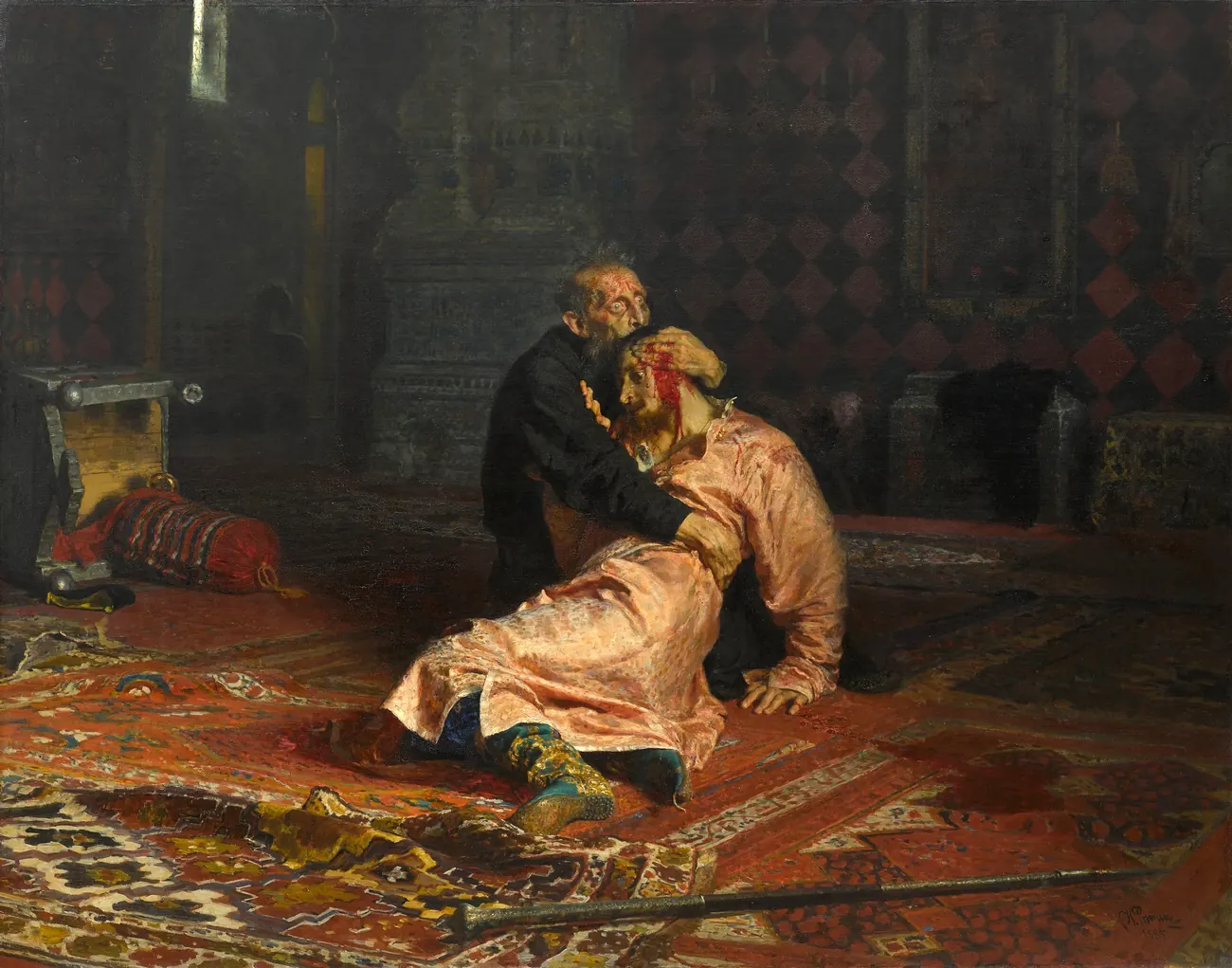
Ivan's later years were destructive. He created a personal police force, the oprichniki, that terrorized the nobility and killed thousands. In 1581, he struck and killed his eldest son and heir with an iron-tipped staff during an argument. The painter Ilya Repin's 1885 depiction of Ivan holding his dying son became one of the most famous paintings in Russian art. Ivan left behind a larger empire and a dynasty that collapsed into civil war within twenty years of his death.
Siberia in sixty years
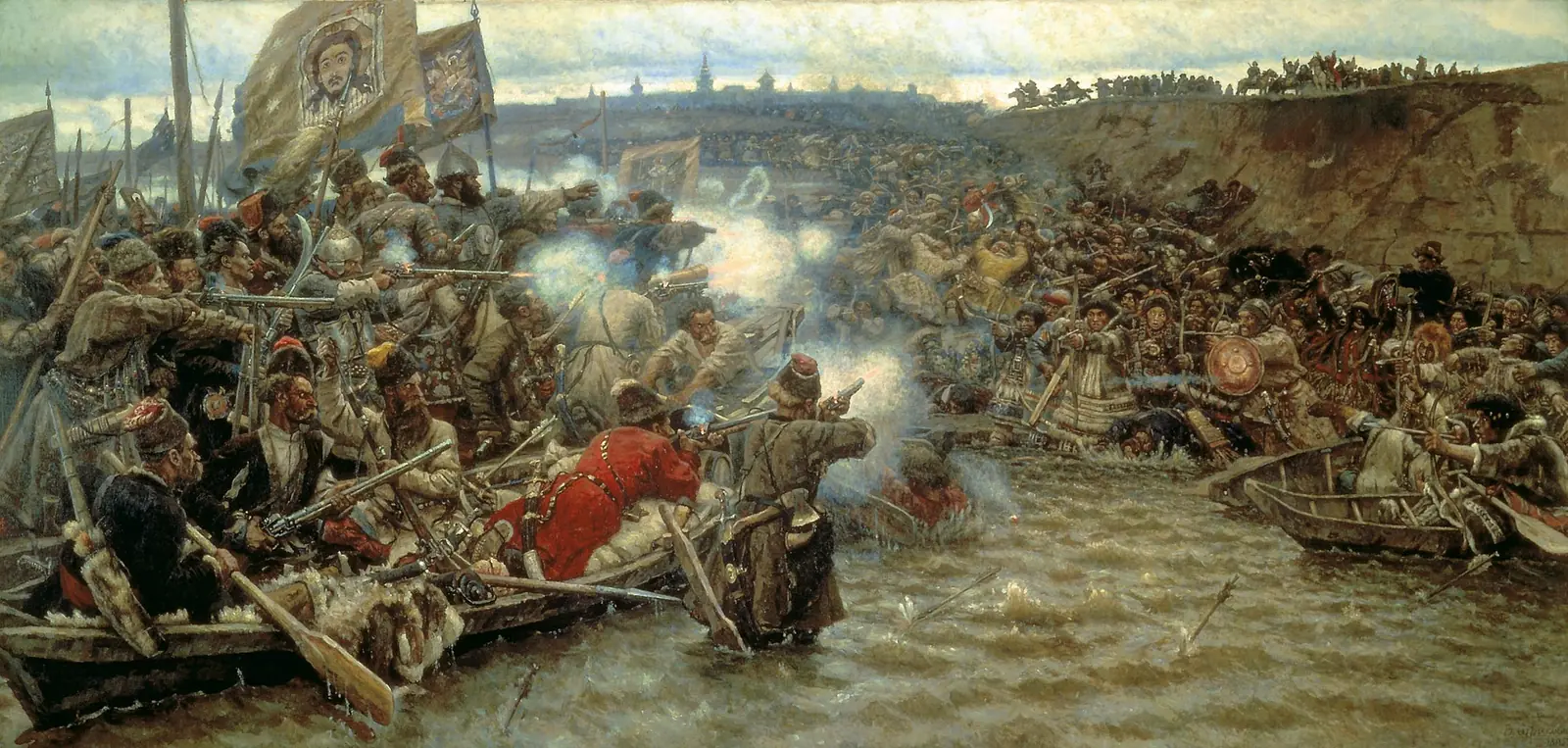
The most remarkable phase of Russia's growth happened almost by accident. In 1582, a Cossack named Yermak Timofeyevich led roughly 800 men across the Ural Mountains into Siberia. The expedition was funded by the Stroganov family, wealthy merchants who wanted access to the fur trade. Yermak defeated the Khanate of Sibir, the local Tatar state, within a year. He drowned in the Irtysh River in 1585, weighed down by a suit of chain mail that Ivan the Terrible had given him as a reward.
Russian fur traders, soldiers, and Cossacks followed Yermak east across the steppe and taiga, building wooden forts as they went. They reached the Pacific coast at Okhotsk by 1639: roughly 4,000 miles in about sixty years, one of the fastest territorial expansions in history.
The speed is explained by one fact: almost nobody was in the way. Siberia had an estimated 200,000 to 300,000 indigenous people across a territory larger than the continental United States. Russians came for sable fur, which sold for prices comparable to gold in European markets. The fur tax, called yasak, became one of the Russian treasury's most important revenue streams by the seventeenth century. Trappers and soldiers pushed east not because the tsar ordered a grand campaign, but because each new river valley offered fresh pelts. When the sable in one area thinned out, they moved further east. The pattern repeated itself for sixty years until there was no more east to move into.
By the 1740s, Russian explorers had crossed the Bering Strait into Alaska. Russia sold Alaska to the United States in 1867 for $7.2 million, roughly $150 million today, at about two cents an acre.
The fight for warm water
While fur traders raced east, Russia's tsars spent two centuries fighting west and south for one thing the country lacked: ports that stayed open year-round.
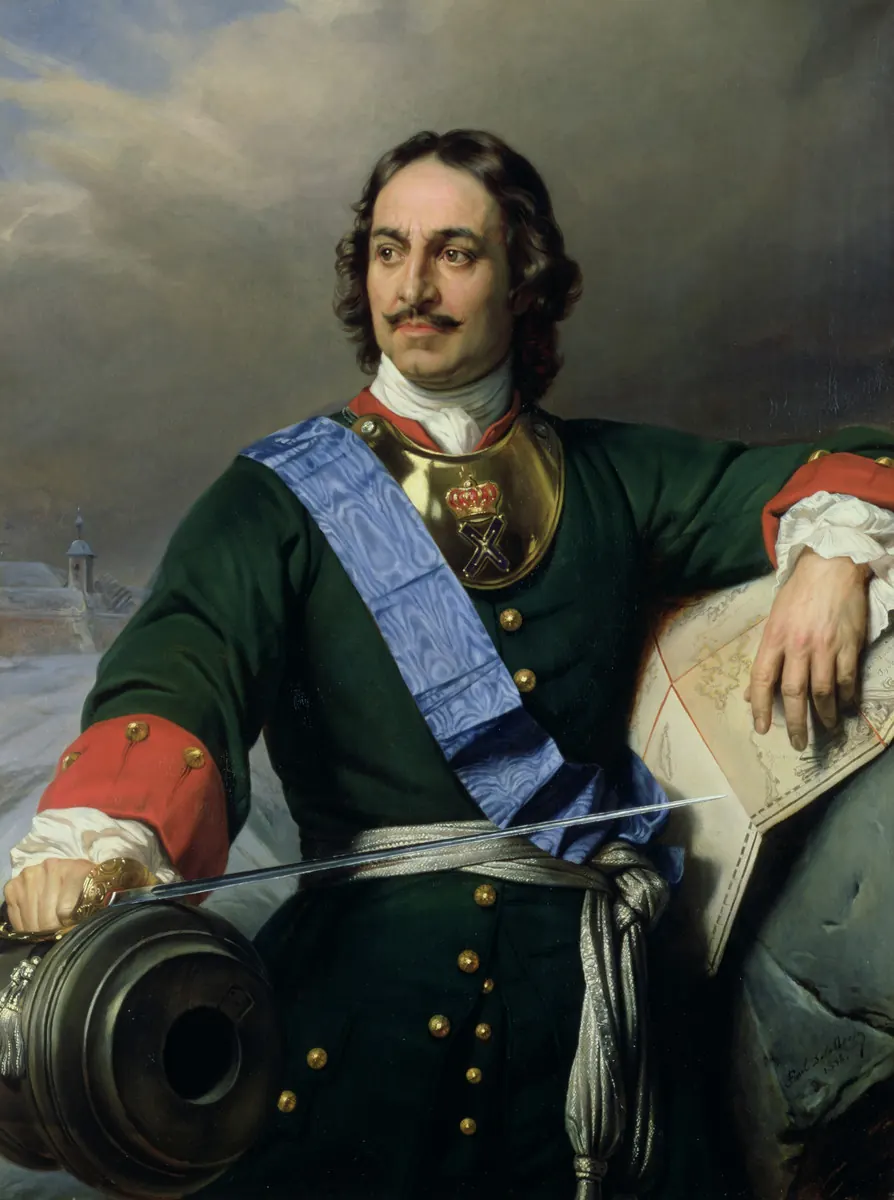
Peter the Great, who ruled from 1682 to 1725, stood roughly six feet eight inches tall, towering over everyone at his own court. In 1697 he traveled to Western Europe disguised as a carpenter named Peter Mikhailov and spent months working in Dutch and English shipyards, learning how they built warships. He then fought Sweden for 21 years in the Great Northern War to win a strip of Baltic coastline. He built St. Petersburg on the conquered land in 1703, on a marshy river delta where construction killed thousands of conscripted laborers. Peter wanted a capital that faced Europe rather than looking east toward the forests, and he forced the Russian nobility to move there.
Catherine the Great, who ruled from 1762 to 1796, was born a German princess named Sophie. She came to Russia at fifteen, learned the language, converted to Orthodoxy, and six months into her husband Peter III's reign, overthrew him in a coup. He was killed days later. Catherine took Crimea from the Ottomans in 1783, giving Russia its first warm-water naval base on the Black Sea. She joined Prussia and Austria in partitioning Poland three times, in 1772, 1793, and 1795, until Poland ceased to exist. Russia took the largest share.
In the nineteenth century, Russia spent decades conquering the Caucasus. Imam Shamil, a religious and military leader from Dagestan, fought the Russian army for 25 years before his capture in 1859. The Circassian population of the western Caucasus was largely killed or deported to the Ottoman Empire in the 1860s; estimates range from 500,000 to 1.5 million people expelled. Russia's last major push came in the 1860s through 1880s, when it conquered the khanates of Central Asia: Kokand, Bukhara, and Khiva. The Trans-Siberian Railway, begun in 1891 and completed in 1916, stitched the eastern and western halves of the empire together for the first time. By 1900 the Russian Empire stretched from Warsaw to Vladivostok, covered eleven time zones, and ruled 125 million people.
Why it stayed big
The Soviet Union inherited nearly all of this territory. When the USSR collapsed in 1991, Russia lost fourteen republics, including the Baltics, Ukraine, Belarus, the Caucasus states, and Central Asia. It kept the Russian Federation: still the largest country on Earth by a wide margin.
The main reason is straightforward. Much of Russia's territory is so cold and empty that no rival ever wanted it enough to take it. Siberia makes up about 77 percent of Russia's land area but holds roughly 33 million people, fewer than California. Most of it is boreal forest or tundra, frozen for half the year. Nuclear weapons since 1949 made any attempt to seize Russian territory by force unthinkable.
What Russia lost in 1991 was the productive, populated land on its edges: Ukraine's farmland, the Baltic ports, Central Asian resources, Caucasus oil. What it kept was the vast cold interior. Vladimir Putin's wars since 2008, in Georgia, then in Crimea in 2014, then the full invasion of Ukraine in 2022, are partly about recovering those edges. They are also driven by the same anxiety that motivated Russian expansion for centuries: that without buffer territory on every side, the core is exposed. Russia became the world's largest country by pushing into empty space and fighting for access to the sea. The question of how much of that expansion it gets to keep is still being answered.
Test what you learned
6 questions on this article. About two minutes, no signup.