
How the Byzantine Empire outlasted Rome by a thousand years
Rome collapsed in 476. The Byzantine Empire survived another thousand years. Better walls, more money, and a willingness to adapt explain why.
In 476, a Germanic officer named Odoacer deposed the last western Roman emperor, a teenager named Romulus Augustulus, and sent the imperial regalia east to Constantinople. There was no siege, no great battle. The western empire had been a formality for years. But the eastern half continued as if nothing fundamental had changed. The emperor in Constantinople still held the Roman title. The courts still enforced Roman law. The people who lived there called themselves Romans. The word "Byzantine" was invented by historians long after the empire fell. The eastern Roman state they built from Constantinople would last another 977 years, until an Ottoman army broke through the city's walls in 1453.
What kept the eastern half alive so long after the west collapsed? Three things: more money, a capital that was nearly impossible to capture, and a political system flexible enough to change when it needed to.
Why the east was richer from the start
The Roman Empire was never evenly balanced. The eastern provinces held most of the wealth. Egypt supplied grain to feed whole cities. Syria and Anatolia had major trading centers: Antioch, Ephesus, Alexandria. The overland trade routes from China and India, what later centuries would call the Silk Road, terminated at eastern Mediterranean ports. The western provinces produced crops and soldiers but generated far less tax revenue. By the fourth century, most of the empire's major cities were in the east, and cities meant commerce, and commerce meant money.
When Constantine refounded the old Greek city of Byzantium as Constantinople in 330, he placed the new capital at the point where Europe meets Asia, on a peninsula controlling the strait between the Mediterranean and the Black Sea. Every ship carrying grain from the Black Sea coast and every merchant traveling between Europe and Asia passed under the city's walls. Constantinople collected tolls on that traffic for a thousand years.
The empire's currency reflected that wealth. The gold solidus, introduced by Constantine at a weight of about 4.5 grams, held its purity for more than seven centuries. In western Europe, where the coin was known as the bezant, it became the standard unit for international trade. By the time the western empire's coinage had been debased into worthlessness, Constantinople was still minting the most trusted currency in the Mediterranean world.
The walls and weapons that no army could break
Geography made Constantinople hard to attack. The city sat on a triangular peninsula, with the Sea of Marmara to the south and the Golden Horn inlet to the north. Only the western side, about 6.5 kilometers, faced land.
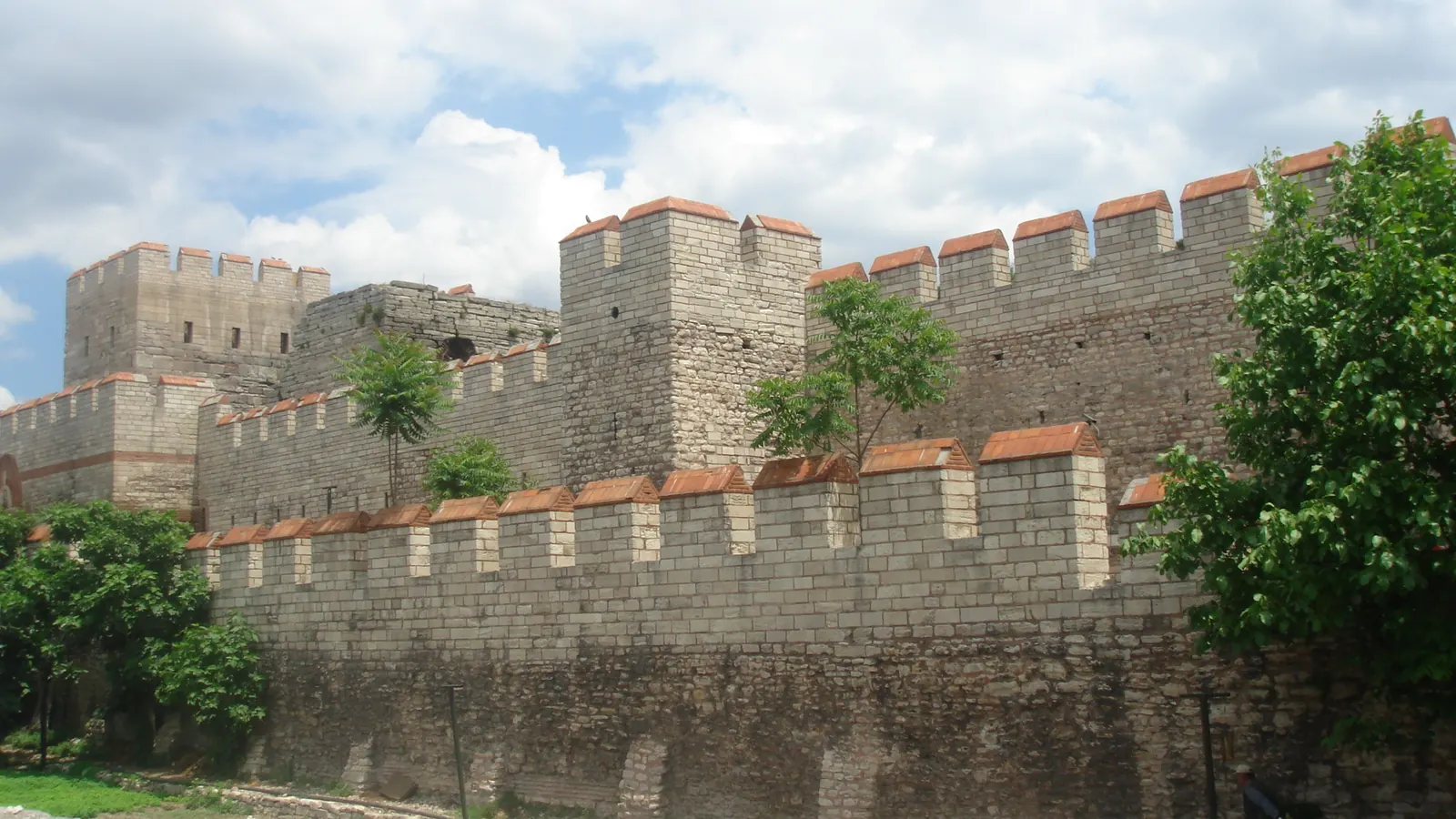
In 413, Emperor Theodosius II built the wall system that would protect the city for the next thousand years. The Theodosian Walls were not one wall but three layers of defense: a deep moat, a low outer wall, and a high inner wall roughly 12 meters tall with 96 towers. Attackers who crossed the moat had to fight through two walls under fire from above. No army breached the Theodosian Walls for more than a thousand years.
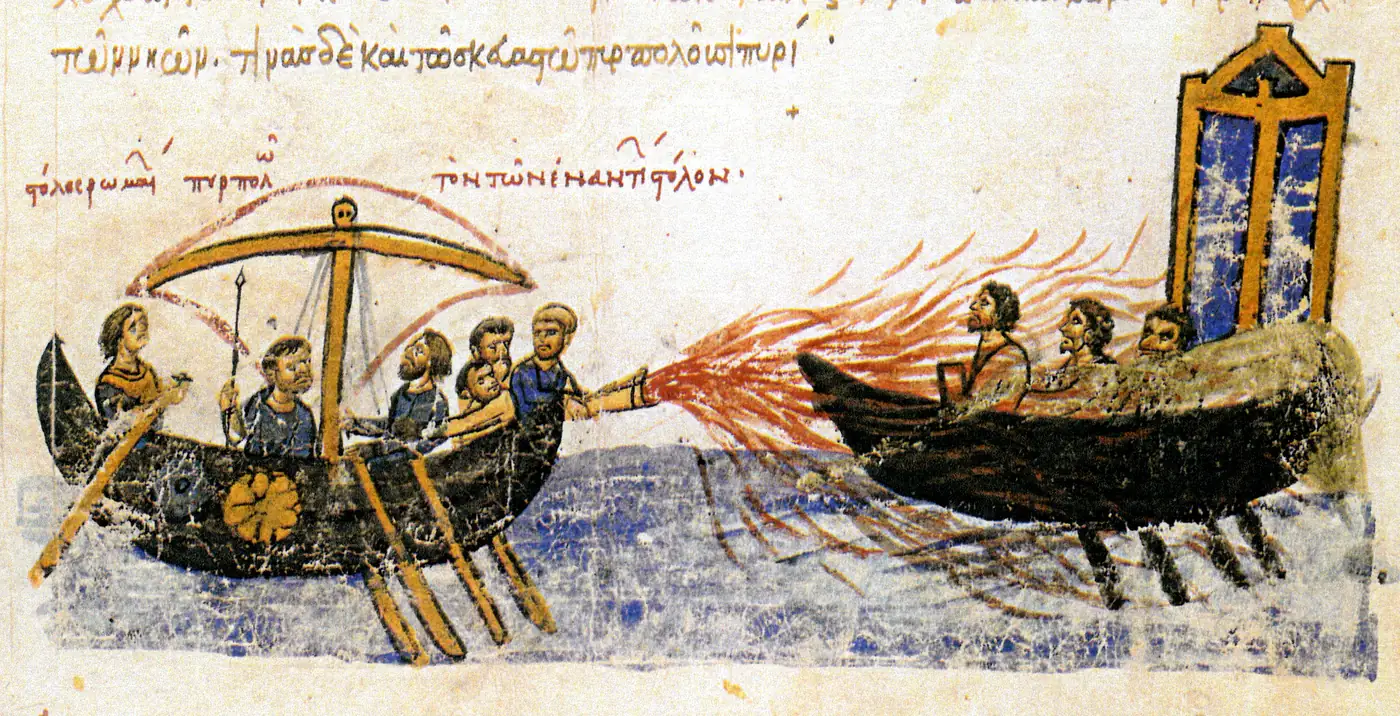
In 678, when an Arab fleet besieged Constantinople, the Byzantines deployed a compound known as Greek fire: a liquid, its formula a state secret, that could be sprayed from tubes mounted on ship prows and that burned on water. The Arab fleet was destroyed. When a larger Arab force returned in 717, Greek fire helped break that siege too. The early Arab conquests swept from Spain to Central Asia, but Constantinople stopped them twice.
How the Byzantines survived by changing
The western Roman Empire fought its enemies with legions, and when it could no longer fill the legions with its own citizens, it hired the same Germanic peoples that were attacking it. That arrangement held until the hired soldiers realized they did not need a Roman employer.
The eastern empire took a different approach. Byzantine emperors treated diplomacy, bribery, and strategic marriages as serious tools, not as admissions of weakness. When a nomadic people threatened the northern frontier, Constantinople often paid tribute rather than fight, or hired one neighboring group to attack another. A tenth-century manual called De Administrando Imperio is essentially a guidebook for managing foreign powers through gifts, alliances, and selectively shared intelligence. The western Romans would have considered this beneath them. The eastern Romans considered it cheaper than war.
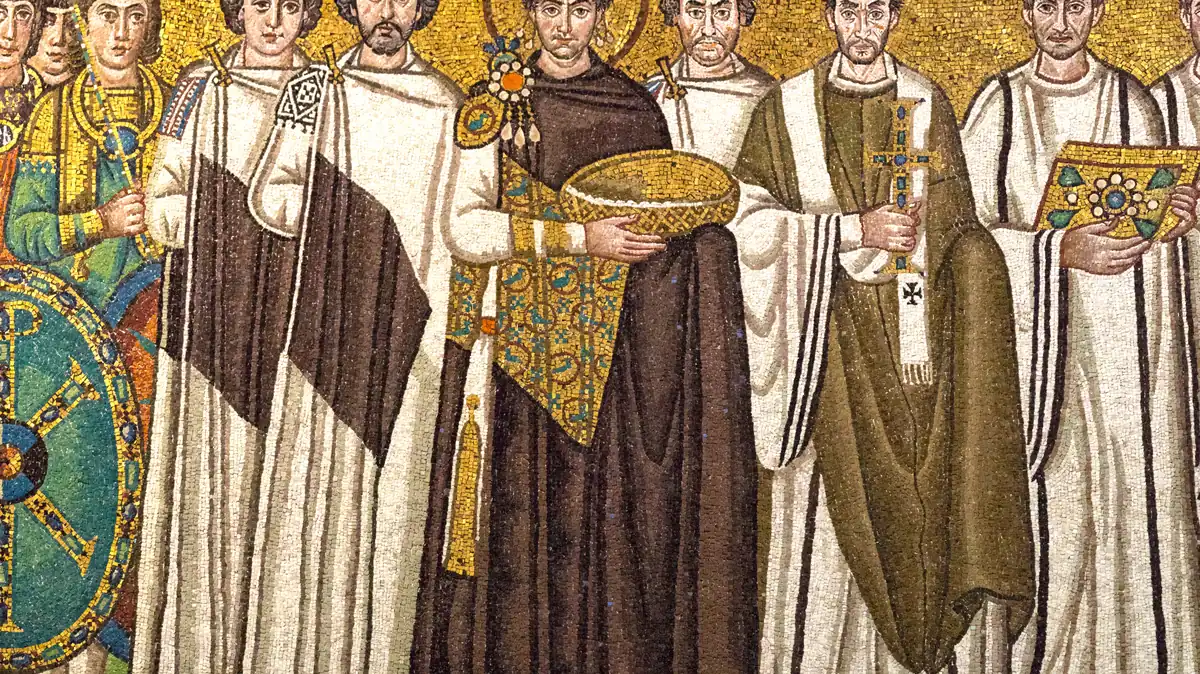
The empire was also willing to reinvent itself from the inside. When Justinian became emperor in 527, his wife Theodora was the daughter of a bear keeper at Constantinople's Hippodrome and had worked as an actress before Justinian changed the law so that a senator could marry her. During the Nika riots of 532, when a mob burned half the capital and nearly overthrew Justinian's government, Theodora reportedly told him she would rather die as empress than flee. Justinian stayed. His general Belisarius crushed the revolt, killing an estimated 30,000 rioters in the Hippodrome, and the emperor used the destruction to rebuild Constantinople around the Hagia Sophia, a cathedral so ambitious that it remained the world's largest church for nearly a thousand years. The military changed too. In the seventh century, the empire reorganized its provinces into districts called themes, where soldiers were given farmland in exchange for local defense. Instead of a professional standing army, Constantinople had local forces defending land they owned. Greek replaced Latin as the language of government around the same time. By the ninth century, the empire looked nothing like the state Augustus had founded. It survived because it kept changing.
The blow that broke the empire
The common assumption is that the Ottomans ended the Byzantine Empire in 1453. The real blow came 250 years earlier, from fellow Christians.
In 1204, a Crusader army that was supposed to be heading for Jerusalem attacked Constantinople instead. The Venetians who financed the Fourth Crusade redirected it to settle commercial rivalries and install a friendly emperor. The Crusaders breached the sea walls on April 12, and the sack lasted three days. Churches were stripped, libraries burned, and the four bronze horses of the Hippodrome were taken to Venice and mounted on the facade of St. Mark's Basilica. The Crusaders set up their own Latin Empire, which lasted until a Byzantine successor state recaptured the city in 1261.
By then the damage was permanent. Constantinople's population had dropped from several hundred thousand to roughly 35,000. The empire's commercial wealth had shifted to Venice and Genoa. What returned in 1261 was not a restored empire but a small state centered on Constantinople and a few outposts in Greece, surrounded on all sides by Ottoman territory. For its final two centuries, the Byzantine Empire survived on diplomacy and tribute payments to the Ottoman sultan.
The fall
By 1453, the empire was an empire in name only. Constantinople held roughly 50,000 people. The emperor, Constantine XI Palaiologos, had fewer than 7,000 soldiers to defend 19 kilometers of walls.
Mehmed II, the Ottoman sultan, was twenty-one and had been planning the siege since he took the throne two years earlier. He hired a Hungarian cannon maker named Orban, who had first offered his services to Constantine XI. The Byzantine emperor could not afford Orban's salary and did not have the raw materials for a large gun. Orban went to the Ottomans instead. The cannon he built was roughly 8 meters long and fired stone balls weighing about 270 kilograms. It took 60 oxen and 200 men to drag into position.
The bombardment began on April 6. The walls that had stood for more than a thousand years lasted 53 days. On the morning of May 29, Ottoman troops broke through near the Gate of St. Romanus. Constantine XI, according to later accounts, tore off his imperial insignia and charged into the fighting. His body was never identified. Greek legend holds that an angel turned him to marble and hid him in a cave beneath the city, waiting for the day he would return.
Mehmed entered Constantinople that afternoon and went to the Hagia Sophia, where he ordered the building converted into a mosque. Constantinople became Istanbul, and the state that had called itself Roman for a thousand years after Rome fell was finished.
The city still sits where Constantine built it, at the junction of Europe and Asia, controlling the same strait it has controlled since 330. Istanbul today has more than 16 million residents and is one of the most strategically important cities on earth. In 2020, President Erdogan reconverted the Hagia Sophia, which Atatürk had turned into a museum in 1934, back into a mosque. The building is nearly 1,500 years old. Empires, currencies, and languages have come and gone around it, but the position that made Constantinople worth building, worth defending, and worth conquering has not changed.
Test what you learned
5 questions on this article. About two minutes, no signup.