
Why Alexander the Great's empire fell apart in a single generation
He conquered from Egypt to India in eleven years. His generals spent the next forty tearing the empire apart.
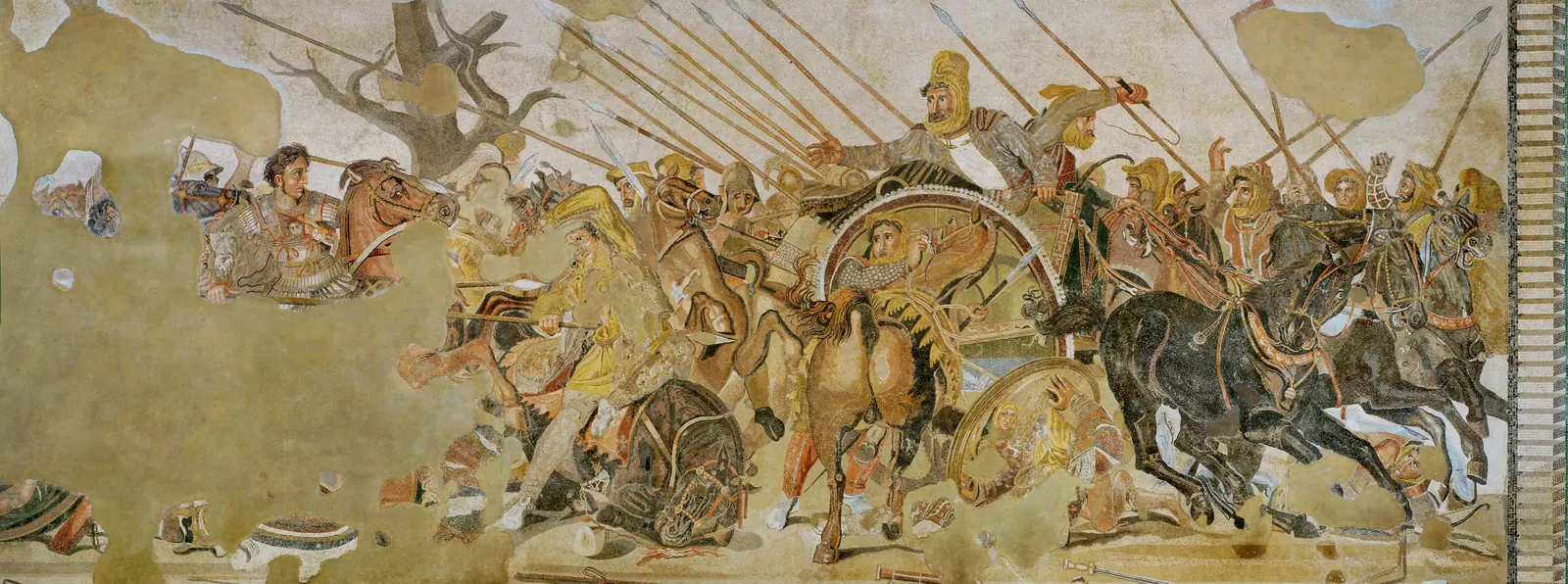
Alexander the Great died in Babylon on June 10, 323 BC. He was 32. He had spent the previous eleven years conquering the Persian Empire, Egypt, Central Asia, and the edge of India. His empire stretched from Greece to the Indus River, the largest the world had ever seen. He left no will, no succession plan, and no adult heir. His wife Roxana was pregnant. His half-brother Philip Arrhidaeus was alive but mentally impaired. When his generals asked who should inherit the empire, Alexander reportedly answered with a single word: "the strongest."
Within two years, they were at war with each other. Within thirteen years, every member of Alexander's family had been murdered by the same generals who had served him. Within forty years, the empire had broken into three kingdoms that never reunited.
Why the empire had no way to survive him
Alexander's empire was not a state. It was a military campaign that never stopped moving. He spent eleven years on the road, governing from his tent, with no permanent capital and no central administration. His father Philip II had ruled Macedon from Pella, held assemblies, and built alliances with Greek city-states. Alexander abandoned all of that. He kept the Persian system of regional governors, but those governors answered to him alone. There was no written law, no council, no mechanism that could function without him at the center.
He also made sure nobody could replace him. In 330 BC he executed Philotas, a cavalry commander, on charges of conspiracy, then sent assassins to kill Philotas's father Parmenion, the most senior general in the army and the man who had commanded the left wing at the decisive Battle of Gaugamela. Alexander stabbed his companion Cleitus to death during a drunken argument. He arrested his own court historian, Callisthenes, a nephew of Aristotle, who died in custody. By the time Alexander drank his way through his last banquet in Babylon, the men around him had learned that closeness to the king could be fatal. What they had not learned was how to share power with each other.
The army's loyalty was personal. Soldiers followed Alexander because he fought in the front rank, took wounds alongside them, and never lost. That kind of loyalty does not transfer, and when Alexander died, it belonged to no one.
The deal that lasted two years
Hours after Alexander's death, his generals gathered in Babylon to divide the empire. Roxana's unborn child would be co-king with Philip Arrhidaeus. Perdiccas, Alexander's second-in-command, would serve as regent. The other generals received territories: Ptolemy got Egypt, Antigonus kept most of Turkey, Lysimachus got Thrace, and Antipater held Macedon and Greece.
The arrangement satisfied no one, because every general understood the same thing: the real prize was the whole empire, and the deal was just a starting position.
Ptolemy made the first move. Alexander's body was being transported in an enormous gold funeral carriage from Babylon toward Macedon for burial. Ptolemy intercepted the cortege near Damascus and took the body to Egypt. Possessing Alexander's corpse gave Ptolemy something no treaty could match: the visible claim to be Alexander's true successor. Perdiccas invaded Egypt to recover the body. His army took heavy losses trying to cross the Nile, and his own officers stabbed him to death in his tent.
That was 321 BC. Alexander had been dead for two years. The regent was already dead, the body was in Egypt, and the first of the successor wars had begun.
How Alexander's generals destroyed his family
Over the next decade, every person with a blood claim to Alexander's throne was murdered by the men who had served him.
Olympias, Alexander's mother, marched into Macedon in 317 BC, seized power, and had Philip Arrhidaeus and his wife Eurydice killed. Cassander, the son of the general Antipater, besieged Olympias at the city of Pydna, captured her, and had her executed the following year.
Alexander's son, Alexander IV, had been born shortly after his father's death. Roxana and the boy spent years under guard in Macedon, useful as political figureheads but dangerous to keep alive. In 310 BC, when Alexander IV was about thirteen, Cassander ordered them both killed at Amphipolis. Their deaths were kept secret for months. Around the same time, Alexander's illegitimate son Heracles was also murdered.
By 309 BC, the Argead dynasty, which had ruled Macedon for centuries, was extinct. The generals stopped pretending they were fighting on behalf of Alexander's heirs and declared themselves kings. In 306 BC, Antigonus, Ptolemy, Seleucus, Lysimachus, and Cassander all took royal titles.
The last battle for a united empire
Only one of Alexander's successors seriously tried to reassemble the empire under a single ruler: Antigonus the One-Eyed.
In 301 BC, Antigonus met a coalition of Seleucus, Lysimachus, and Cassander's forces at Ipsus in central Turkey. He was 81 years old. Both sides fielded roughly 70,000 to 80,000 men. The battle turned on war elephants. Seleucus had acquired roughly 400 of them from the Indian king Chandragupta Maurya, trading away Alexander's easternmost provinces to get them. When Antigonus's son Demetrius led a cavalry charge that carried too far from the main line, Seleucus deployed the elephants as a wall that cut Demetrius off from the battlefield. Antigonus's infantry was surrounded and overwhelmed. Antigonus himself was killed by a javelin.
After Ipsus, nobody tried again. The empire settled into three successor kingdoms: the Ptolemies in Egypt, the Seleucids across western Asia, and the Antigonids in Macedon. Cleopatra, the last Ptolemaic queen, did not die until 30 BC, nearly three centuries later. Generals from Julius Caesar to Napoleon measured themselves against Alexander. But the empire he built died with him.
Why personal empires still break the same way
The pattern Alexander set has been repeating for 2,300 years. An empire built around one person, with no institutions for succession, does not survive that person.
Tito held Yugoslavia together for 35 years. He died in 1980, and within a decade the country was at war with itself. Gaddafi built a Libyan state with no institutions outside his own control, and when he was killed in 2011, the country shattered into armed factions that have not reunited. The Soviet leadership after Stalin, Iraq after Saddam: the dynamic is the same. The system works because one person makes it work, and when that person is gone, there is no mechanism to replace them.
Alexander was history's most successful military commander. He was also its worst succession planner. He built an empire that depended entirely on his being alive, then died at 32 without naming a successor. His reported last words on the matter, "the strongest," were not a succession plan but a guarantee of civil war.
Test what you learned
6 questions on this article. About two minutes, no signup.