
Bandung Conference
The Bandung Conference was a 1955 meeting of 29 Asian and African nations that established the developing world as a political force.
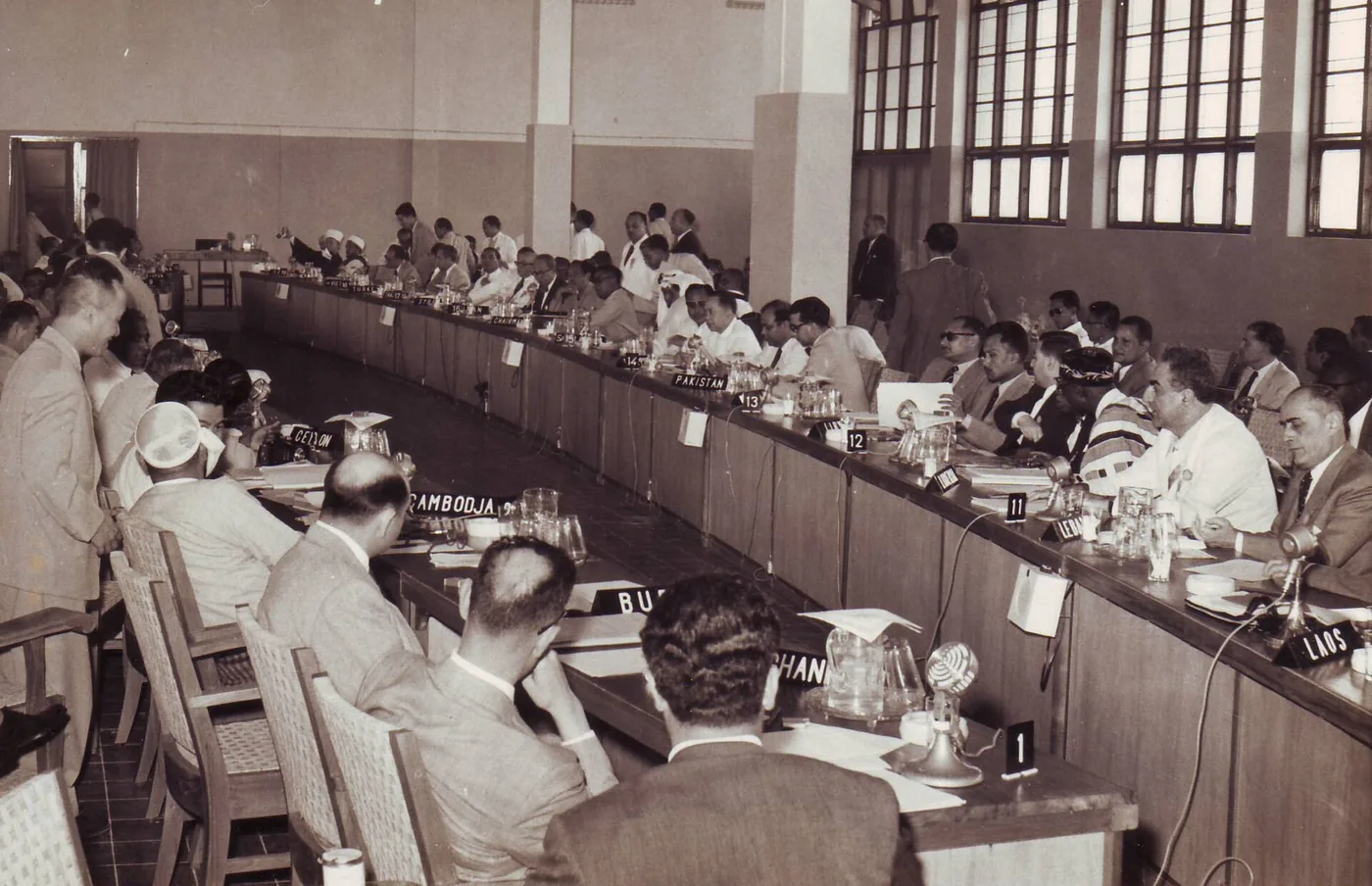
The Bandung Conference was a meeting of twenty-nine Asian and African countries held in Bandung, Indonesia, from April 18 to 24, 1955. It was the first major international conference organized by formerly colonized countries on their own soil. Most of the countries at the table had been under colonial rule a generation earlier, and several had gained their independence less than ten years before. Together they represented about 1.5 billion people, more than half of humanity, but almost none of the world's military or industrial power. No European country attended, and neither the United States nor the Soviet Union was invited. Over seven days the delegates produced a set of principles that challenged the Cold War assumption that every country had to choose a side.
How the Bandung Conference came together
Five countries organized the conference: Indonesia, India, Burma, Ceylon (now Sri Lanka), and Pakistan. Indonesia's president, Sukarno, hosted it in Bandung's Merdeka Building and gave the opening address on April 18. Sukarno had spent years as a political prisoner under Dutch colonial rule before proclaiming Indonesia's independence in 1945. He noted that the conference fell on the 180th anniversary of Paul Revere's ride, the night that set off the American War of Independence. He told the delegates that no gathering of Asian and African peoples on this scale had ever taken place.
The most prominent leaders in attendance were Jawaharlal Nehru, India's prime minister and the conference's intellectual leader; Gamal Abdel Nasser, Egypt's prime minister, who had held power for fewer than three years and arrived without much of an international reputation; and Zhou Enlai, China's premier. A week before the conference, a bomb planted by Kuomintang agents destroyed the chartered plane that was supposed to carry the Chinese delegation to Bandung, killing sixteen of the nineteen people aboard. Zhou had changed his travel plans and was not on the flight. At the conference he spent the week reassuring neighboring countries that China had no territorial ambitions toward them, presenting the country as part of Asia rather than an arm of the Soviet Union. Nasser left Bandung with far more standing on the world stage than he had when he arrived.
What the conference debated and decided
The twenty-nine delegations agreed on less than the conference photographs suggested. Five of them, Pakistan, Turkey, Thailand, Iraq, and the Philippines, belonged to Western military alliances including the Baghdad Pact and SEATO. They saw no reason to form a neutralist bloc. The prime minister of Ceylon went further, publicly asking why Soviet control of Eastern Europe should not count as colonialism too.
The final communique glossed over these divisions, which is the only reason all twenty-nine delegations signed it. It included a ten-point declaration called the Dasasila Bandung, which drew on the five principles of peaceful coexistence that Nehru and Zhou had agreed on in 1954. The communique said that every state was sovereign and equal regardless of its size, that no country should interfere in another's internal affairs, that disputes should be settled peacefully, and that colonialism in all its forms should end. The language condemning colonialism was written carefully enough that anti-Soviet delegates could read it as covering the Soviet Union too.
What proved more important than the declaration was the precedent the conference set. It showed that newly independent countries could come together and negotiate as a bloc at the United Nations, and it showed that choosing neither superpower was a real stance, not simply the absence of one.
What did the Bandung Conference lead to?
The Non-Aligned Movement held its founding conference in Belgrade in 1961. Its architects were five leaders: Nehru, Nasser, Sukarno, Yugoslavia's Tito, and Ghana's Kwame Nkrumah. The Group of 77 was created in 1964 to press the economic demands of developing countries. In the 1970s, many of the same countries campaigned for what they called a New International Economic Order, an overhaul of global trade and finance in their favor.
The coalition that Bandung brought together did not hold. Within ten years, India and China fought a border war. Sukarno was overthrown in a wave of mass violence against Indonesian communists. Nkrumah was deposed. In practice, countries that called themselves non-aligned often accepted aid from both the Western and Soviet blocs rather than from neither, and the push for a new economic order did not succeed.
But the idea that Bandung put into international politics outlived the coalition. Before 1955, small and poor countries entered the international system on terms set by others. After Bandung, a group of countries with no large navies and no nuclear weapons used their population as bargaining power. They argued that a state's sovereignty did not depend on its military strength, and they pushed decolonization onto the standing agenda of the United Nations. Every grouping of the developing world since, from the Group of 77 to BRICS summits to current arguments about a multipolar order, works from the same starting point. The conference is still invoked in the foreign policy of China, India, and Indonesia, typically by leaders who want to present themselves as champions of the developing world.