
David Livingstone
David Livingstone was a Scottish missionary and explorer who crossed a third of Africa on foot in the mid-1800s.
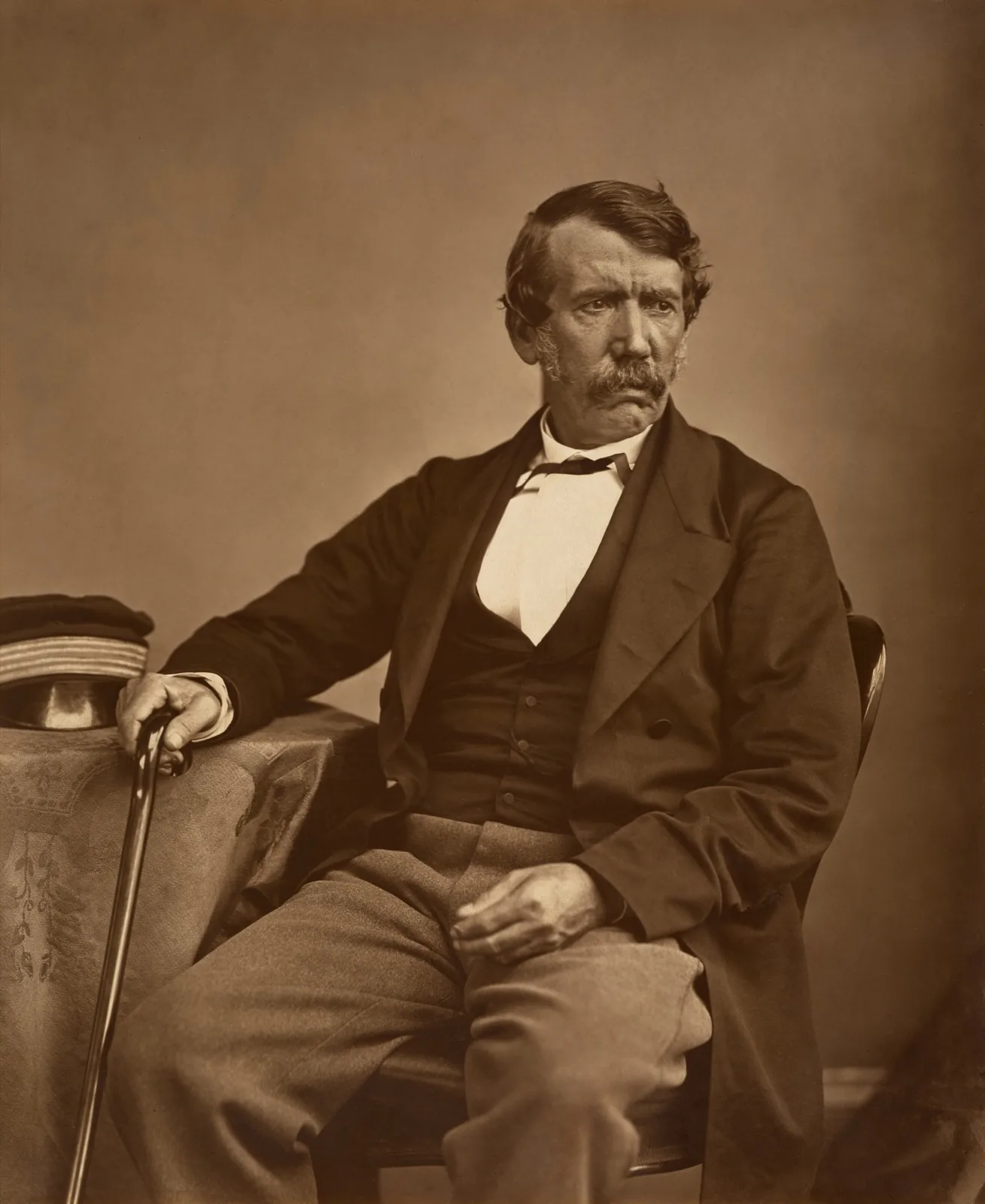
David Livingstone (1813–1873) was a Scottish missionary and explorer who spent thirty years traveling through southern and central Africa. He walked and canoed across thousands of miles of territory that no European had seen. He traced the course of the Zambezi, and in 1855 he reached the massive waterfall that the local Kololo people called Mosi-oa-Tunya, "the smoke that thunders." No European had seen it before. He renamed it Victoria Falls after Queen Victoria. His book Missionary Travels made him the most famous explorer in Britain, and his accounts of the East African slave trade helped turn British public opinion against it. He converted almost nobody to Christianity, but he changed how Britain thought about Africa.
How Livingstone crossed Africa
Livingstone grew up in a one-room tenement in Blantyre, Scotland, where his family lived in housing for cotton mill workers. He started working in the mill at ten. He studied between shifts, teaching himself Latin and saving enough to enroll at Anderson's University in Glasgow, where he took courses in medicine and theology. He had originally hoped to go to China as a missionary, but the First Opium War closed that option. A meeting with the Scottish missionary Robert Moffat convinced him that Africa was where he should go. He qualified as a doctor in 1840 and sailed for southern Africa the same year.
He spent a decade at mission stations in what is now Botswana and South Africa, where he married Moffat's daughter Mary. He made few converts, and the work frustrated him. What pulled him forward was the interior of the continent, still unmapped by Europeans. Between 1852 and 1856 he walked and canoed across Africa from coast to coast, reaching Luanda on the Atlantic in 1854 and Quelimane on the Indian Ocean in 1856, tracing the Zambezi River for much of the way. In November 1855 he became the first European to see Victoria Falls, a waterfall more than a mile wide on the border of modern Zambia and Zimbabwe.
When he returned to Britain in 1856 he was a national hero. Missionary Travels, published in 1857, sold out its first printing of 12,000 copies before it was released and became one of the bestselling travel books of the Victorian era. Livingstone told the British public that Africa could and should be opened up. His slogan was "Christianity, commerce, and civilization." His argument was that if European traders and missionaries moved into the interior, they would replace the slave economy with lawful commerce and end it. He had witnessed the trade himself, recording how Arab-Swahili and Portuguese slavers marched captives hundreds of miles to the coast.
"Dr. Livingstone, I presume?"
Livingstone's later expeditions did not go as well. The government-backed Zambezi expedition (1858–1864) ended in failure when the river turned out to be blocked by cataracts and could not be navigated by steamship. During the expedition, his wife Mary died of fever on the Zambezi in 1862. In 1866 he went back to Africa to search for where the Nile began, and then vanished. For years no reliable news of him reached Europe.
In July 1871, at the trading town of Nyangwe in what is now the Democratic Republic of the Congo, Livingstone witnessed Arab slave traders open fire on a crowd at the marketplace. His account said that between 400 and 500 people were killed, most of them women. When the account reached Britain it caused outrage and helped pressure the sultan of Zanzibar to close the island's slave market in 1873.
Meanwhile, a New York newspaper, the Herald, sent a Welsh-born journalist named Henry Morton Stanley to track Livingstone down. On November 10, 1871, Stanley reached the town of Ujiji on Lake Tanganyika and found a gaunt, gray-haired European. He reportedly greeted him with "Dr. Livingstone, I presume?" Whether Stanley actually said the line or polished it afterward is unclear; he tore out the relevant pages of his diary. Either way, the sentence became one of the most quoted lines of the nineteenth century. Stanley brought supplies and letters from Livingstone's children. The two explored the northern end of Lake Tanganyika together before Stanley left.
Livingstone stayed in Africa. He died on May 1, 1873, at Chitambo's village in what is now Zambia. His attendant Abdullah Susi and others found him kneeling beside his cot. Two of his closest African companions, James Chuma and Susi, buried his heart under a tree and preserved his body with salt. They then led a caravan that walked it over a thousand miles to the Indian Ocean coast for the voyage back to Britain. He was buried in Westminster Abbey.
What did David Livingstone discover?
Livingstone was not the first European in the African interior, but he mapped more of it than anyone before him. He was one of the first Europeans to reach Lake Ngami in 1849, the first to cross Africa from the Atlantic to the Indian Ocean, and the first to see Victoria Falls. He explored the Lake Malawi region in the early 1860s and reached Lakes Mweru and Bangweulu later in the decade. His journals and maps gave European geographers their first detailed picture of central Africa's rivers, lakes, and peoples.
His most lasting contribution was not geographical. His documentation of the East African slave trade, especially the Nyangwe massacre, did more to turn British opinion against slavery in East Africa than any pamphlet had.
Livingstone and the Scramble for Africa
Livingstone promoted commerce and Christianity as ways to end the slave trade and improve African lives. Within a decade of his death, the public feeling he had stirred, partly humanitarian and partly commercial, helped fuel the European rush to claim African territory. After the Berlin Conference of 1884–1885, European powers divided almost the entire continent among themselves. Figures like Cecil Rhodes built personal empires in the territory Livingstone had mapped, and the Congo Free State became one of the most brutal colonial regimes on the continent. The European powers that moved into Africa came for conquest and profit, not the humanitarian mission Livingstone had promoted.